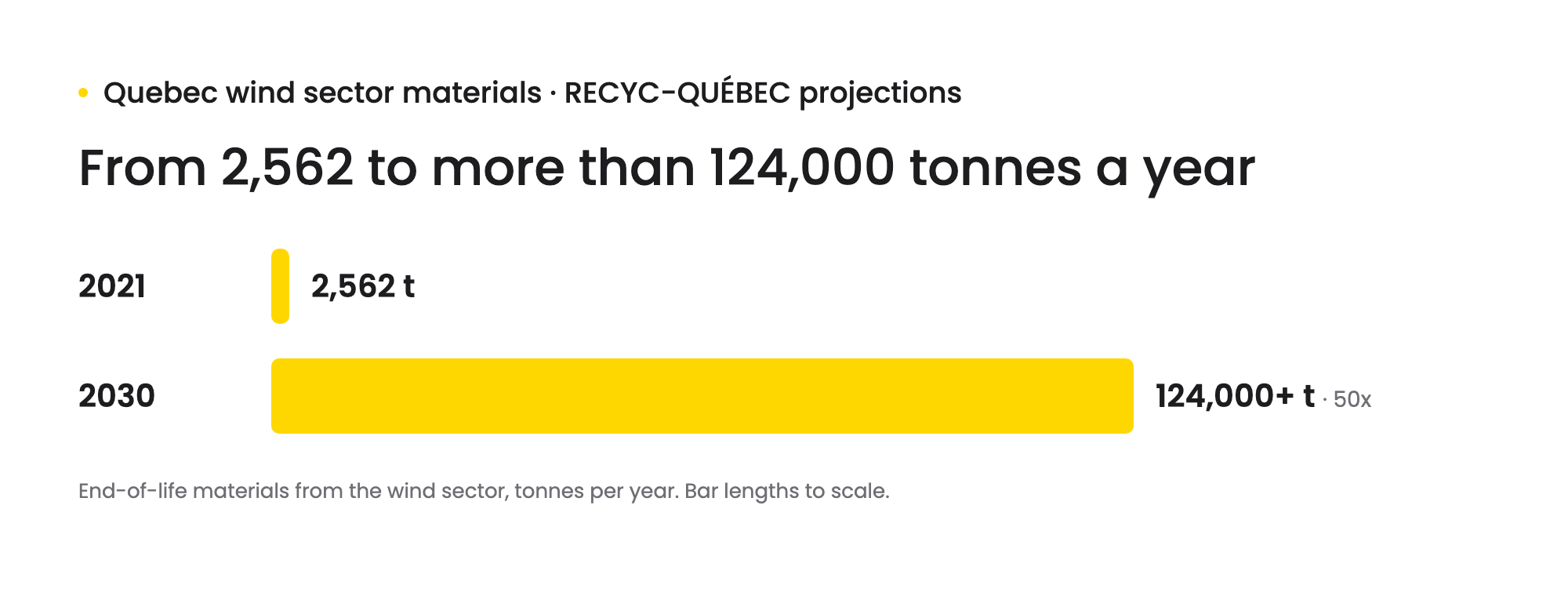
Quebec’s wind sector generated 2,562 tonnes of end-of-life materials in 2021. By 2030, RECYC-QUÉBEC projects that figure will exceed 124,000 tonnes per year – a fifty-fold increase in nine years. This post assembles the key numbers behind Quebec’s wind turbine blade waste problem in one place, with sources, because decisions about recycling infrastructure are being made now and the quality of those decisions depends on the numbers being visible.
Key takeaways
- 1,985 wind turbines have been installed in Quebec since 1999; the earliest are now reaching the end of their 20-to-25-year service lives.
- Wind sector materials are projected to grow from 2,562 tonnes (2021) to over 124,000 tonnes per year by 2030 – a 50x increase.
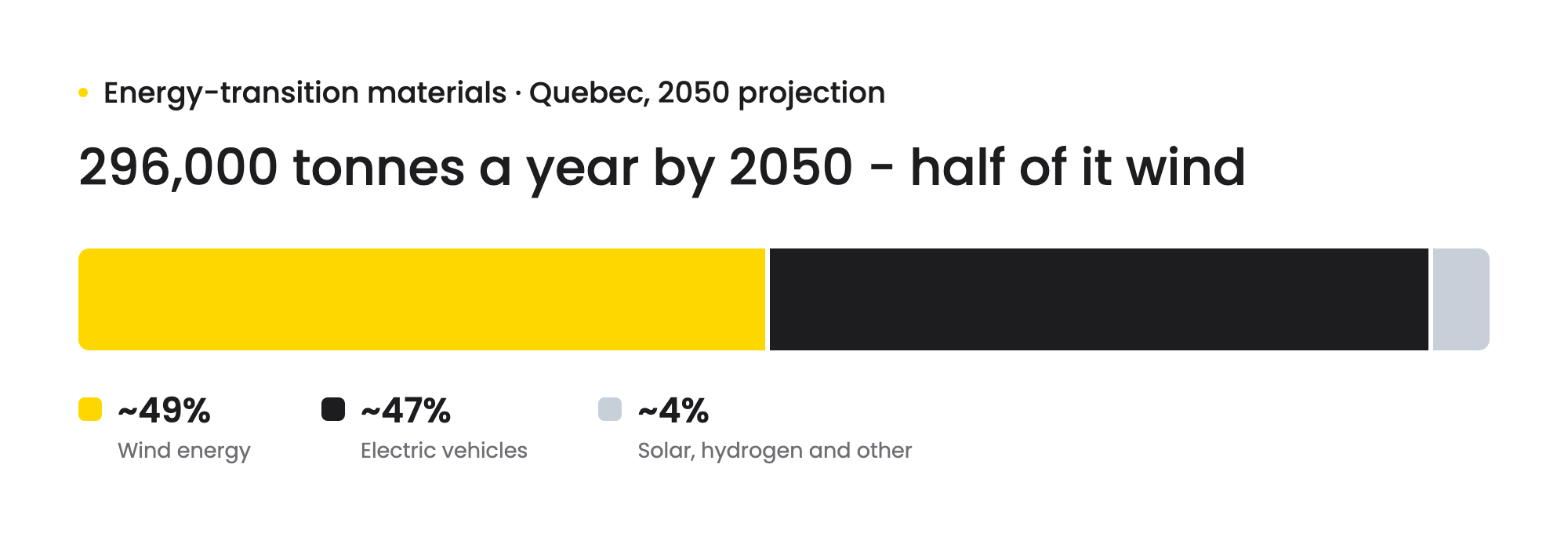
- Across all energy-transition sectors, RECYC-QUÉBEC projects more than 296,000 tonnes per year by 2050, with wind accounting for roughly 49%.
- Blades – fiberglass, carbon fiber and thermoset resin – are today massively landfilled for lack of suitable recycling channels.
- Hydro-Québec’s Action Plan 2035 adds 10,000 MW of new wind capacity, roughly 1,500 additional turbines, extending the waste curve well past 2030.
How many wind turbines does Quebec have, and how old are they?
Quebec’s commercial wind fleet dates to 1999, and 1,985 turbines have been installed since. A wind turbine is engineered for 20 to 25 years of service, which places the province’s first generation of machines at end of life now – RECYC-QUÉBEC notes that the wind farms installed in the late 1990s are approaching the end of their estimated 20-to-25-year lives. Decommissioning is not a hypothetical future event; it has started.
Age is only half the timing question. Turbines also leave service early when operators repower a site – swapping older machines for fewer, larger, more efficient ones – so the waste stream follows economics as much as engineering. Either way, the material has to go somewhere.
What do the waste projections actually say?
The numbers come from RECYC-QUÉBEC’s study Matériaux de la transition énergétique : État de situation et pistes de solution, and they are steep at every horizon:
- 2021: the wind sector generated 2,562 tonnes of materials; all energy-transition sectors combined generated just over 4,000 tonnes.
- 2030: wind sector materials are projected to exceed 124,000 tonnes per year – a 50x increase over 2021. All transition sectors combined reach approximately 142,000 tonnes.
- 2050: transition materials exceed 296,000 tonnes per year, roughly 70 times the 2021 level, with wind representing about 49% of the total, ahead of electric vehicles at roughly 47%.
Two features of that curve deserve emphasis. First, wind is not one contributor among many – it is the largest single materials stream of Quebec’s energy transition through 2050. Second, the steepest part of the curve is the current decade: the 50x jump happens between 2021 and 2030, which means the processing capacity question cannot wait for 2040.
Why do blades end up in landfills?
Between 85% and 90% of a turbine’s mass – the steel tower, copper cabling, drivetrain components – recycles through channels so mature they are unremarkable. The blades are the exception. Built from fiberglass and carbon fiber bound in thermoset resin, a blade is engineered to survive two decades of storms without structural failure, and the same chemistry that delivers that durability resists disassembly: cured thermoset resin cannot be melted back down the way metals can.
The result, in RECYC-QUÉBEC’s assessment, is that blades are the main barrier to wind turbine recycling, and in Quebec today they are sent to landfill for lack of suitable channels. The technologies that could change this – mechanical processing into concrete aggregates, fiber recovery, structural reuse – exist, but mostly at pilot scale. Two of them are being tested in Quebec right now through the Wind Circular Innovation Challenge, including HPSH’s pilot recycling blades into concrete materials.
How much bigger does this get after 2030?
Substantially. Hydro-Québec’s wind power development strategy targets more than 10,000 MW of new wind capacity by 2035 – the equivalent of roughly 1,500 additional turbines under the utility’s Action Plan 2035 – with the utility acting as project lead for large-scale developments in partnership with First Nations and municipalities. Every one of those machines is a future entry on the decommissioning ledger, arriving in the 2050s and 2060s.
This is the structural fact the waste projections encode: Quebec is adding wind capacity faster than it has ever retired it, so the materials stream grows at both ends – old fleets retiring, new fleets committing future volumes. A recycling industry sized for 2,562 tonnes cannot simply scale linearly to meet 124,000; it has to be built, financed and proven in the years in between.
Where do these numbers come from, and what do they count?
Precision about sources matters here, because two sets of figures circulate and they measure different things. The wind-sector-specific figures – 2,562 tonnes in 2021 rising to over 124,000 tonnes per year by 2030 – count materials from the wind industry alone. The broader figures published in RECYC-QUÉBEC’s study – just over 4,000 tonnes in 2021, approximately 142,000 tonnes in 2030, more than 296,000 tonnes in 2050 – cover all energy-transition sectors together: wind, solar, green hydrogen and electric mobility. The two series are consistent; wind simply dominates the total this decade, before electric-vehicle batteries catch up mid-century.
What counts as “materials” is equally specific: the study tracks components reaching end of life – blades, towers, nacelles and electrical systems for wind – not operating waste. The projections are driven by installation history and service life, which makes them unusually reliable as forecasts go: the turbines that will retire in 2030 are already standing, their installation dates are public record, and their service lives are engineering constants. Unlike demand forecasts, a decommissioning curve has little room to surprise on the downside.
That reliability is worth underlining for anyone planning infrastructure or policy against these numbers. The 50x increase is not a scenario; it is largely arithmetic already committed by the existing fleet.
What does 124,000 tonnes a year look like in practice?
Abstract tonnage hides the operational reality, so it is worth translating. A utility-scale blade weighs several tonnes and runs 40 to 70 metres or more; it cannot be moved whole on ordinary roads. Decommissioning crews cut blades into transportable sections on site – a controlled operation involving diamond-wire saws and dust management, since composite dust is an occupational hazard – before anything reaches a truck. At the projected 2030 volumes, Quebec would be handling on the order of thousands of blade-equivalents of composite material every year, each requiring cutting, transport and either a landfill cell or a processing facility.
Geography compounds the challenge. Quebec’s wind farms concentrate in specific regions – the Gaspé peninsula, the Lower St. Lawrence, the Seigneurie de Beaupré – often hundreds of kilometres from industrial processing infrastructure. Transport economics therefore shape which recycling routes are viable: a process that only pays with free blades delivered to its gate does not work at provincial scale. This is why pilot projects test logistics and cost structures, not just chemistry – and why the province’s processing capacity has to be planned against the map, not just the tonnage curve.
What do these numbers mean for the recycling industry?
Read as a market rather than a problem, the projections describe a feedstock supply that grows 50x this decade in a jurisdiction with clean electricity, an established industrial base and – unusually – a coordinated coalition already organizing demand for solutions. For recycling and materials companies, the strategic window is precisely the low-volume years: process knowledge acquired at thousands of tonnes is what makes a company credible when the tens of thousands of tonnes arrive.
That is the logic behind the pilots now running in the province, and behind our work with clean tech startups building in this space. For the broader collaborative framework these numbers sit inside, see our overview of wind turbine recycling in Quebec.