By Niels Hagège, Director, Business Development and Partnerships at Cycle Momentum and Thibault Beudin, Commercialization Lead at Cycle Momentum
Wind turbine recycling has an unusual structure as an industrial problem: 85-90% of a turbine’s mass recycles through channels so mature nobody discusses them, while the blades – fiberglass and carbon fiber locked in thermoset resin – still go to landfill for lack of suitable channels. Quebec is addressing that gap the only way its structure allows: collectively. A coalition assembled by RECYC-QUÉBEC and Cycle Momentum has taken the problem from diagnosis to two funded industrial pilots, and its model is now spreading to other materials.
Key takeaways
- Quebec’s wind-sector materials will grow from 2,562 tonnes in 2021 to over 124,000 tonnes per year by 2030 – and blades are the fraction with no established recycling route.
- The response is a coalition, not a mandate: RECYC-QUÉBEC, Cycle Momentum, RBC and six industrial Mission Allies running a shared innovation funnel.
- The Wind Circular Innovation Challenge reviewed 66 solutions from 13 countries and launched 2 industrial pilots with $350K CAD in structured funding.
- Pilots are running now with HPSH (blades into concrete materials) and FibeCycle (blades into recycled composites).
Why is wind turbine recycling suddenly urgent in Quebec?
Timing. The 1,985 turbines installed in Quebec since 1999 are engineered for 20 to 25 years of service, which puts the province’s first generation at end of life now. According to RECYC-QUÉBEC’s study of energy-transition materials, the volumes to manage will grow from 2,562 tonnes in 2021 to more than 124,000 tonnes per year by 2030 – a fifty-fold increase in nine years – and Hydro-Québec’s plans for over 10,000 MW of new wind capacity extend the curve for decades beyond that. The full dataset, with sources, is assembled in our post on Quebec’s wind turbine blade waste numbers.
The technical bottleneck is specific: thermoset composites. Cure the resin once and the chemistry runs one way – a blade cannot be melted back into feedstock the way a tower can. Mechanical grinding exists but produces low-value filler; higher-value routes such as fiber recovery, concrete integration and structural reuse were, until recently, stuck at laboratory scale with no industrial demand signal to pull them forward.
Repowering compresses the timeline further. Blades leave service not only at end of life but whenever an operator upgrades a site to larger, more efficient machines – so the waste stream follows investment cycles as well as engineering limits. A province simultaneously retiring its first fleet and planning its largest-ever wind expansion should expect the curve to arrive early, not late.
What does a collaborative model for recycling actually look like?
Three tiers, each doing what it is structurally positioned to do.
- Initiators. RECYC-QUÉBEC, the Québec state corporation responsible for the circular economy, brings the public mandate and the materials data. Cycle Momentum, as an international acceleration platform, brings the scouting, evaluation and pilot-structuring capability. The Royal Bank of Canada provides financial support for the program and its pilots.
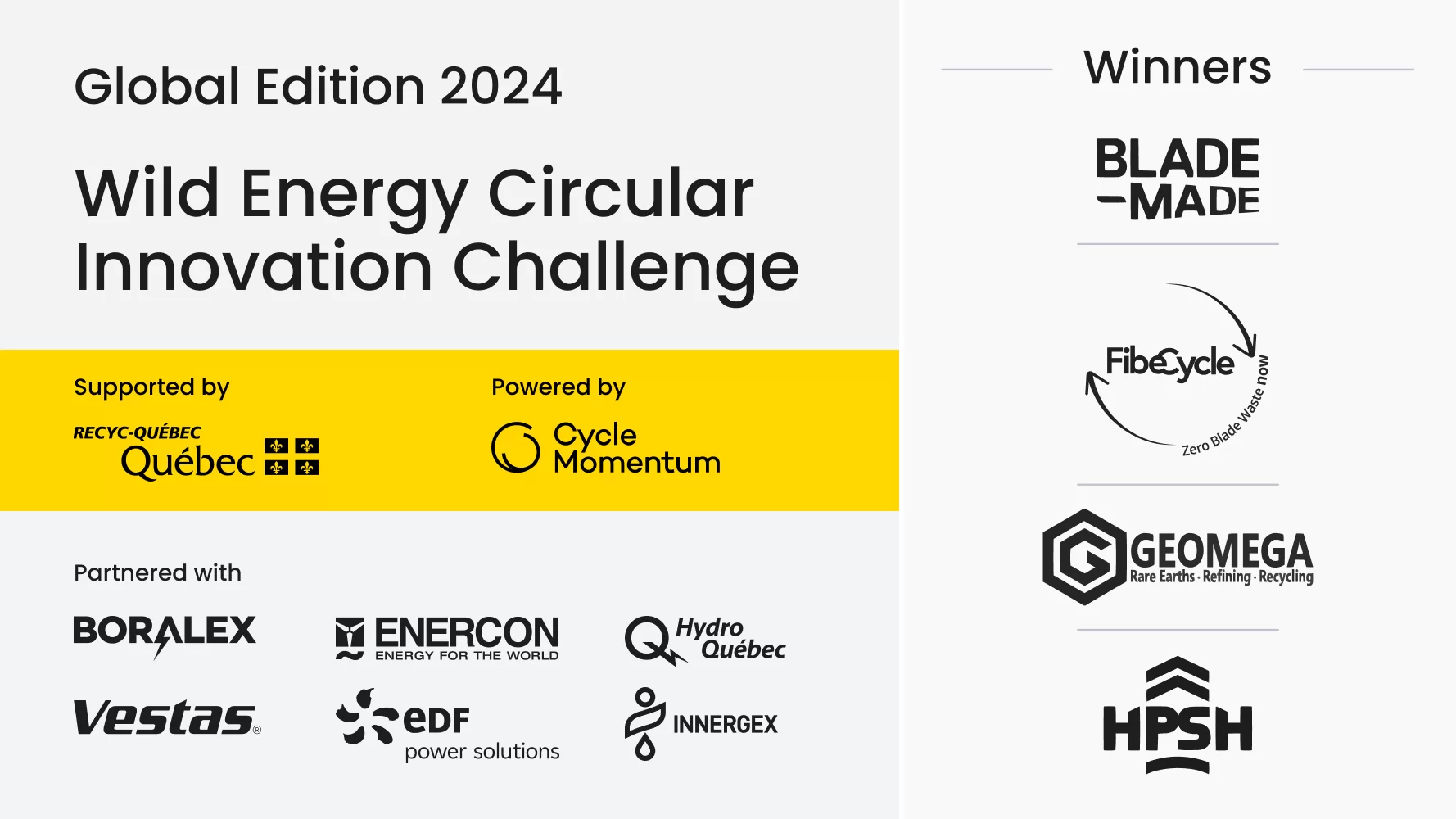
- Mission Allies. The industrial layer: Boralex, EDF Solutions Électriques, Hydro-Québec, Innergex, Kruger Energy and Wind Power Solutions, with turbine manufacturer ENERCON among the industry participants. These are the companies whose decommissioning schedules make the problem concrete – and whose sites, feedstock and engineering judgment make pilots meaningful.
- Ecosystem partners. AQPER (renewable energy producers), CRIBIQ (bioeconomy innovation), NRC IRAP (federal SME innovation funding) and PRIMA Québec (advanced materials) – the organizations that connect the program to research capacity and public funding instruments.
The division of labor matters more than the org chart. Operators cannot run global technology scouts; accelerators cannot supply feedstock or industrial sites; public agencies cannot pick technology winners alone. The coalition lets each participant contribute the one thing the others lack.
How did the coalition find its technologies?
Through the Wind Circular Innovation Challenge – an international open-innovation competition run from September 2024 through the pilot launches of March 2026. The funnel: 66 solutions reviewed from 13 countries across 4 continents, 19 shortlisted, 9 finalists before an industry jury, 4 winners – HPSH, FibeCycle, Blade-Made and Innord/Geomega – followed by a 12-month acceleration program of workshops, diagnostics and industrial matchmaking. The complete retrospective, including the selection calendar and jury process, is in our case study of the challenge results; the December 2024 selection is covered in the winners announcement.
Two design choices did most of the work. The call was international – a regional waste problem was put in front of a global solver pool, and the winning portfolio reflects it. And the jury was industrial: the people who would have to host, feed and eventually buy these technologies made the selection, which converts a prize decision into the first step of an adoption path.
What are the pilots testing?
Two different answers to the same waste stream, running in parallel since March 2026:
- HPSH transforms end-of-life blades into fibers, powders and aggregates for new concrete formulations – including foundations for new wind turbines, which closes the loop inside the industry that created the waste. Details in the HPSH pilot story.
- FibeCycle converts blade waste into ecoFibers and ecoFRP, a high-performance recycled composite, validating recyclability at industrial scale and quantifying CO2 reductions. Details in the FibeCycle pilot story.
The pilots are financed through a structured public-private blend – $350,000 CAD split across private partners, federal and provincial sources and the startups themselves – with deliverables specified in advance: process reports, validated formulations, cost analyses, life-cycle data and deployment plans. The financing architecture is dissected in our post on the pilot funding model.
Testing under operational conditions is the point. A recycling technology that works in a laboratory has answered the easy question; whether it works on real blades, at real cost, with real industrial hosts is what determines adoption – and what the partners are paying to find out.
What makes the collaborative model work?
Looking back across the program, three ingredients did the structural work, and all three are transferable to other industrial waste problems.
A neutral convener with a public mandate. Wind operators compete with each other; none could credibly host a shared program on its own. RECYC-QUÉBEC’s mandate made the table neutral, and Cycle Momentum’s position outside the industry made the scouting agnostic about where solutions came from.
Shared cost, shared evidence. Every structural decision – the coalition funding, the jury composition, the specified pilot deliverables – converts a private bet into a shared experiment. Each partner pays a fraction of the cost and receives all of the evidence, which is the arithmetic that gets competing companies into the same program.
A deadline structure. Open-ended working groups produce position papers. A challenge with an application window, a jury date and a pilot launch calendar produces decisions – the wind edition moved from first call to running industrial pilots in eighteen months, a pace bilateral negotiation in this sector rarely approaches.
Does the model extend beyond wind energy?
It already is extending. The same thermoset-composite chemistry that makes blades hard to recycle sits in aircraft, vehicles, boats, rail interiors and construction panels – wind was simply the sector where end-of-life volumes and public attention arrived first. The coalition model is designed to move to whichever waste stream comes next, and each edition reuses the assets the last one built: the jury process, the funding templates, the pilot frameworks and the coalition habit itself.
For Quebec, the strategic logic runs deeper than waste management. Regions that build recycling and materials-recovery capacity during the low-volume years own the industrial capability when volumes multiply – in a province whose clean tech ecosystem is already organized to commercialize exactly these technologies.
How can companies get involved?
Startups with materials and recycling technologies can reach us through our programs for startups. Industrial players – in wind, or in any sector holding composite waste – can join the next coalition through our corporate partner services. The wind challenge demonstrated the mechanism; the next editions are where its compounding begins.