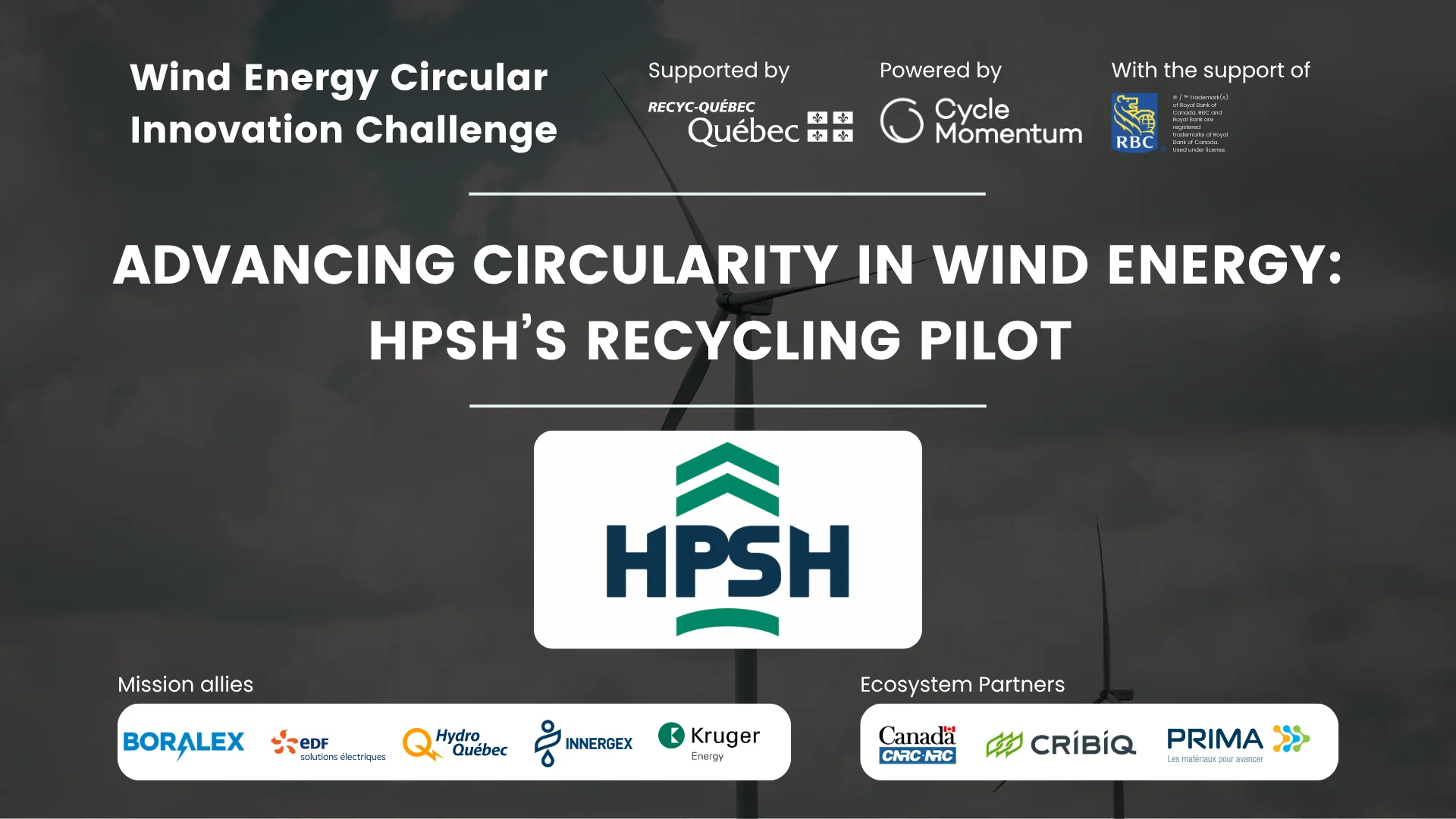
As part of the Circular Innovation Challenge – Wind Energy | International Edition 2024, carried out in partnership with RECYC-QUÉBEC and supported by RBC, HPSH is launching an ambitious pilot project aimed at transforming end-of-life wind turbine blades into reusable materials, with Innergex, Boralex, Kruger, EDF Electrical Solutions and Hydro-Québec participating as industrial partners.
Key takeaways
- HPSH’s patented technology transforms composite blade materials into fibers, powders and aggregates that go back into concrete, starting with wind turbine foundations.
- Québec’s energy-transition material flows are set to grow from 2,562 tonnes in 2021 to over 124,000 tonnes annually by 2030, a near 50-fold increase (RECYC-QUÉBEC, 2022).
- The CAD $252,000 pilot is 70% publicly funded (NRC IRAP, PRIMA Québec/CRIBIQ) with the remainder from HPSH and its industrial partners.
Why do wind turbine blades pile up?
Turbine blades are the wind industry’s hardest recycling problem. Built from complex glass-fiber composites engineered to survive decades of storms, they resist exactly the processes that make steel towers and copper wiring easy to recover. Most decommissioned blades end up in landfills, where they can persist for centuries, and researchers project global blade waste will accumulate to roughly 43 million tonnes by 2050 (Liu & Barlow, Waste Management). Existing recycling routes like mechanical grinding mostly downcycle the material into low-value filler.
The energy transition makes the problem urgent, not optional. Electrification of transportation, reduced fossil fuel use and a growing renewable share all cut greenhouse gas emissions, but they also create new end-of-life material streams that today have nowhere good to go.
How big is the challenge in Québec?
The numbers are specific and close to home. According to the Québec Ministry of Energy and Natural Resources (MERN, 2022), 1,985 wind turbines were installed in Québec between 1999 and 2021, primarily in the Gaspésie–Îles-de-la-Madeleine region. With an average lifespan of 25 to 30 years, turbines installed in the early 2000s begin reaching end-of-life in the coming years.
RECYC-QUÉBEC’s 2022 study of the material flows behind Québec’s energy transition puts a curve on it: from 2,562 tonnes generated in 2021 to over 124,000 tonnes annually by 2030, nearly a 50-fold increase in nine years. And the fleet keeps growing: Hydro-Québec’s 2035 plan calls for roughly 1,500 additional turbines. Every one of them will someday be feedstock, or landfill.
What will the HPSH pilot do?
HPSH proposes a technology capable of closing the loop inside the wind sector itself:
- Transforming composite materials into fibers, powders, and aggregates
- Integrating these materials into new concrete formulations, particularly for wind turbine foundations
- Significantly reducing waste and the carbon footprint of concrete
- Establishing a circular economy loop within the wind energy sector
The elegance is in the destination: blades that once caught wind become the foundations of the next generation of turbines. Concrete is also where the climate math compounds, since displacing virgin cement and aggregates lowers the footprint of one of the world’s most emissions-intensive materials.
What’s in it for industrial partners?
For the wind operators and industrials funding the pilot, the project offers three strategic advantages:
- Strong environmental impact: reduced landfill use and lower cement-related emissions
- Access to HPSH’s expertise in composite materials and its patented high-performance hybrid structures technology
- Strategic positioning as leaders in circular economy practices within the wind sector
Participating industrial partners include INNERGEX, BORALEX, KRUGER, EDF Electrical Solutions, and HYDRO-QUÉBEC, all of whom contribute to both the funding and success of the project. It’s the model Cycle Momentum builds its industrial partnership programs around: operators with a shared structural problem co-funding the startup best positioned to solve it.
Who funds the project?
The project has a total budget of CAD 252,000, with 70% funded through provincial and federal grants and the remainder covered by HPSH and its industrial partners. Federal funding comes through the National Research Council of Canada’s Industrial Research Assistance Program (NRC IRAP). At the provincial level, funding is granted by the Québec Ministry of Economy, Innovation and Energy through PRIMA Québec, the advanced materials research and innovation hub, as part of a circular economy call for projects administered by CRIBIQ. That blend of public and private money is what lets a feasibility-stage pilot move at commercial speed.
Part of a growing wind-circularity portfolio
The HPSH pilot is the second project to emerge from the Circular Innovation Challenge – Wind Energy, following the FibeCycle pilot announced in April, which takes a complementary route from blade composites to new materials. Both build on the collaborative model Cycle Momentum described in its deep-dive on wind energy circularity, and on the cohort selected among the winners of the challenge’s 2024 international edition.
Together, the pilots demonstrate how technological innovation, industrial collaboration, and public support can converge on a concrete recycling solution for the wind energy sector, and pave the way for broader adoption of recycled materials in concrete applications across Québec’s clean-tech ecosystem.