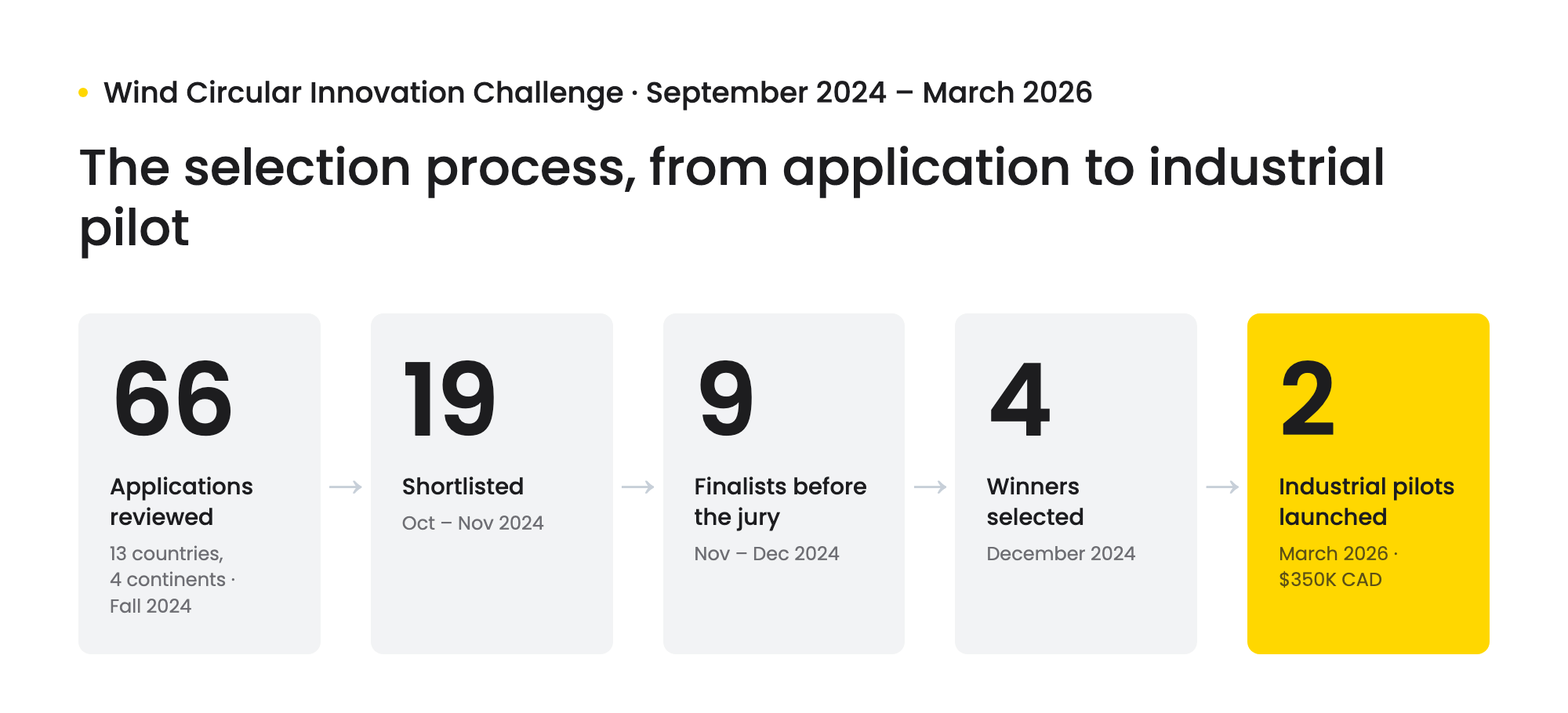
Between September 2024 and March 2026, the Wind Circular Innovation Challenge took a single industrial problem – what to do with Quebec’s end-of-life wind turbine materials – and ran it through an international innovation funnel: 66 solutions reviewed from 13 countries across 4 continents, 19 shortlisted, 4 winners selected by an industry jury, and 2 industrial pilots launched with $350,000 CAD in funding. This is the full account of how that funnel worked, organized by Cycle Momentum and RECYC-QUÉBEC with the support of the Royal Bank of Canada.
Key takeaways
- An international call for applications ran for six weeks in fall 2024 and drew 66 candidate solutions from 13 countries – evidence that a regional waste problem can attract a global solver pool.
- An industry jury selected 4 winners from 9 finalists: HPSH, FibeCycle and Innord/Geomega from Canada, and Blade-Made from the Netherlands.
- Winners entered a 12-month acceleration program of workshops, diagnostics, matchmaking and funding structuring.
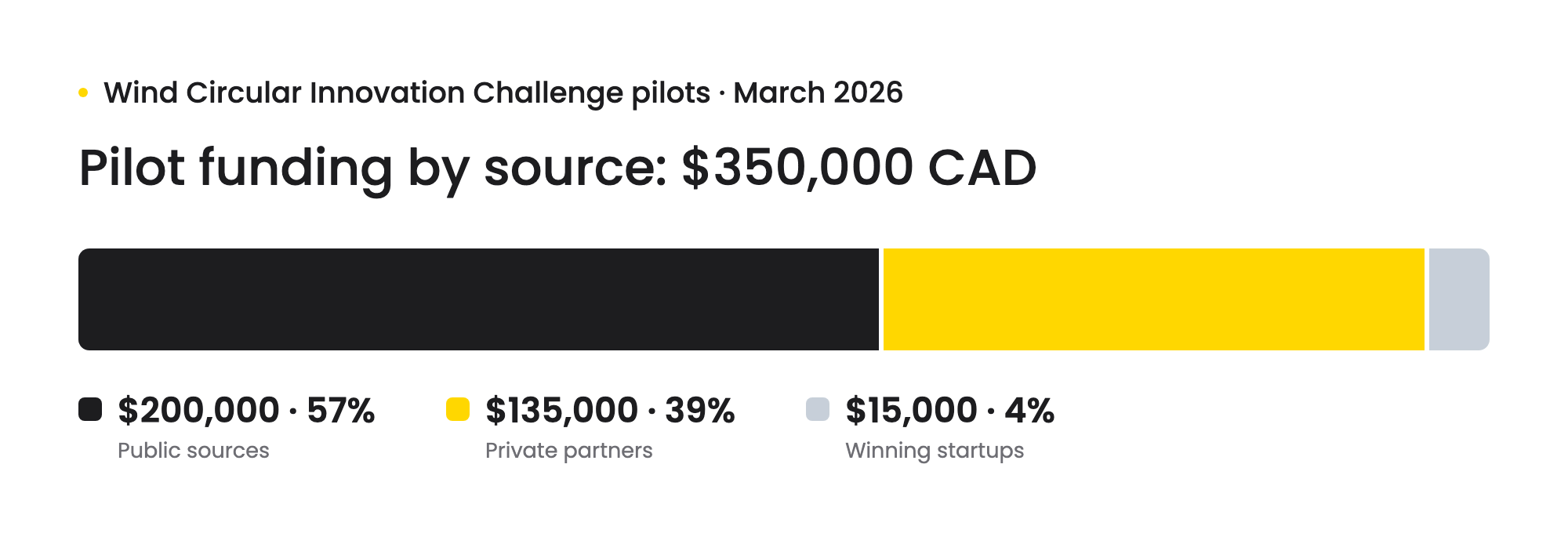
- Two pilots launched in March 2026 with $350,000 CAD: $135K from private partners, $200K from public sources and $15K from the winning startups themselves.
Why did the wind industry need an innovation challenge?
Quebec’s first commercial wind farms were installed in the late 1990s, and the 1,985 turbines erected since then are gradually reaching the end of their 20-to-25-year service lives. Most of a turbine recycles through established channels – steel, copper, electronics – but the blades, built from fiberglass, carbon fiber and thermoset resin, still go overwhelmingly to landfill because no suitable recycling channels exist at scale. The volumes are about to make that untenable: materials from the wind sector are projected to grow from 2,562 tonnes in 2021 to more than 124,000 tonnes per year by 2030, a fifty-fold increase in nine years. We examine those projections in detail in our data post on Quebec’s wind turbine blade waste.
No single operator owns this problem, which is precisely what makes it hard. Blade waste lands on whoever decommissions or repowers next, the recycling technologies are early-stage, and the economics depend on volumes no individual wind farm controls. The response, described in our overview of the collaborative approach to wind circularity, was to build a coalition first and run the technology search second.
How was the challenge structured?
The challenge assembled three tiers of participants around one funnel. Cycle Momentum and RECYC-QUÉBEC initiated the program, with the Royal Bank of Canada providing financial support for its development and for the pilot projects. Six industrial Mission Allies – Boralex, EDF Solutions Électriques, Hydro-Québec, Innergex, Kruger Energy and Wind Power Solutions – committed expertise, sites and co-funding. Ecosystem partners AQPER, CRIBIQ, NRC IRAP and PRIMA Québec extended the program’s reach into the renewable energy, bioeconomy and advanced materials communities.
The funnel itself ran on a defined calendar:
- International call for applications (September 17 to October 29, 2024): 66 solutions reviewed, from 13 countries across 4 continents.
- Shortlisting and interviews (October 30 to November 18, 2024): 19 solutions retained for closer evaluation.
- Industry jury (November 19-20 and December 10, 2024): 9 finalists presented; 4 winners selected.
- Acceleration program (January 2025 to January 2026): twelve months of workshops, technical diagnostics, industrial matchmaking and funding structuring.
- Pilot launch (March 2026): HPSH and FibeCycle began funded industrial pilots with the support of the industrial and ecosystem partners.
Who won, and what are they building?
The jury’s four selections cover distinct routes out of the landfill, which was deliberate – at this stage of the market, the routes are hypotheses, and a portfolio of approaches produces more information than a single bet.
- HPSH Inc. (Canada) transforms end-of-life blades into fibers, powders and aggregates for new concrete formulations – including the foundations of new wind turbines, which closes the loop in the most literal sense. Its pilot is profiled in our HPSH recycling pilot story.
- FibeCycle (Canada) converts blade waste into ecoFibers and then ecoFRP, a high-performance recycled composite. The pilot validates recyclability at industrial scale and quantifies CO2 reductions – see the FibeCycle pilot project.
- Blade-Made (Netherlands) repurposes decommissioned blades into urban furniture – a reuse route that skips reprocessing entirely.
- Innord/Geomega (Canada) recycles rare earth elements, addressing the magnets and critical materials inside the nacelle rather than the blade.
The announcement of the winners in December 2024 is covered in our winners announcement; what this case study adds is the part that came after: turning a jury decision into operating pilots.
Why does the challenge format work for industrial waste problems?
Challenge prizes are an old mechanism experiencing a disciplined revival. Nesta, which has run more than 30 challenge prizes attracting over 7,000 innovators, argues they fit problems with clearly defined goals that would benefit from fresh thinking and could realistically attract new entrants – a precise description of blade waste, where the incumbent “solution” is a landfill and the relevant technologies sit scattered across materials science, construction and chemistry. Public agencies have reached the same conclusion: NIST’s open innovation program uses prize challenges specifically because they let the solvers determine the how, drawing companies, academics and individuals from outside the industry that owns the problem.
The wind challenge’s own numbers bear this out. Of 66 applications, most came from outside Quebec, and two of the four winners attack the problem from directions no wind operator would have specified in a procurement document – urban furniture and rare earth recovery. A conventional tender produces compliant bids; a well-run challenge produces options the buyer did not know existed.
The format’s second advantage is risk-sharing. No Mission Ally had to bet alone on an unproven recycling technology. The coalition structure spread the cost of scouting, evaluation and piloting across six industrial partners, public funders and the startups themselves – a structure we break down in how the $350K pilot funding was structured.
What did the acceleration year add?
The twelve months between selection and pilot launch are the least visible part of the program and arguably the most consequential. Winning a jury vote does not make a technology deployable; the acceleration phase existed to close that gap. Between January 2025 and January 2026, the four winners worked through technical diagnostics with the Mission Allies’ engineering teams, matchmaking sessions that paired each technology with the operators whose feedstock and sites it would need, and funding structuring that assembled the provincial, federal and private components of the pilot budgets.
That sequencing is deliberate. Pilots negotiated before an acceleration phase tend to inherit whatever assumptions the startup arrived with – the wrong feedstock spec, an unrealistic cost baseline, a site that cannot host the equipment. Running the diagnostics first meant the two pilots that launched in March 2026 started with agreed success criteria, committed hosts and secured budgets, rather than discovering those gaps mid-pilot. It is also why the program produced two launched pilots from four winners rather than four stalled memoranda of understanding: the acceleration year filtered for deployability under real conditions, not just technical merit.
What did the challenge actually produce?
Judged by its stated objective – identify technological solutions for wind sector materials and facilitate their adoption by Quebec industry – the challenge’s output is concrete:
- Two funded industrial pilots running as of March 2026, generating operational process data, validated formulations, cost analyses and life-cycle indicators that will be reported to partners.
- A mapped global solution set – 66 evaluated technologies the coalition can draw on as volumes grow.
- A working coalition of operators, manufacturers, public agencies and research organizations that did not exist in 2023 and now has a repeatable process.
As Emmanuelle Géhin, CEO of RECYC-QUÉBEC, put it: “We must not wait to put circular economy strategies in place. The time to act is now, to set up mechanisms that will manage materials from the energy transition when they reach end of life.” Patrick Gagné, CEO of Cycle Momentum, framed the other half of the equation: “This partnership with RECYC-QUÉBEC enables us to catalyze innovative solutions that will not only reduce environmental impact, but also create new economic opportunities for Québec.”
What comes next?
The coalition model was built to be reused, and industrial players who want early access to the next cohort of vetted solutions – and the pilot data they generate – can learn how participation works through our corporate partner services.