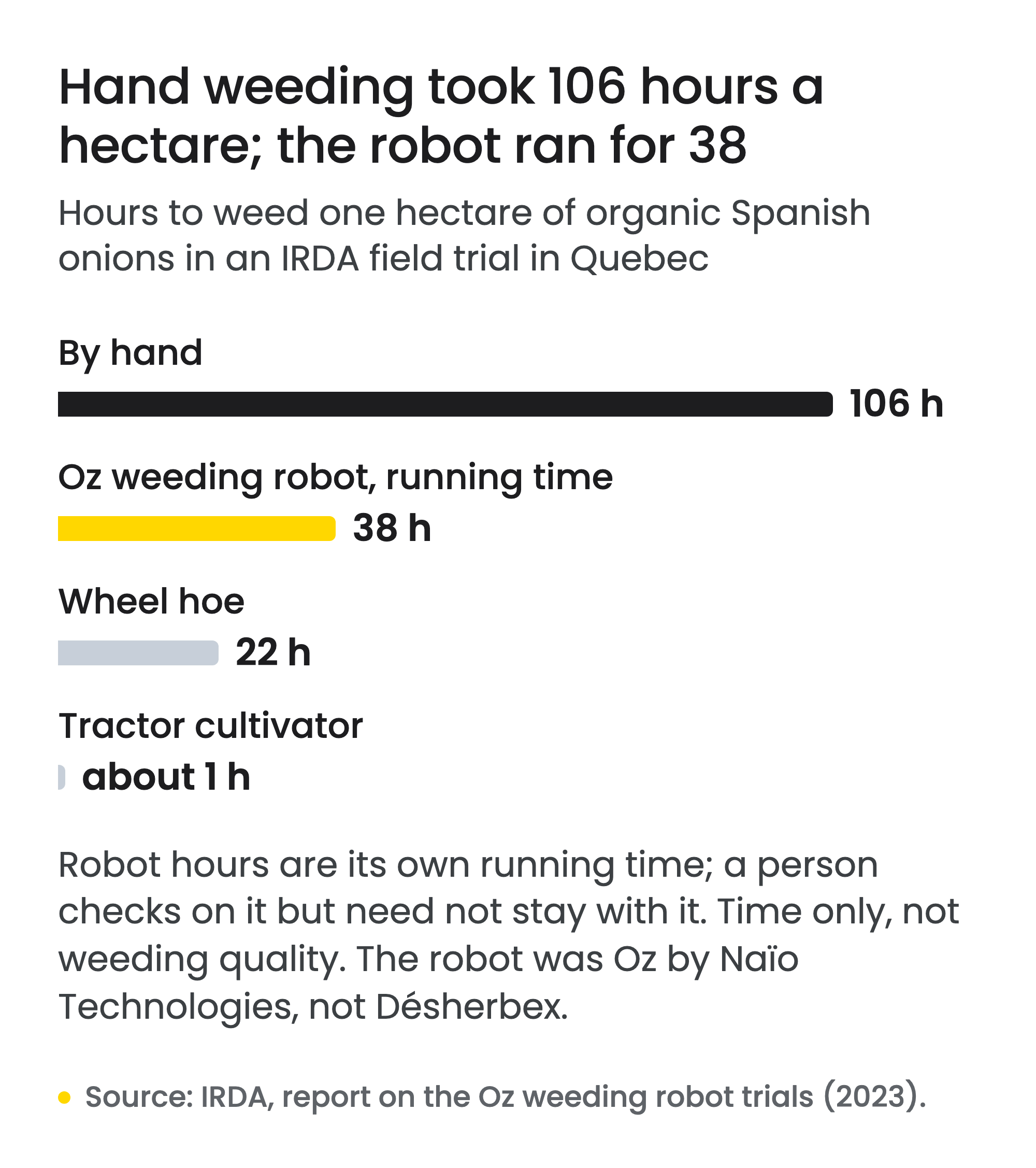
A robotic weeder uses cameras and artificial intelligence to tell weeds from crop plants. It then removes the weeds with a mechanical tool, heat, electricity or a small dose of herbicide. Vegetable growers are interested because the alternative is often hand weeding. In a Quebec trial on organic onions, weeding by hand took 106 hours per hectare, or about $2,656 at $25 an hour.
Désherbex, a Sherbrooke company, builds a tractor-drawn robotic weeder whose arms pull weeds out of vegetable rows, with no herbicide. It skipped the first phase of the Nexterre Program: in September it went directly to demonstrations, one of three companies to do so.
Key takeaways
- Robotic weeders pair computer vision with a removal tool that can be mechanical, thermal, chemical or electrical.
- In research cited by NC State Extension, a robot that sprays only the weeds cut herbicide use by up to 95%.
- Laser weeders matched common herbicides in a 2025 Cornell and Rutgers study, but the machines tested cost up to $1.5 million each.
- Herbicides make up about 60% of the pesticides sold to Quebec agriculture, and in carrots, many growers still weed the row by hand.
- Désherbex put its first commercial machine in Quebec fields in 2025 and had three units at vegetable farms in 2026.
What is a robotic weeder?
NC State Extension defines robotic weeders as uncrewed vehicles designed to identify and remove weeds from crop fields with minimal human intervention. Cameras and AI models separate crop from weed, down to the pixel. A tool on the machine then does the removal: a mechanical implement, a thermal or electrical device, or a sprayer that puts herbicide only where a weed is. The stated goals are more efficient weed control with less herbicide and less hand labour.
The category is broad. At one end are self-propelled sprayers with sensor booms for large fields. At the other are small robots, which the extension service says suit smaller farms because they target weeds precisely, disturb little soil and cost less. Tractor-drawn machines sit in between. Two vision-guided cultivators already sold in the US, the Robovator and the Steketee IC, reduced labour needs by 37% in California lettuce, according to a 2016 evaluation the extension service cites.
Do weeding robots work as well as herbicides?
Some do, in trials, and others use far less herbicide. In research NC State cites, a robot that detects weeds and doses each one could cut the herbicide volume needed 20-fold compared with a conventional sprayer. Herbicide use could drop by up to 95%.
Laser weeders take another route. They photograph the crop rows, a deep learning program picks out the weeds, and lasers kill them. Cornell AgriTech and Rutgers tested them in a study published in 2025 in Pest Management Science. In that work, the lasers worked as well as common herbicides in test plots of peas, beets and spinach. Compared with untreated plots, they cut weed density by up to 66%, leaving 97% less weed biomass by season’s end. The herbicides delayed or stunted the crops, while laser stunting stayed under 1%.
The limits are just as concrete. Lasers were less effective on purslane and annual grasses, whose growing points are hidden or below ground, and worked better on small weeds. Carbon Robotics, the Seattle maker of the machines tested, has sold around 100 of them at up to $1.5 million each.
Why is weeding inside the crop row so hard?
Between the rows, tractor tools already do the job well, as an IRDA factsheet on organic carrots notes. Weeding on the row is harder, because few tools can get close to carrot seedlings without damaging them. Ontario guidance cited in the factsheet warns that working the soil within 12 cm of a seedling can harm the roots. Many growers weed by hand instead, to avoid yield losses from weed competition, and that costs time and labour.
IRDA’s own trials, run from 2019 to 2021, found a partial answer. Tools run 2.5 cm from the row at early stages caused no loss of yield or quality, and they shrank the strip left for hand weeding.
The hours add up. In IRDA’s trials in organic vegetables, run in 2021 and 2022 and reported in 2023, hand weeding Spanish onions took 106 hours per hectare. The Oz robot from French company Naïo Technologies needed 38, a wheel hoe 22 and a tractor cultivator about an hour.
The robot’s 38 hours are its own running time. Because it works on its own, IRDA notes, the labour cost can be lower, though someone still has to check on it. It weeded as well as the other machines early in the season, but less well in later passes. Writing in 2023, Sollio Agriculture counted around 10 Oz robots in use in Canada. More testing was needed, it said, before such robots could be widely used on Canadian farms.
Herbicides are the environmental side of the question. They make up about 60% of the pesticides sold to Quebec agriculture, according to the province’s 2024 pesticide sales report. Glyphosate alone accounts for 48% of those herbicides. In all, 3.7 million kg of active ingredients were sold to farms that year. Other companies in the Nexterre cohort go after other chemicals: ADSOL is testing light against grey mould, a fungus growers fight with fungicides, and BLEIZ is developing an electrical alternative to chemical seed treatments.
How does Désherbex pull weeds?
Désherbex’s robotic weeder takes the mechanical route. The machine is pulled by the grower’s own tractor, and its arms are built as independent modules, so it can be configured for each farm’s fields. Several high-definition cameras identify the weeds. Then, as the Université de Sherbrooke described it in 2025, small robotic hands pull them as the tractor moves forward. The machine weighs about 2,000 pounds.
The company has worked in lettuce, onion, shallot, carrot and Chinese radish, and is running trials in beet, garlic, coriander and spinach. In 2023, Frequency News reported plans for an 18-foot-wide model with more than 30 robotic arms. In 2025 the team was widening its machines to cover three times more ground and working on weeding speed. The university article ties that speed to a faster return on investment for growers, who are trained to run the machines themselves.
Where is Désherbex today?
Founder Simon Michaud holds a master’s degree in robotics from the Université de Sherbrooke, and two other robotics students joined him to keep developing the machine. The milestones so far:
- Summer 2019: the idea takes shape during Michaud’s internship at a carrot farm.
- 2022: the first prototype goes to work and carries out its first weedings.
- Summer 2025: the first commercial machine goes into Quebec fields.
- Summer 2026: three units work at several Quebec vegetable growers, with the goal of extending the arms to six new crops, including beet and garlic.
Its awards include $75,000 from the Bourses Pierre-Péladeau competition. Citing trade tensions between Canada and the United States, the company has also started directing part of its efforts toward Europe.
The demonstration phase gives Désherbex funded trials on working farms. The useful test is the chart above with one more row: Désherbex’s hours per hectare against a hand crew, alongside crop damage along the row and cost per hectare. Two disclosures apply: Désherbex is part of Cycle Momentum’s agtech portfolio, and we are a Nexterre partner alongside Zone Agtech and Écotech Québec. Our agtech startup accelerator page explains how we work with founders in farm robotics and other agtech.