Insect frass is what insect farms leave behind: droppings, leftover feed and the skins larvae shed as they grow. Every tonne of farmed insects produces two to four tonnes of it. Because it carries nitrogen, phosphorus and potassium, researchers and farmers have started treating it as a fertilizer. Circulus Agtech, a Montreal company, turns organic waste, frass included, into precise liquid fertilizer for greenhouse and field crops.
Circulus is far enough along that the Nexterre Program let it skip the first phase and start at the demonstration stage.
Key takeaways
- Insect frass is a mix of insect excreta, feed residue and molted skins, and Quebec’s insect farms produced an estimated 368 to 1,500 tonnes of it in 2020.
- In a two-year US trial, a high rate of mealworm frass added twice the soil carbon and nearly three times the soil nitrogen of ammonium nitrate, at similar forage yields.
- Canada’s food inspection agency no longer treats frass as manure, so frass sold as a fertilizer now needs registration.
- Circulus extracts liquid nutrients from manure, compost and frass, measures them precisely, and supplies fertilizer for soil and hydroponic crops.
What is insect frass?
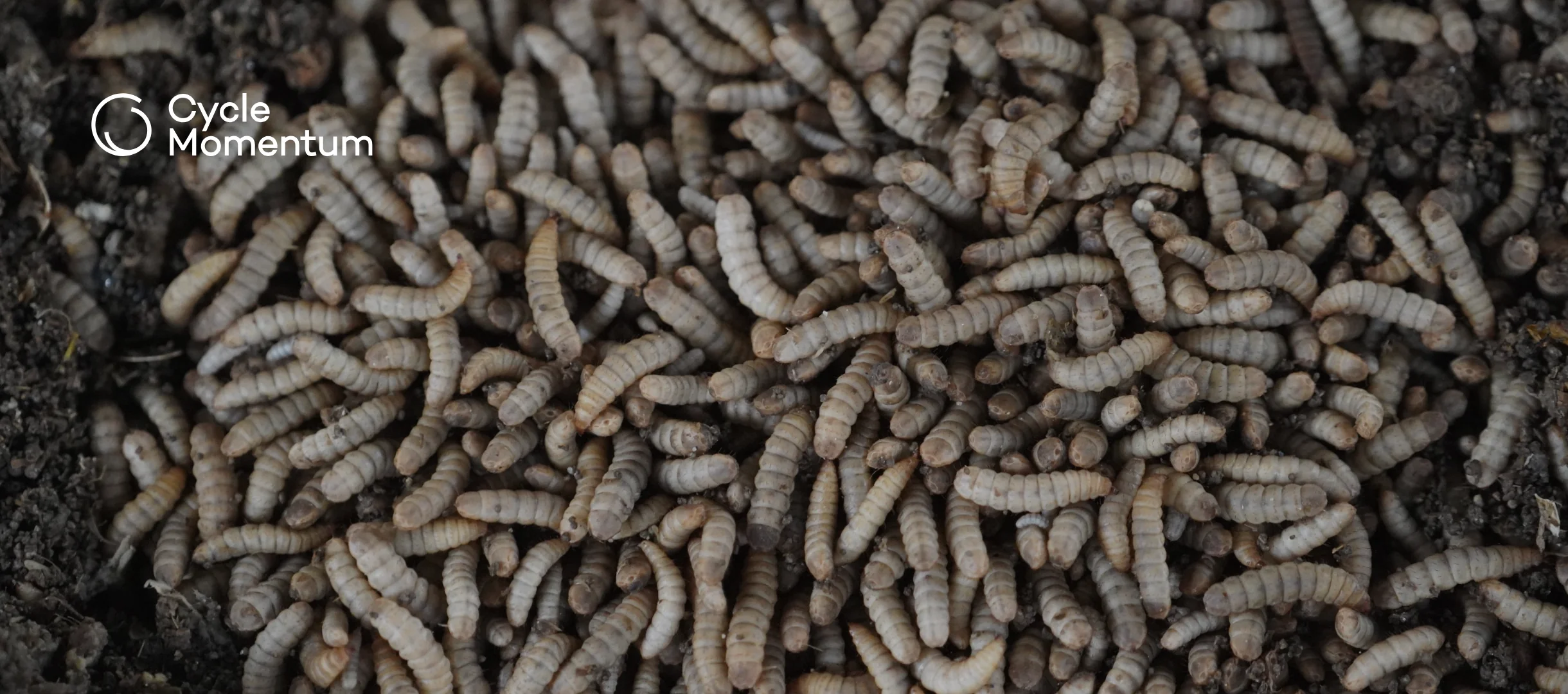
Insect frass is a mixture of excreta, feed and molted skins, in the plain words of the US Department of Agriculture’s research service. It is a by-product of farming insects such as yellow mealworms, crickets and black soldier flies. The more insects a farm raises, the more frass it produces. A 2024 review led by researchers at Quebec’s INRS estimates that each tonne of edible insects generates two to four tonnes of frass.
Quebec already has a supply. The same review counted 23 edible insect producers in the province in 2020, producing 184 to 375 tonnes of insects a year between them. That puts frass output somewhere between 368 and 1,500 tonnes. The authors expect agriculture to be its most likely market.
Does insect frass work as a fertilizer?
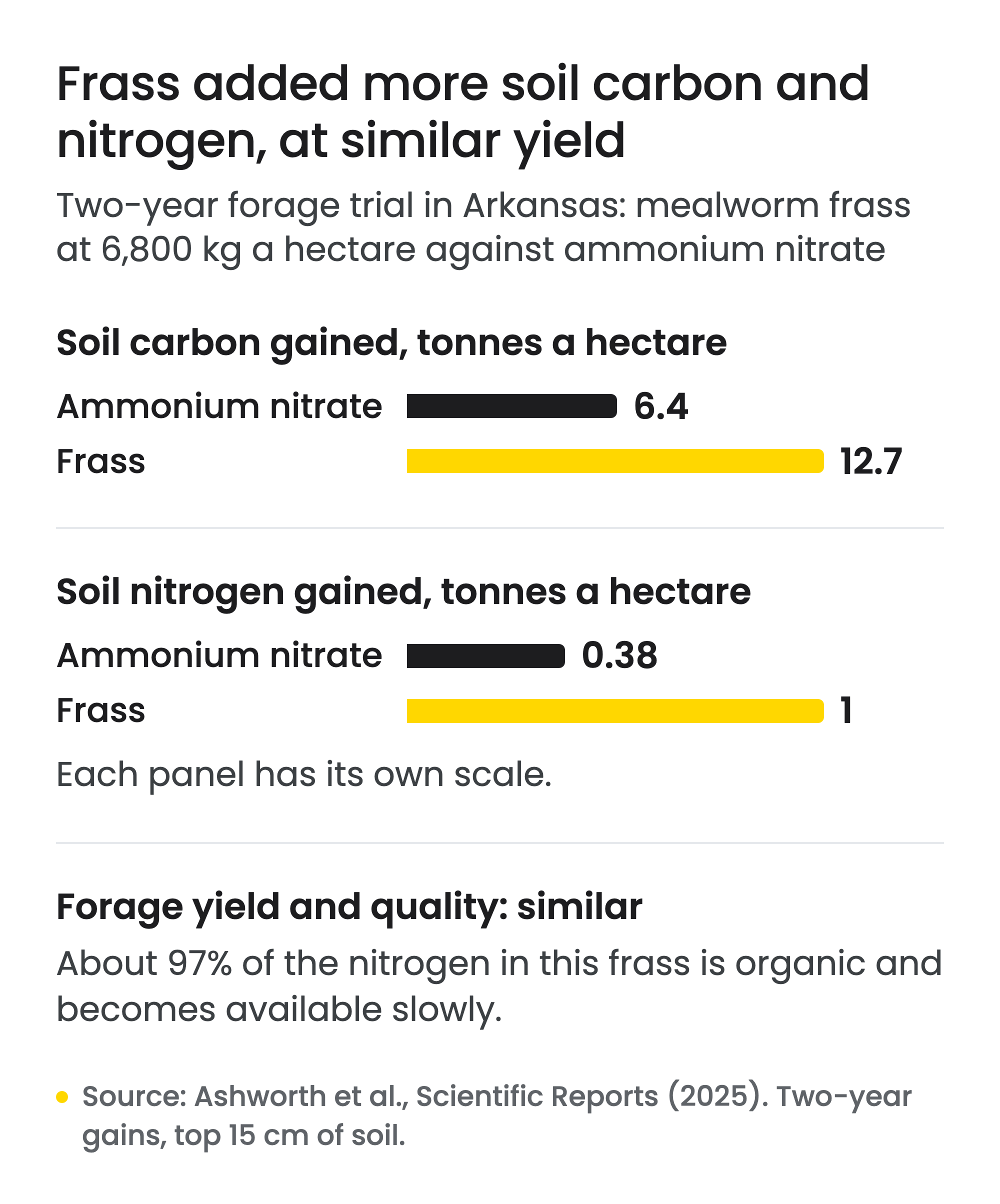
Recent field evidence says yes, with caveats. A two-year trial in Arkansas, published in Scientific Reports in January 2025, spread mealworm frass on forage at 3,400 and 6,800 kg per hectare. At the lower rate, frass supplied 116 kg of nitrogen, 68 kg of phosphorus and 68 kg of potassium per hectare. Over those two years, soil carbon in the top 15 cm grew by 12.7 tonnes per hectare under the higher rate, twice the 6.4 tonnes under ammonium nitrate. Soil nitrogen grew by 1 tonne, close to three times the 0.38 tonnes.
“Insect frass substantially improved soil fertility,” said Amanda Ashworth, the USDA soil scientist who is the study’s lead author.
The caveats matter as much as the headline. Forage yield and quality were similar across fertilizers, not higher with frass. That is because about 97% of the nitrogen in frass is organic and becomes available slowly. Nutrient content and pathogen levels also vary with the insect species and its feed, the authors note. The INRS review adds a practical point. Frass, like compost, has low concentrations of nitrogen, phosphorus and potassium, so farmers need more of it than of conventional fertilizer.
That is the opening for processing. Spread raw, frass is a slow soil amendment. Extracted and measured, its nutrients can go through an irrigation line, the practice known as fertigation. Circulus describes that form as directly available to the crop. Solugen, another Nexterre company, takes a similar route with hog manure, which it turns into a fast-release liquid nitrogen fertilizer.
Can frass be sold as fertilizer in Canada?
Yes, but the rules changed recently. Until October 2023, frass was marketed under the federal Fertilizers Act as a special fertilizer without registration, the INRS review explains. The Canadian Food Inspection Agency now limits its definition of manure to excreta of birds or mammals. The review reports that the agency sees insect body fragments in frass as a reason it does not qualify, so frass now needs registration.
Uptake was slow at first: when the review was written, only 10% of Quebec insect farmers had applied to register their frass. Provincial rules can treat frass as manure or as fertilizer, depending on how it is sold and used. Anyone planning to sell or buy frass products should check its registration status first.
How does Circulus turn waste into liquid fertilizer?
Circulus performs liquid extractions on residual organic matter, then monitors the biological reactions and the nutrient content. The company says it monitors specific ion activity to determine the nutrient content of the liquid extracts. These are brewed into a concentrated organic liquid fertilizer that it describes as odourless, pathogen-free and fast-acting. It all happens in an aerobic biodigester. Circulus offers it as a rapidly deployable Circulus System for small and medium operations, and a Circulus Plant for large volumes.
Its current product line highlights a frass-based fertilizer, and the company says its fertilizers are available through Lufa Farms.
The market makes sense for Quebec. More than a third of the province’s greenhouse fruit and vegetable area is certified organic. Those growers need nutrient sources that are both compliant and precise enough for drip irrigation. On the supply side, organic materials still made up 25% of everything Quebec sent to landfill or incineration in 2023, according to its residual materials report.
What results has Circulus reported?
Circulus publishes several trials on its case studies page. All of them are company-reported. Replacing the nitrogen in a hydroponic basil recipe with processed manure extract gave a 15% increase in mass. Its frass-based fertilizer produced peppers with 20% more sugar. A field pilot in Lunenburg, Ontario, tested frass-derived liquid fertilizer on corn as an alternative to synthetic nitrogen.
Outside recognition came in 2023, when Circulus won the $100,000 grand prize of the HSBC Quebec Cleantech Investment Challenge. The investor team picked it from 60 applications. In 2022, Agriculture and Agri-Food Canada also awarded it $124,500 through Innovative Solutions Canada for computer vision and an automated liquid nutrient analyzer for indoor hydroponic farms.
Circulus began in 2019 as Cannafish, founded by McGill agricultural and environmental sciences students who had studied chicken manure as a hydroponic fertilizer. It took its current name in 2020, in the 12th cohort of the Ecofuel Accelerator founded by Cycle Capital. Co-founder David Leroux brings a background in chemical engineering, waste management and fermentation.
The demonstration phase moves the fertilizer out of the company’s own trials and onto working farms. The most useful result would mirror the Arkansas trial: yield, soil nutrients and cost against a conventional fertilizer, with a liquid made by Circulus. In full disclosure: Cycle Momentum belongs to the Cycle Capital platform that founded the Ecofuel Accelerator, co-delivered the 2023 challenge Circulus won, and is a Nexterre partner. Our green chemistry startup accelerator is where we work with founders on circular inputs like this one.