What investors and founders should know about the clean economy tax credits.
Canada’s clean economy tax credits, announced in March 2026, are now paying out, and they can meaningfully lower the capital that climatetech companies need to reach market.
That was the message Bryan Watson brought to Cycle Momentum’s recent investor webinar on climatetech investment in Canada. Bryan, Managing Director of CleanTech North, and co-chair of the CPA Canada working group on the Clean Economy Tax Credits has spent more than two decades in Canada’s venture and incentives ecosystem. In his keynote, he explained what these credits are, why they matter for investors, and what founders should be doing right now.
A lower cost of capital through three pathways
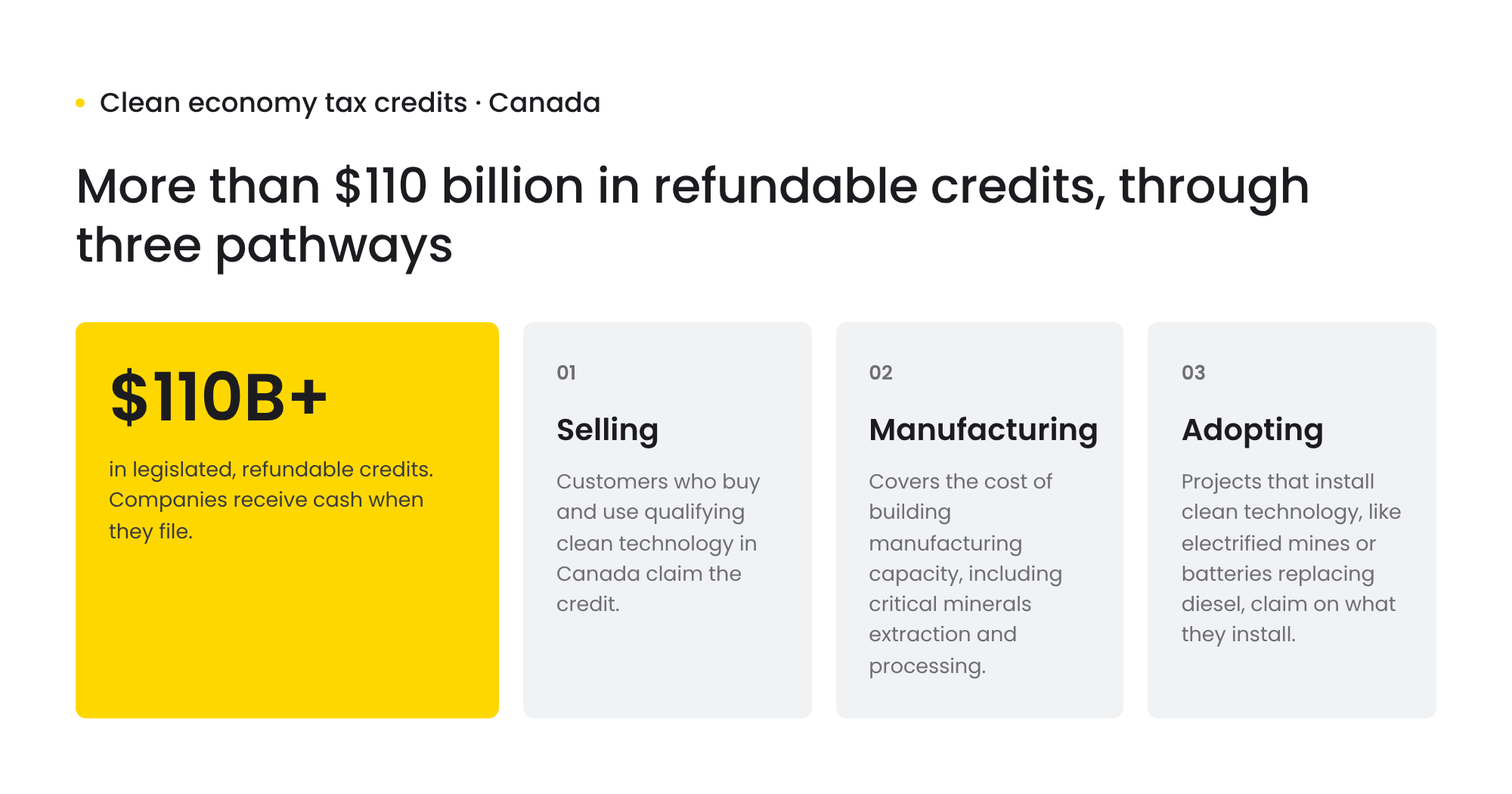
Canada’s federal government has legislated more than $110 billion in clean economy tax credits. They cover most of the clean economy, and all of them are refundable, so companies receive cash when they file rather than a reduction in future taxes. After a first cycle through the Canada Revenue Agency (CRA), the money is now going out the door. There are three ways the credits support climatetech companies.
- Selling clean technology. Customers who buy and use qualifying technology in Canada can claim a significant credit.
- Manufacturing clean technology. A separate credit covers the cost of building manufacturing capacity for qualifying products, including the extraction and processing of critical minerals.
- Adopting clean technology. Mining projects electrifying their operations, or mountain resorts replacing diesel backup generators with batteries, can claim credits on what they install.
In each case, the credits lower the company’s net cost of capital. As Bryan put it: “I’ve been talking for 25 years about the Valley of Death. I have yet to see that valley contract, but this is one way to make it maybe a little bit shallower.”
Entitlements, not grants
For Bryan, the most important feature of these credits is that they are entitlements, not grants. There is no limited envelope or committee deciding who gets funded. If the asset or the work qualifies, the company receives the credit.
That makes the credit a government receivable. CRA is auditing every claim, and processing takes about a year and a half. Because the amount is owed, though, it can be financed.
For investors, every dollar covered by a credit is a dollar the company doesn’t need to raise in equity.
Stacking credits and changes to SR&ED
Most provinces offer their own manufacturing tax credits, and these stack on top of the federal ones. For example, a battery production facility in Ontario could see roughly 45% of its capital cost covered once the federal credits are combined with the Ontario Made Manufacturing Investment Tax Credit. Anyone investing in a company like that should be factoring this in.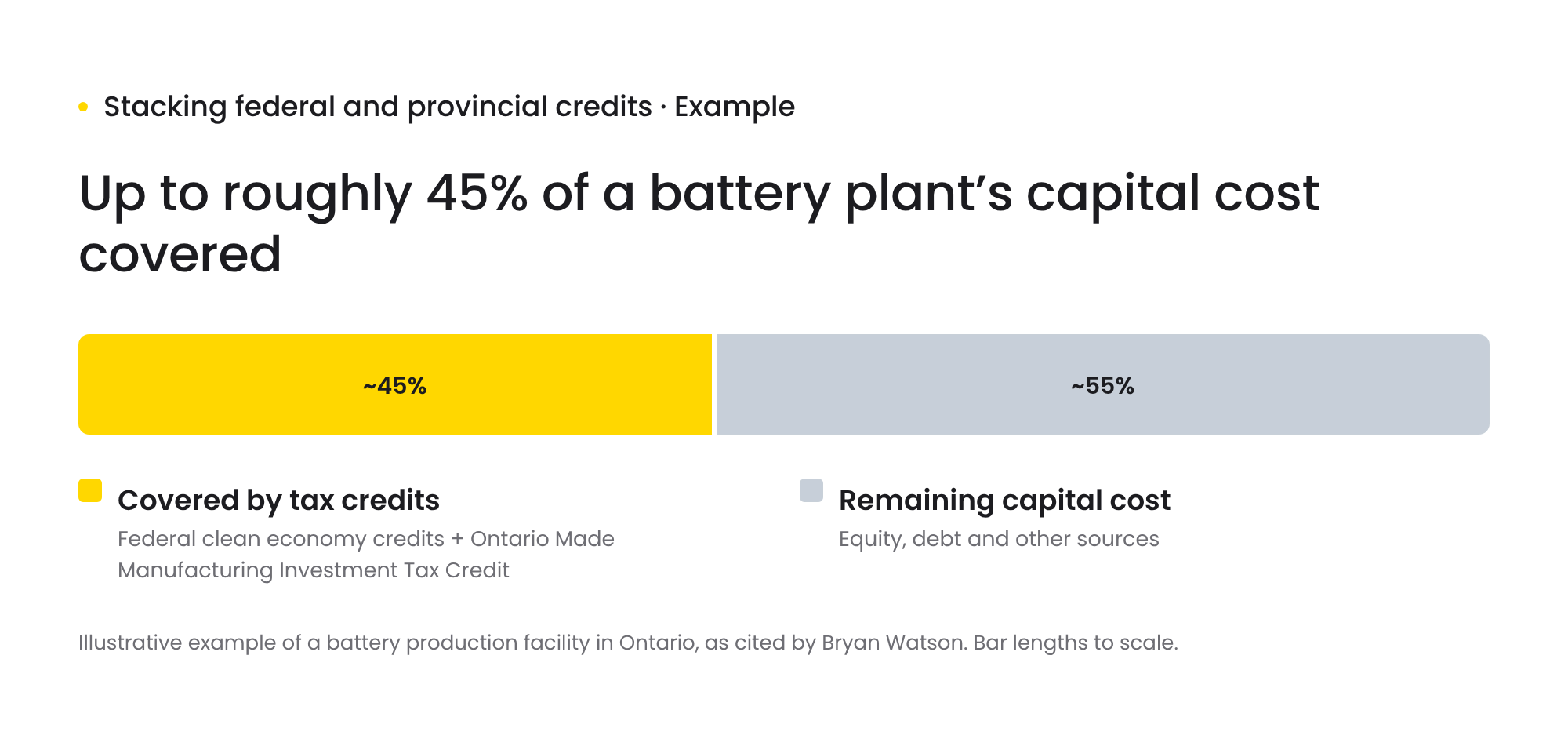
Hard tech also gets a boost on the R&D side. SR&ED, Canada’s R&D tax incentive, now covers the equipment used for experiments.
What’s coming and what to do now
More changes are expected in the upcoming federal budget. Bryan pointed to a proposed deduction that would let companies depreciate capital assets faster, a wider range of eligible technologies, and simpler administrative rules.
His advice for founders and investors came down to three points:
- Get a good advisor. These credits are complex, and capturing their full value takes expertise.
- Document everything. With every claim being audited, a company that can’t show exactly when a qualifying asset went into service risks losing the credit. Companies need to keep proper records.
- Watch the December 31 deadline. Companies can still claim eligible spending from the past two years or so, but only until December 31.

The Valley of Death isn’t going away, but these credits can make it a lot easier to cross. At Cycle Momentum, many of the founders we work with are building hard tech, where every non-dilutive dollar counts. Making sure our investor community understands these credits is one more way we can help those companies reach market.