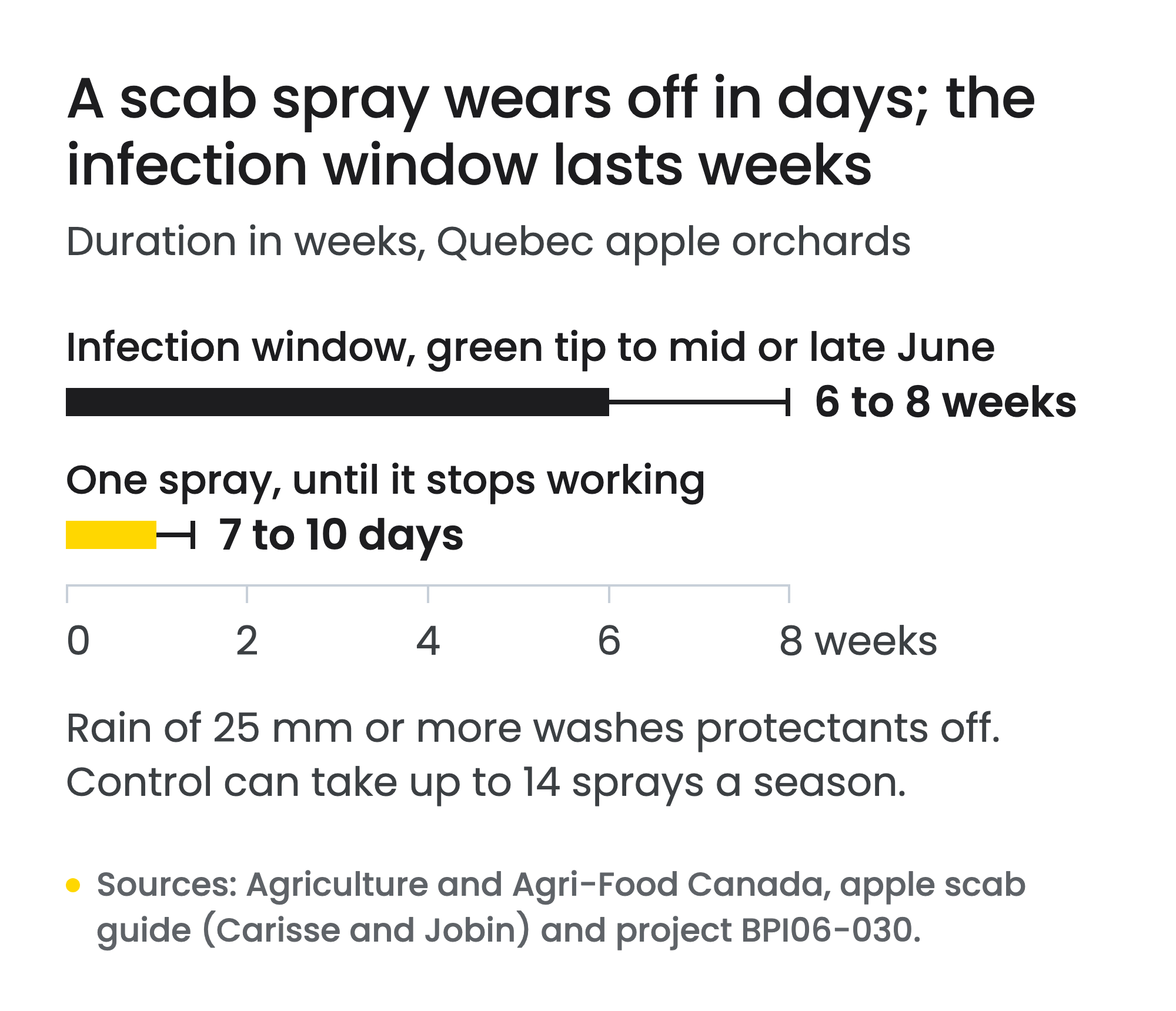
In a Quebec orchard, apple scab runs on a spring clock. It starts at green tip, when the fungus has its first spores ready, and stops six to eight weeks later, around mid to late June. Any rain or heavy dew in between can carry spores onto young leaves. Growers answer with fungicides, up to 14 sprays a season according to a federal research project.
CropMind wants to add a camera to that routine. The Canadian agtech company describes itself as based in Naramata, British Columbia, and lists orchard pilots in Quebec. Its software counts buds, flags disease and forecasts yields from video shot along the rows. In September the Nexterre Program picked it for Phase 1, the maturation stage before funded field demonstrations.
At a glance
- Apple scab infects mainly in a spring window of six to eight weeks, and its low damage threshold can mean up to 14 fungicide sprays a season.
- In a 2007 federal trial, monitoring-based spraying cut pesticide use by 24% and 45% at two Quebec orchards, with no significant effect at the other sites.
- An end-of-June leaf count decides summer sprays, but the Quebec threshold is hard to see by eye.
- CropMind’s spray savings are company-reported, and its tree-fruit page marks disease detection as in progress.
When does apple scab infect an orchard?
Apple scab starts the autumn before. The fungus, Venturia inaequalis, overwinters in dead leaves on the orchard floor, according to Agriculture and Agri-Food Canada’s guide to the disease. In spring, rain or heavy dew shoots its spores into the air. The primary infection period ends about two weeks after fruit set. New leaves stay vulnerable for about eight days after they emerge. Later, summer spores can cause fresh infections whenever conditions stay wet.
Growers cannot sell scabbed fruit, Quebec’s government notes. A 2014 federal strategy calls apple scab the most serious disease of apple in Canada, able to cause a 100% crop loss in any year if it is not controlled. Quebec then held 29% of the country’s apple orchard area.
Why does apple scab take so many fungicide sprays?
The margin for error is tiny. With an economic threshold of 1 to 2% scabbed fruit, growing apples without scab protection is practically impossible, according to an AAFC project page. Several scab fungicides have a high environmental impact, it adds, while the gentler ones are prone to resistance.
Each spray also wears off quickly. Infection risk depends on temperature and how long leaves stay wet: 15 wet hours at an average below 7°C carry no risk. Fungicide efficacy fades to nothing within 7 to 10 days, the guide says, and 25 mm of rain or more washes protectant products off. Fresh leaves emerge unprotected between sprays. Quebec’s public network of agricultural weather stations feeds disease models of this kind.
Resistance can raise the count, because growers make up for weaker products with more sprays. In AAFC lab tests on isolates from 58 Quebec orchards, 70% were insensitive to the fungicide Nova, though most growers still used that class without major loss of control. Grey mould shows the same trend: most Botrytis strains tested in Quebec berry and grape crops resist at least one fungicide group.
Is fire blight worse than apple scab?
Bloom brings a second threat inside the same spring window. Quebec’s government ranks fire blight as the more serious of the two, because it can destroy a tree in a single season, while scab is less virulent but more widespread. The bacterium attacks 130 plant species, apple and pear trees among them. It enters through flowers and new shoots and spreads on pruning tools and pollinating insects. If the trunk is infected, the province says, the tree must be cut down and burned.
Can orchard monitoring cut scab sprays?
It did at two test sites, though not at the others. In 2007, a team led by AAFC researcher Odile Carisse tested a scheme that follows the season. It started after the 2006 harvest with a biological control agent meant to shrink next spring’s spore supply. Spring sprays were timed on leaf emergence, spore maturity and infection conditions, and summer sprays depended on a scab count.
At St-Grégoire and Frelighsburg in Quebec, the scheme brought significantly less scab and cut pesticide use by 24% and 45% compared with the grower’s standard practice. At Magog, also in Quebec, and at the Ontario sites, it made no significant difference. AAFC said a longer evaluation was needed.
The summer decision is the delicate one. When the primary infection period ends, the guide tells growers to check at least 80 shoots. Below 0.05 scabbed leaves per shoot, a threshold tested only in Quebec, summer sprays can be reduced or dropped. By our arithmetic, that is one scabbed leaf in every 20 shoots, and the guide admits such low levels are hard to detect. Miss a few lesions and a rainy summer can push fruit scab past 1 to 2% by harvest.
Autumn closes the cycle. Shredding fallen leaves or treating them with urea or a biological agent can cut the next spring’s spores by as much as 95%, the guide says. Late leaf fall or early snow can rule that out in some years.
What does CropMind offer orchards?
According to its website, a grower clips a $400 GoPro to an ATV or carries it on foot and makes one pass along the rows at walking pace. Overnight, the company says, its AI returns bud counts, a yield forecast, disease alerts, spray prescriptions and an insurance-ready PDF. A 2025 ASTech Awards finalist listing says the platform lets apple and grape growers detect early disease, such as fire blight and apple scab.
The stage-by-stage view is more cautious. CropMind’s tree-fruit page marks bud density at green tip and bloom counts as complete. Disease detection, placed later in the fruit development stage, is marked in progress. Its spray prescription tool sorts each row into full rate, reduced rate or no spray for the grower to approve, and its worked example is a 2026 vineyard block in California.
What has CropMind shown so far?
CropMind grew out of a 2018 research initiative at the University of New Brunswick, co-founded by Damilare Odumosu, its CEO, and Rilwan Shokunbi. NRC IRAP funded its georeferenced flower and apple analysis for orchard management in 2024 and 2025. In 2025 it closed a $500,000 round led by the New Brunswick Innovation Foundation and BKR Capital, partly to launch pilot projects in Quebec and B.C., Entrevestor reported.
Its website does not name the Quebec orchards. Its homepage cites a 30 to 47% spray reduction without saying where or how that was measured, and we found no published results for its scab or fire blight detection.
A Quebec pilot would have to prove itself at the end of June. Can one camera pass find apple scab at 0.05 scabbed leaves per shoot as reliably as a scout checking 80 shoots? Can it do so early enough for a grower to skip a summer spray, then harvest fruit with less than 1 to 2% scab? One season would not settle it, since the 2007 AAFC scheme worked at two sites and not at the others.
Cycle Momentum is a partner in Nexterre, which Zone Agtech leads with Écotech Québec, so this profile is not a neutral review, and the product claims in it are CropMind’s own. Our agtech startup accelerator works with companies at this point, when a field trial has to back up what the software promises.