Why Canada? Investors on the climatetech opportunity
Why should investors look to Canada for climatetech? During our latest investor webinar, four Canadian investors shared why Canada stands out, where they see the biggest opportunities, and what investors may be overlooking.
Moderated by Lynn Côté of the Canada Cleantech Alliance, the panel brought together Pascal Drouin of Cycle Capital, Ka-Hay Law of NorthX Cleantech, Mary Dimou of Nadarra Ventures, Alicia Lenis of Chrysalix Venture Capital, and Bryan Watson of CleanTech North.
Our key takeaways
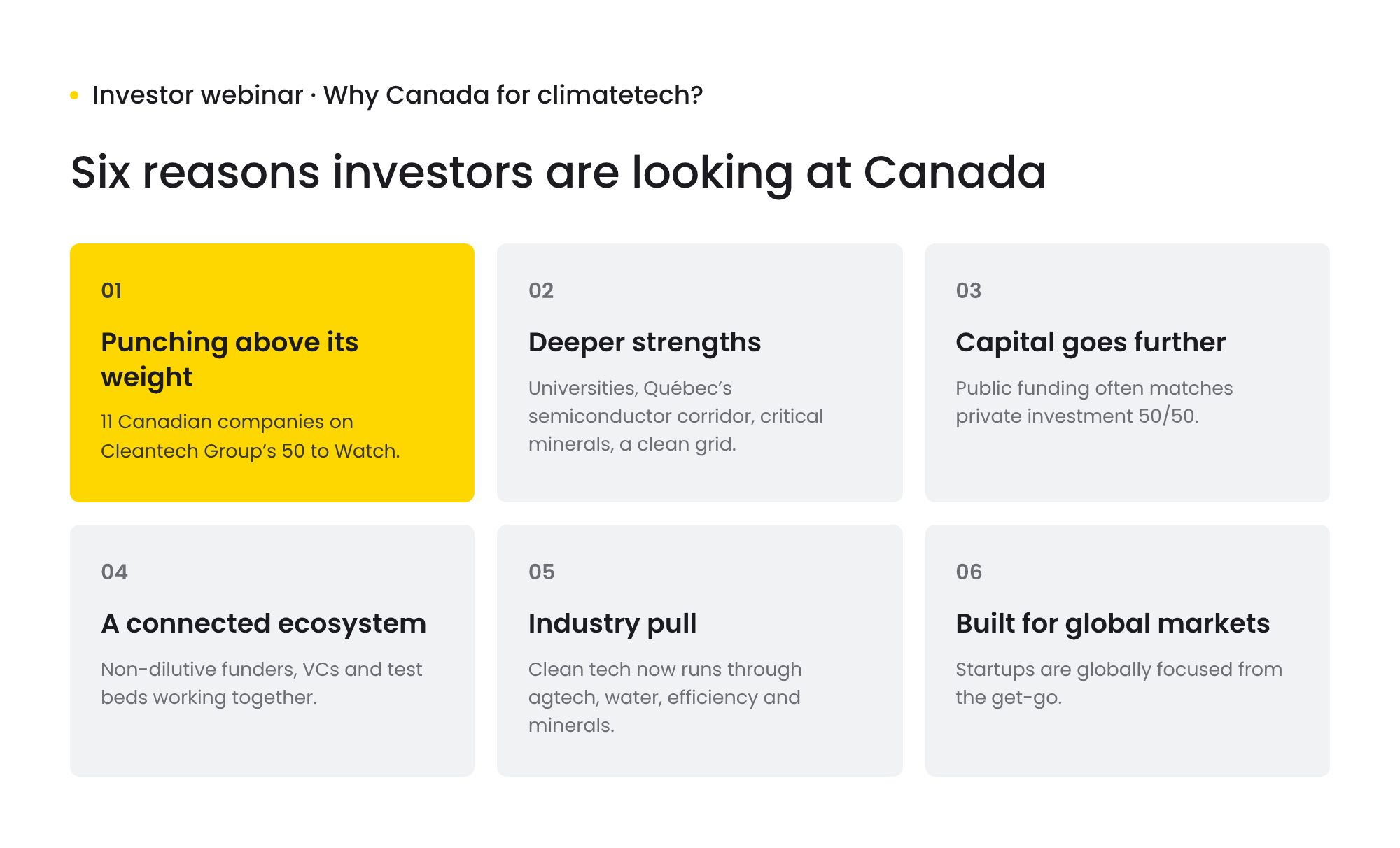
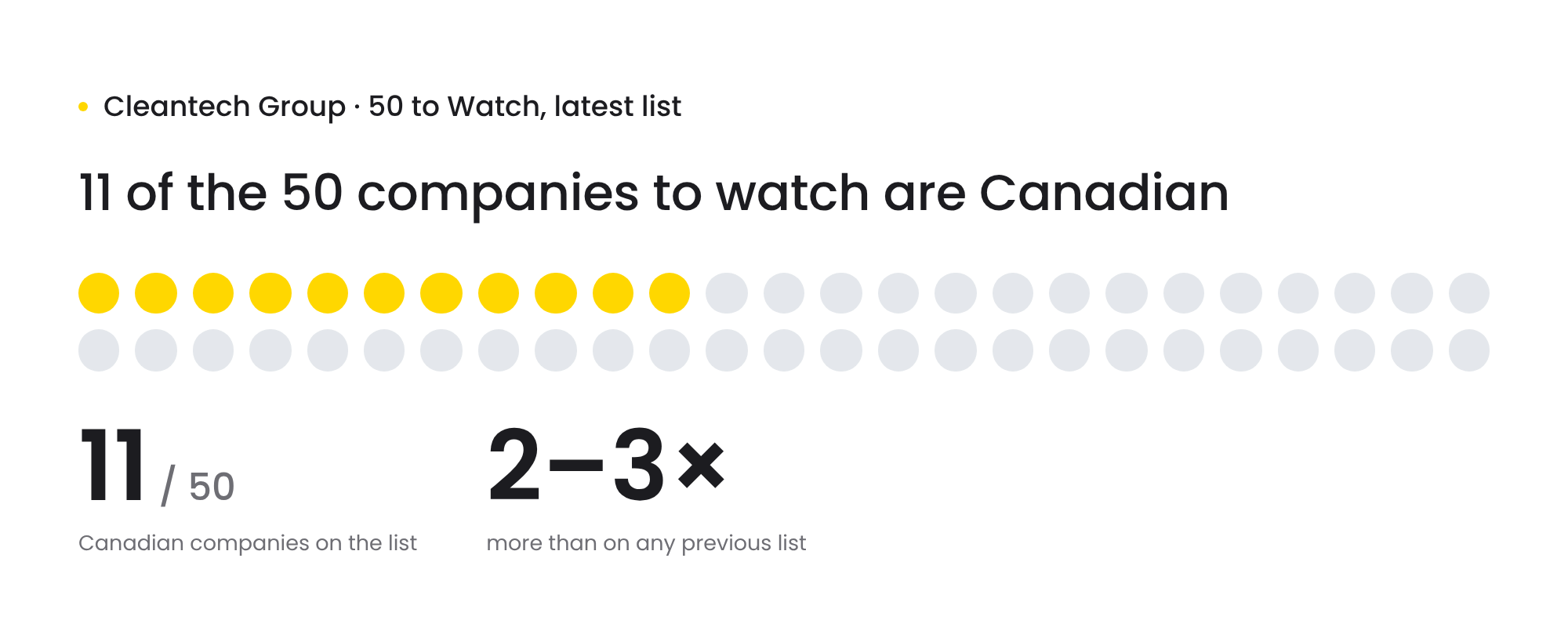
- Canada is punching above its weight. Eleven Canadian companies made the Cleantech Group’s recent 50 to Watch list, and more are moving from lab to commercial scale.
- Canada’s strengths run deeper than many realize. Strong universities, Québec’s semiconductor corridor, critical minerals expertise and a clean, affordable grid all give Canadian companies an edge.
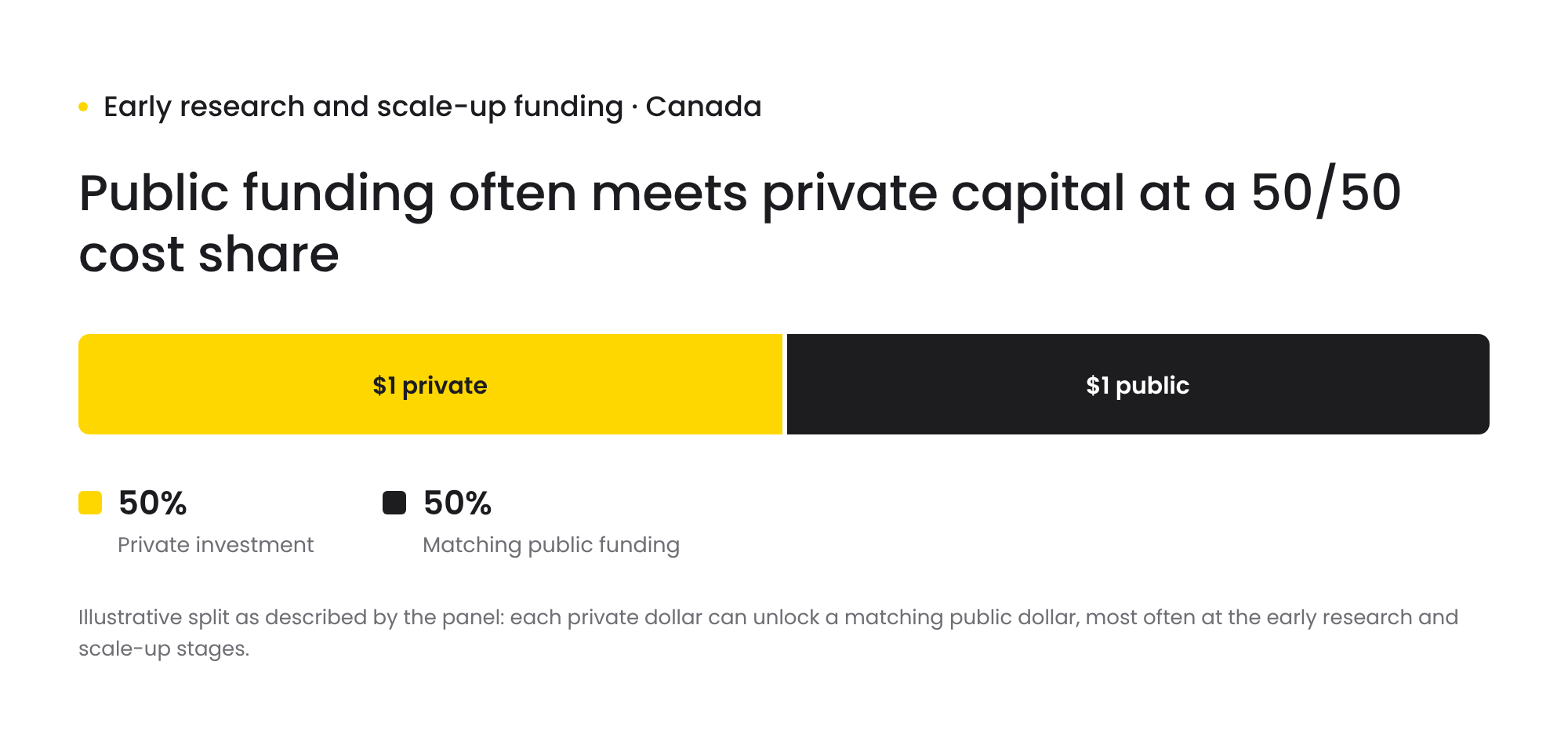
- Private capital goes further in Canada. Public funding often meets private investment at a 50/50 cost share, especially for early research and scale-up.
- The ecosystem is increasingly more connected. Non-dilutive funders, VCs and test beds are working together to help hard tech companies become investment-ready.
- Industry is asking for clean tech, often without realizing it. It now runs through agtech, water, industrial efficiency and critical minerals. Where startups once had to push their technology, industry is now pulling it in.
- Built for global markets. Canadian climatetech startups aren’t building for the Canadian market alone. They’re globally focused from the get-go.
Read the full conversation below. Note that it has been edited and condensed for clarity.
Why should investors invest in Canada?
Lynn: The investors on the line are from all over, so a simple question. Why should they invest in Canada?
Pascal (Cycle Capital): There are many good reasons. There are plenty of incentives, which is important. We have very strong technical expertise and a great network of universities to seed and foster innovation. There’s a very stable legal environment, and something a lot of European investors find interesting is access to the broader North American market.
Mary (Nadarra Ventures): Our private dollars can go a lot farther here because public funding is available to meet us at a 50/50 cost share most of the time. That’s particularly true for the very difficult early stage research, and for scale-up.
Ka-Hay (NorthX Cleantech): There’s already a lot of momentum in Canadian climatetech, from the early stages all the way to growth stage companies. The recent Cleantech Group 50 to Watch list had 11 Canadian companies out of 50. That’s a testament to the strength of our universities, which are generating a lot of IP and talent that can help commercialize it.
Lynn: That’s two or three times more than we’ve ever had. And the companies look very different from a list a decade ago. You see fire prevention, green materials and chemicals.
Alicia (Chrysalix Venture Capital): I’m a pre-seed and seed investor, so I come in right after that university R&D. Folks don’t realize Canada’s potential on that front. For the relative size of the country as a G7 economy, we punch pretty high on IP and R&D.
What gets you excited about climatetech in Canada right now?
Mary: For us, anything that can replace a synthetic chemical is investable. We recently invested in Opalia in Québec, which isolates mammary cells to produce milk, and livestock is one of the largest GHG producers in the world. Another Québec company in our portfolio, Dispersa, makes biosurfactants, the foaming agent in detergents and soaps. They’re the only fully waste-derived version globally.
Pascal: What gets us excited is also a little bit scary. It’s the entire AI ecosystem. AI requires a significant amount of energy, data centres are going up, and all of that is attracting a lot of capital. What excites us is the surrounding technology: more efficient semiconductors, better cooling systems, more efficient data transfer. Those don’t necessarily require significant capex, which is typically what VCs don’t like.
Alicia: Critical minerals. Canada’s huge resource industries have percolated into universities focused on geology, mining and earth sciences, and that is creating really attractive startups. Some have already grown to significant double-digit revenue, and there are test bed programs like NORCAT where you can try your technology in a real mining setting.
Ka-Hay: I always start with the companies showing what’s possible from lab to commercial scale. Moment Energy started in the lab at Simon Fraser University (SFU) about seven years ago, and just opened the world’s largest facility for repurposing used EV batteries into energy storage. Longer term, I’m excited to see parts of the capital stack that used to be siloed, like non-dilutive funding and venture capital, working together to help hard tech companies become investment-ready.
Bryan Watson: What excites me most is the mashup of clean tech. When we started in 2008, clean tech was its own thing. Now it’s clean tech and agtech, clean tech and critical minerals, clean tech and industrial efficiency. It has become the infrastructure layer of so many industries. In the past it felt like a technology push. Now, in critical minerals, I’m seeing huge technology pull.
What might investors be overlooking in Canada?
Pascal: In Québec, you’ve got the semiconductor corridor. It’s a collaboration between Université de Sherbrooke and C2MI, a large technology centre where you can go from prototyping all the way to test volume production, working with IBM and Teledyne DALSA right across the street. You have research in local universities, entrepreneurs taking it to market, and a whole ecosystem of experts to help turn a CAD file into an actual product.
Ka-Hay: Canada’s clean grid. The cost of electricity makes many emerging technologies cost competitive, especially in electrochemistry. Companies are using it to turn CO2 into industrial molecules and reduce reliance on petroleum-based feedstock, which in today’s geopolitical climate is a real supply chain resilience story.
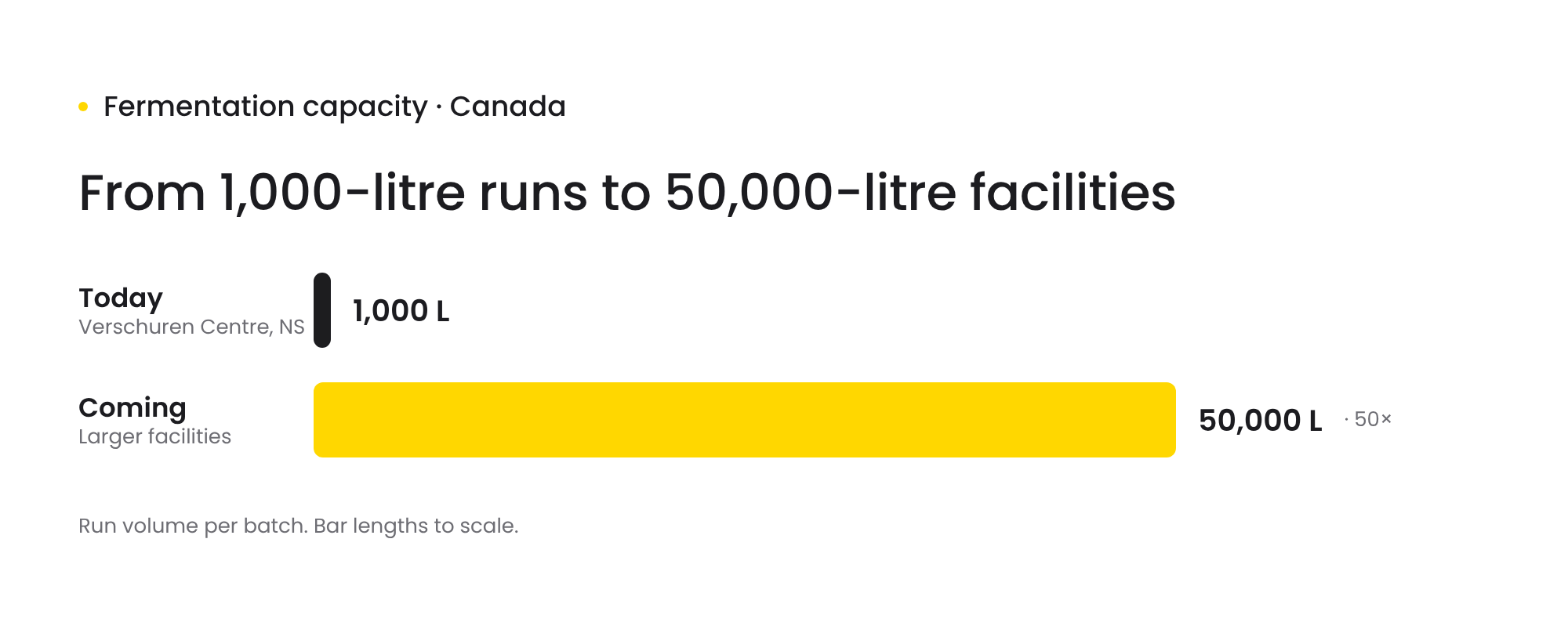
Mary: Fermentation capacity is growing across Canada. The Verschuren Centre in Nova Scotia can do 1,000 litre runs, with larger facilities coming that should handle 50,000 litres. Wet lab space is increasing too, especially in Ontario. And this is probably the first 24 months in my career that I’ve seen universities negotiate IP agreements one-on-one with companies, which makes cap tables much easier for investors to navigate.
Questions from the audience
What do you make of the current US trade position?
Alicia: Canadian climatetech startups aren’t building for the Canadian market. They’re building for global markets. Our mining tech companies have customers in Canada, Latin America, the US and other mining jurisdictions. They’re globally focused from the get-go.
Bryan Watson: There’s also a proposed clean technology content adder to the tax credit, likely to be in the budget. The more of your supply chain you can find in Canada, the higher the credit is likely to be.
Beyond tax credits, how should companies think about project financing?
Ka-Hay: There’s a lot of momentum, with NorthX, MaRS, Cycle and other investors, around helping hard tech companies figure out what their first of a kind financing stack needs to look like, and pulling that thinking forward to the pilot stage. We’re also seeing more project finance and equipment financing players recognizing the opportunity in Canada.
Do startups need to be Canadian to access these programs?
Bryan Watson: For the clean economy tax credits, as long as the clean technology property is in Canada and the company pays taxes here, it doesn’t.