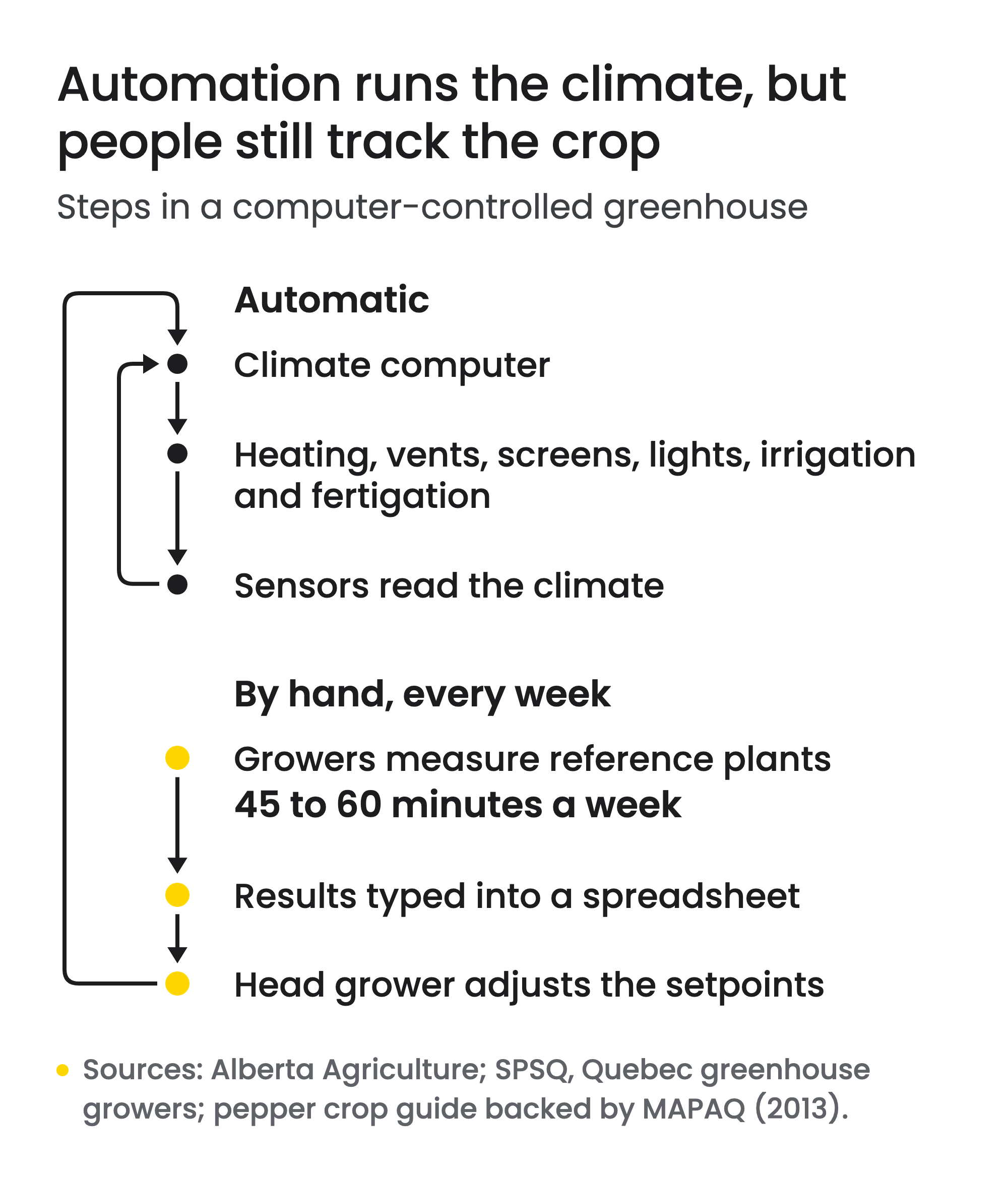
Greenhouse automation starts with a climate control computer. It reads the sensors, follows the grower’s setpoints and runs heating, ventilation, screens, lighting, irrigation and fertigation together. It also manages zones separately, raises alarms when something drifts and logs the climate. Crop measurements and work records are another matter. A Quebec pepper-growing guide has growers type plant measurements into a spreadsheet each week. Sentinus built its product around that kind of record, written down once and entered again later.
Sentinus, a Quebec company, does not build a new controller. It builds the layer around it: wireless sensors, a platform that ties together team activity, greenhouse measurements and crop records, and an AI assistant. It went straight to the demonstration stage of the Nexterre Program in September, without the maturation phase most of the cohort started with.
Key takeaways
- In greenhouse automation, a climate computer combines sensor readings with the grower’s setpoints to run heating, ventilation, screens, lighting, irrigation and fertigation together.
- Automation is only as good as its sensors, which need good hardware, routine maintenance and careful placement.
- Labour accounts for about a third of greenhouse production costs, according to a 2022 report by Quebec’s IRDA, and wages have been rising.
- Sentinus does not replace the controller. Its solar-powered stations measure fertigation and the crop canopy, and its platform keeps those readings next to work and crop records.
- It enters Nexterre at the demonstration stage, after field work with a tomato greenhouse in L’Assomption.
What does a greenhouse climate computer control?
It controls the systems that shape the growing climate. Computerized environmental control lets growers integrate the control of all the systems involved in manipulating the greenhouse environment, according to Alberta’s agriculture ministry. In its words, the whole greenhouse becomes a single instrument for control. The optimum conditions are defined, and the equipment acts in concert to hold them. The factsheet puts that nerve centre in the header house, next to the boilers and the irrigation and fertilizer tanks.
Not every system does all of that. Quebec’s greenhouse growers’ union sorts them into three levels: simple, intermediate and integrated. The more advanced ones control several types of systems and equipment at the same time, such as heating, lighting, thermal screens, fertigation, irrigation and ventilation. They also run zones on different setpoints, flag abnormal situations against the grower’s own criteria and record climate data for graphs and analysis.
Where does greenhouse automation fall short?
The first weak point is the sensors. A climate computer is only as good as the information it receives, the Alberta factsheet warns. Its sensors need to be of good quality and routinely maintained. Placement matters too. A temperature sensor in direct sunlight reads differently from one inside the crop canopy. The same logic explains why field growers install their own weather stations. Cost rises with each integrated system. The growers’ union warns that the investment pays off only if it delivers the effects it was bought for.
Crop records are the second gap. Climate computers log the climate, but tracking how the plants respond is still manual. A 2013 pepper crop guide, backed by Quebec’s agriculture ministry, describes the routine. Growers measure reference plants in two representative zones and enter the results in an Excel spreadsheet next to average climate and irrigation data. The head grower can then take stock every week and quickly adjust setpoints when the crop drifts from its target. Collecting the measurements takes 45 to 60 minutes a week.
Why does labour weigh so heavily on greenhouse growers?
Labour and energy are among the largest expenses in the business. Together they make up 44% to 55% of total operating costs across Canada’s major greenhouse-producing provinces, according to a July 2026 Farm Credit Canada analysis. The same analysis points to disease outbreaks, rising energy costs and several high-profile insolvencies as reasons margins need close management.
In Quebec, labour represents about a third of costs in greenhouse production, says a 2022 report by IRDA, the province’s agri-environmental research institute. Rapid wage increases put some operations at risk. Large companies are looking at robotics and production automation, the report adds, while smaller ones look for tools that fit their budgets. The pepper guide gives a sense of scale. Crop maintenance in a well-equipped Quebec greenhouse takes about 0.8 hours per square metre a year, or roughly 8,000 hours per hectare.
How does Sentinus fit next to the controller?
Sentinus tells growers plainly that their controllers continue to run the equipment, and its two stations add measurements where growers want more of them. SentiAqua tracks fertigation from feed to drain: pH, electrical conductivity, temperature and volume, plus runoff percentage and volume per emitter depending on the configuration. SentiFlora sits in the crop canopy and measures air temperature and humidity, with light, CO₂ and root-zone readings as options. Both are solar-powered and wireless, and every reading keeps its location.
The drain readings carry the environmental stake. Whatever fertilizer the crop does not take up leaves with the drainage water. In Quebec greenhouses, drainage averages 40% of the water applied, as our explainer on fertigation details. A grower who measures runoff can see that loss instead of estimating it.
Its platform puts those readings next to work and crop records: who did what in which row, pollination, harvest, quality, orders and delivery. The problem it targets, as its homepage puts it, is the same information recorded on paper or in spreadsheets and entered again later. An AI assistant, SentiAssist, summarizes what has been recorded, cites its sources and flags missing data. Sentinus extends greenhouse automation to the record-keeping, not the climate, and the company says this reduces manual measurement and duplicate data entry.
Where has Sentinus been tested?
Sentinus says it develops its platform in a commercial greenhouse in Québec, close to the crops, equipment and teams that keep it running. Both stations have been used in greenhouse conditions, it adds. Its field collaborator is Les Serres Point du Jour, a complex of specialty tomato greenhouses covering 100,000 square feet in L’Assomption. Sentinus has posted a video report from a 2025 pilot there but has not published measured results.
Mathieu Gagnon founded the company with co-founder Laila Lakrimi. Sentinus went through Centech’s Propulsé AgriTech cohort in summer 2024. At the time it pitched a broader product, a smart growing companion for anything from outdoor gardens to indoor greenhouses. Since then it has narrowed to commercial greenhouses. The company is a member of Zone Agtech, which leads Nexterre, and reports support from the Quebec government under the Primo-adoptants call.
Where Sentinus will run its Nexterre demonstration has not been announced. For a records platform, the useful results are practical: hours of manual entry saved, how fast a fertigation problem is caught, and whether the team still uses it after the pilot. As a Nexterre partner, Cycle Momentum is not a neutral party, and the product claims above are Sentinus’s own. Our industry 4.0 startup accelerator works with founders who bring sensors and software into farm operations.