Every wind turbine blade that goes out of service today has nowhere to go. Most end up in a landfill, buried, not recycled. But what if the material inside that blade could be recovered, transformed, and put back to work in a completely different industry?
FibeCycle is setting out to prove exactly that, and the next seven months will show how. Starting April 15, 2026, the company will process a complete wind turbine blade from end to end, in Canada, validating the full recycling pathway at industrial scale for the first time.
Key takeaways
- FibeCycle’s seven-month pilot will process an entire wind turbine blade end to end in Canada, one of the first industrial initiatives of its kind in the country.
- Recovered composites become ecoFRP™, a reinforced high-performance thermoplastic that can be injection-molded and 3D-printed into parts for automotive, construction, furniture and consumer goods.
- Industrial partners Innergex, Kruger Energy, EDF Power Solutions and Wind Power Solutions get early access to results and priority access to FibeCycle’s future recycling capacity.
How big is the blade-waste problem?
Researchers project global wind turbine blade waste will accumulate to roughly 43 million tonnes by 2050 (Liu & Barlow, Waste Management), and blades landfilled today can persist for centuries. Québec is on the leading edge of the curve: 1,985 turbines were installed between 1999 and 2021 (MERN, 2022), mostly in Gaspésie–Îles-de-la-Madeleine, and with a 20-to-25-year lifespan the earliest fleets are reaching end-of-life now.
RECYC-QUÉBEC’s 2022 study quantified what’s coming: materials generated by Québec’s energy transition are expected to grow from 2,562 tonnes in 2021 to more than 124,000 tonnes per year by 2030, a near fifty-fold increase, before Hydro-Québec’s 2035 plan adds roughly 1,500 more turbines. We covered the full numbers in the HPSH recycling pilot announcement; the short version is that end-of-life blade management has moved from a future concern to a present-tense industrial problem.
What will the pilot prove?
Building on three years of active work in fibreglass composite recycling, this pilot marks FibeCycle’s most ambitious step yet: processing a complete wind turbine blade from end to end, in Canada, and validating the full recycling pathway at industrial scale.
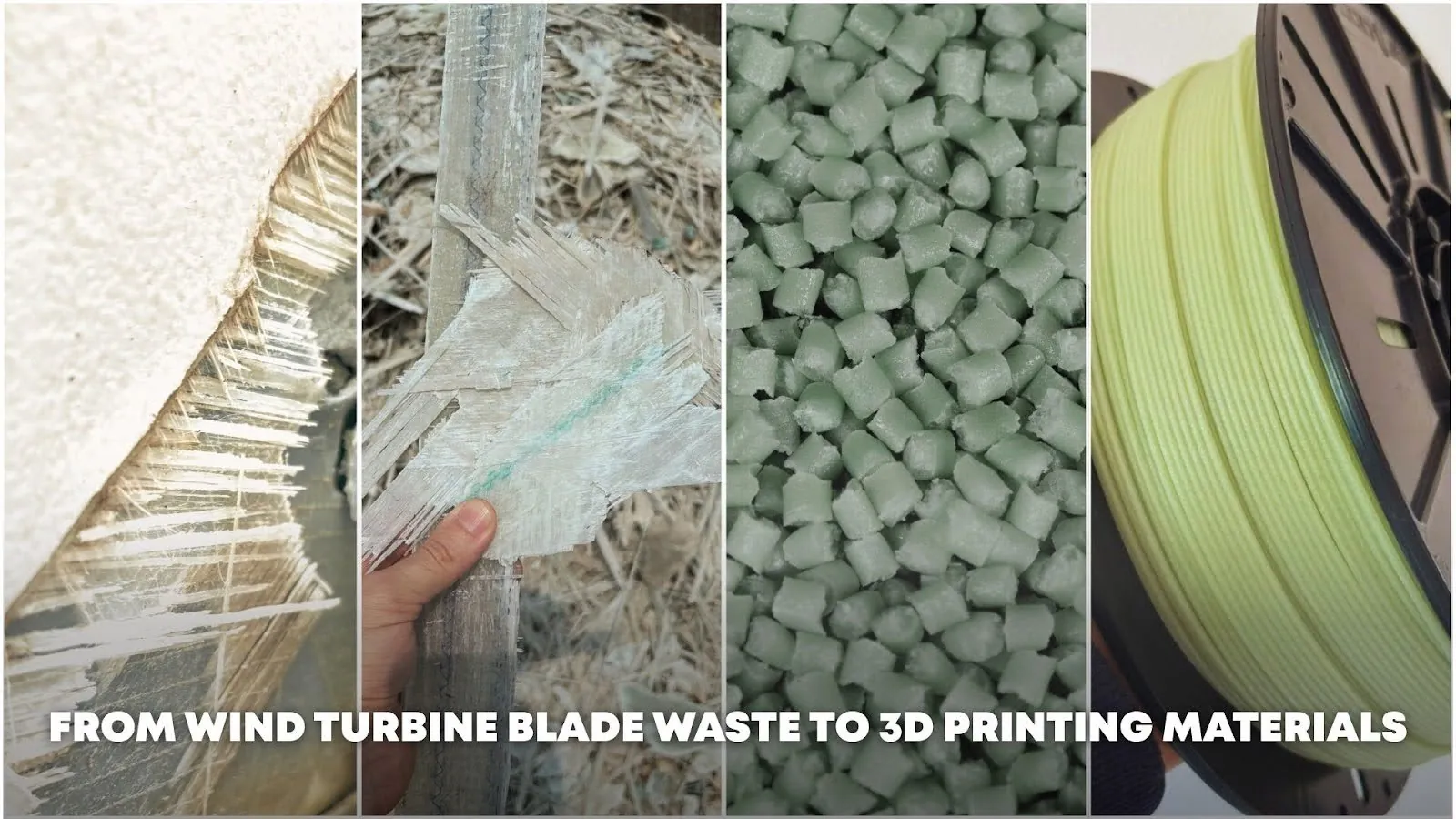
Through its proprietary technology, evaluated in collaboration with the National Research Council of Canada, composite materials recovered from decommissioned blades are transformed into ecoFRP™, reinforced high-performance thermoplastic composites that can be processed by injection moulding and additive manufacturing into parts for automotive, construction, furniture, consumer goods, and other industries. The market pull is real: the recycled glass-fiber polymer market was worth USD $1.27 billion in 2024 and is projected to roughly double to $2.62 billion by 2033 (Growth Market Reports), driven by lightweighting and recycled-content mandates in automotive and construction.
The pilot will explore and maximize the different material streams a single blade can generate, demonstrating the full potential of recovery. Results will be documented in a comprehensive technical report covering findings, lessons learned and potential CO₂ emission reductions, validating the recyclability of ecoFRP™. Ultimately, the project aims to lay the groundwork for a large-scale industrial recycling model.
How does a blade become ecoFRP™?
The seven-month pilot runs in sequence:
- Cutting and pre-processing of an entire wind turbine blade
- Recovery and processing of the resulting mix of resins and fibres, the intermediate material that feeds ecoFRP™ production
- Manufacturing and characterization of ecoFRP™
- Demonstration prototype built through 3D printing
- Validation testing of the recyclability of the obtained materials
What do industrial partners get?
For industrial partners, the project is a concrete opportunity to validate the recyclability of wind turbine blades while participating in one of the first industrial initiatives of this kind in Canada. Contributing to the pilot phase gives partners early insight into emerging recycling pathways for composite materials and positions them at the forefront of circular solutions in the wind sector, with the visibility that comes with it.
Partners also receive priority access to FibeCycle’s future recycling capacity as the technology moves toward industrial deployment, a meaningful option to hold as decommissioning volumes climb. It’s the same industrial-collaboration model Cycle Momentum runs across its partner programs: operators co-funding the solution to a shared structural problem before it becomes an acute one.
Who’s behind the project?
The pilot brings together INNERGEX, KRUGER Energy, EDF Power Solutions, and Wind Power Solutions LLC, contributing financial participation, in-kind support, and industry expertise. Their financial contribution provides access to project reports and early engagement with the technology. Beyond funding, partners provide operational backbone: the provision, cutting, and transportation of wind turbine blades, plus technical and logistical collaboration.
Cycle Momentum supported FibeCycle in structuring the pilot initiative and in exploring public funding opportunities through programs such as Québec’s Technoclimat program. The initiative could represent an important step toward one of the first dedicated industrial solutions in Canada for fiberglass composite waste from wind turbine blades, connecting the full value chain, from blade decommissioning to material recovery and advanced manufacturing, within a circular economy approach.
Part of a growing wind-circularity portfolio
FibeCycle’s pilot emerged from the Circular Innovation Challenge – Wind Energy | International Edition 2024, run with RECYC-QUÉBEC and supported by RBC, alongside the HPSH blade-to-concrete pilot. The two projects attack the same waste stream through complementary routes, one toward concrete, one toward high-performance thermoplastics. Both build on the collaborative approach described in our wind energy circularity deep-dive and on the 2024 challenge winners.
FibeCycle believes a circular economy is only possible when the entire value chain commits to it. That is the real value of this project: bringing together companies and people who believe they can make a difference, to solve a real problem together. This is where wind turbine blade waste becomes circular economy value, a real solution for a real problem that Canada can no longer afford to ignore.
Curious about what comes next? Follow FibeCycle on LinkedIn, and explore Cycle Momentum’s clean-tech accelerator to see how industrial pilots like this get structured.