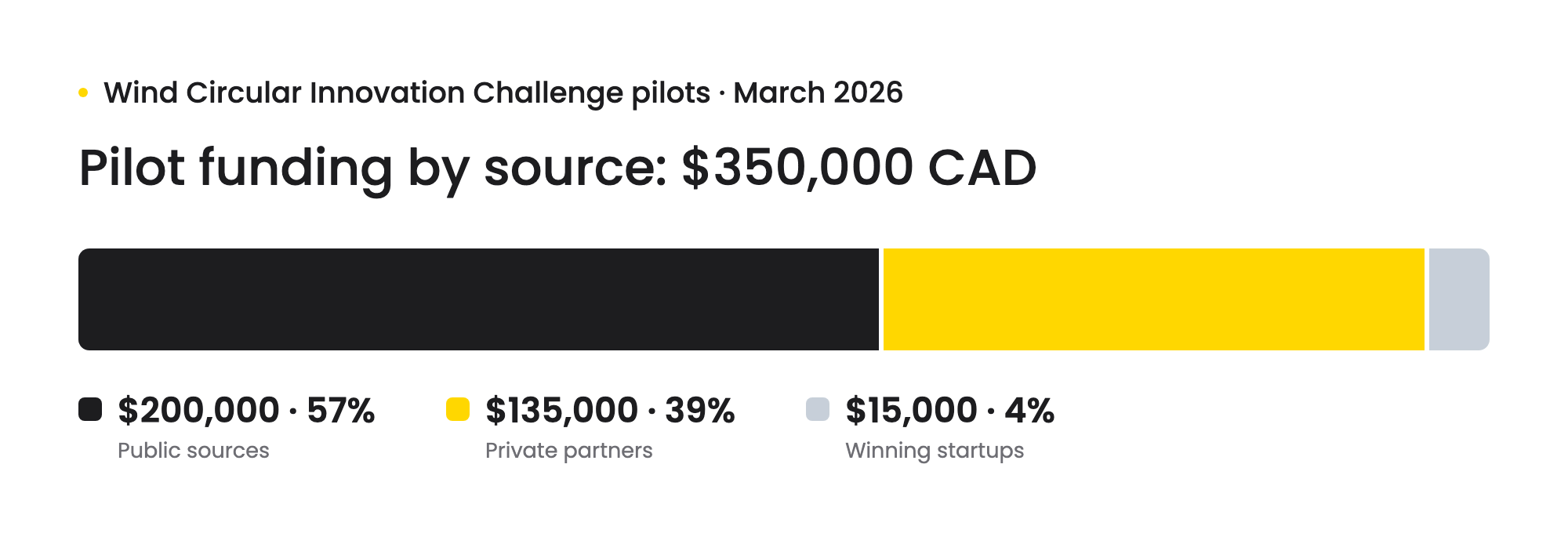
The two industrial pilots launched through the Wind Circular Innovation Challenge run on $350,000 CAD – and the composition of that money matters more than the amount. Of the total, $135K came from private partners, $200K from public sources, and $15K from the winning startups themselves. This post breaks down how that structure was assembled, why the two pilots were financed differently, and what corporate partners actually receive for their share.
Key takeaways
- The $350K total splits into $135K private, $200K public and $15K from the startups – no single funder carries the pilot risk alone.
- The two pilots used opposite blends: HPSH’s $252K budget is 20% Mission Allies / 80% federal and provincial; FibeCycle’s $98K is 85% Mission Allies / 15% entrepreneur.
- Partners are paid in evidence: an interim report (process, formulations, cost analysis) and a final report (technical, economic, environmental results plus a deployment plan).
- The startup contribution is small by design but non-zero – commitment pricing, not revenue.
- The structure mirrors the blended-finance logic Canada increasingly applies to first-of-a-kind projects at much larger scales.
Why do industrial pilots need engineered funding at all?
Because the pilot stage sits precisely where private capital is weakest. As the Canadian Climate Institute puts it in its analysis of blended finance, investors hesitate when projects carry large capital expenditures, complex risks and long payback periods – and a first industrial demonstration of an unproven recycling technology is all three in miniature. The technology works in a lab; whether it works on real feedstock, at real cost, with a real industrial host is exactly the question the pilot exists to answer. Nobody pays full price for an answer they might not like.
Blended structures resolve this by letting public money absorb the part of the risk that serves the public interest – building a recycling industry before the waste wave arrives – while private partners pay for the part that serves them: early access to the technology and the data. Canada already applies this logic at scale; the Climate Institute cites the Canada Growth Fund’s $500-million investment in the Strathcona carbon capture project, with returns tied to the carbon credits generated. The Wind Challenge applies the same principle three orders of magnitude smaller.
How was the $350K actually assembled?
Three layers, each with a different job:
- Public sources – $200K (57%). Federal and provincial funding carries the majority of the heavier pilot, keeping the barrier low for industrial participants in a sector where no one yet owns the waste problem.
- Private partners – $135K (39%). The Mission Allies – wind operators and manufacturers including Boralex, EDF Solutions Électriques, Hydro-Québec, Innergex and Kruger Energy – co-fund the pilots their own decommissioning projections make necessary, with the Royal Bank of Canada supporting the program’s development.
- The startups – $15K (4%). A deliberate asymmetry: large enough that the entrepreneurs have committed capital at stake, small enough that participation doesn’t distort an early-stage balance sheet.
For scale, compare Canada’s public pilot-funding programs: the BC Fast Pilot program funds cleantech demonstrations at up to $200,000 each and has invested $11.4 million across 87 pilots since 2019 – explicitly to help technology companies show impact in real-world conditions and reduce the adoption risk their industrial customers face. The Wind Challenge’s per-pilot budgets sit in the same band, which is not a coincidence: this is roughly what it costs to move a materials technology from lab result to credible industrial evidence.
Why were the two pilots financed differently?
Because they carry different risk profiles, and the funding blend priced that difference.
HPSH – $252,000, 20% Mission Allies / 80% federal and provincial. Transforming blades into validated concrete materials is the capital-heavier pilot with the longer route to standardization, so public money carries most of it. The industrial partners’ 20% keeps them committed – and first in line for the results.
FibeCycle – $98,000, 85% Mission Allies / 15% entrepreneur. A leaner pilot with nearer-term commercial logic, funded predominantly by the industrial partners who stand to use its output – including priority access to FibeCycle’s future recycling capacity. When the value of the evidence accrues clearly to identifiable companies, those companies pay for most of it.
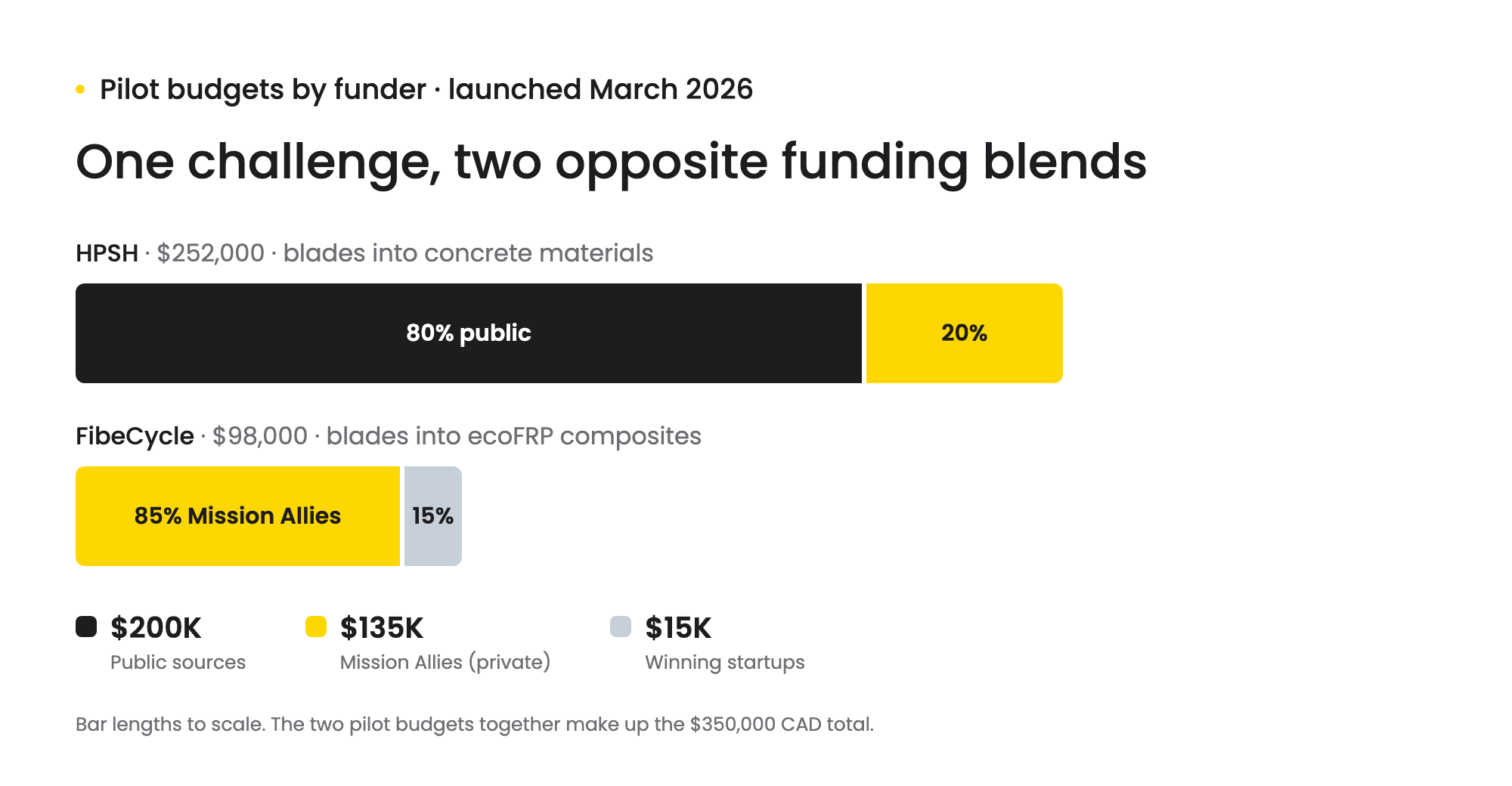
One challenge, two blends: the structure flexed to fit each technology rather than forcing both through one template. That flexibility is the practical advantage of running pilots inside a coalition, as described in our full case study of the challenge, instead of negotiating each one bilaterally.
Why not just one funder?
Each single-funder counterfactual fails in a characteristic way, and the blend exists to avoid all three failures at once.
All-public funding produces pilots without adoption paths. A government grant can pay for a demonstration, but it cannot supply an industrial host with real feedstock, an engineering team that stress-tests the cost model, or a buyer whose procurement decision the results will inform. Publicly funded pilots that skip industrial participation tend to end as reports rather than deployments.
All-private funding underinvests, because pilot evidence behaves like a public good. The first operator to prove a blade-recycling route pays the full proving cost while every competitor benefits from the knowledge; rational operators therefore wait for someone else to go first, and collectively nobody moves. Public co-funding compensates for exactly this free-rider structure.
All-startup funding is arithmetic fantasy at this stage. An early-stage materials company cannot carry a quarter-million-dollar demonstration on its balance sheet, and if it could, evidence produced entirely under the startup’s own control would carry less weight with future investors and customers than results witnessed by industrial partners on industrial sites.
The blend, in other words, is not a compromise between funding sources – it is the only structure in which the pilot produces evidence everyone involved has reason to trust and act on.