Quebec raised 6.9 million hogs on 1,943 farms in 2023, and it accounts for close to 34% of all hog slaughter in Canada. Most of those farms sit in two regions, Montérégie with 31% and Chaudière-Appalaches with 30%, according to the Quebec government. All of that manure has to go somewhere. Where it goes has a climate cost, and for some growers it could be a source of nitrogen.
Solugen Global, a company in Lévis, turns hog manure into clean water and a fast-release organic nitrogen fertilizer called Azogen. In March 2026 it announced a $50 million equity commitment to expand its plant and build a second one in Quebec. Solugen is also in the first phase of the Nexterre Program, whose cohort was announced in September.
Key takeaways
- Quebec raised 6.9 million hogs in 2023 and accounts for close to 34% of Canadian hog slaughter.
- Emissions from manure management in Quebec rose 42.8% between 1990 and 2023, mainly because there were more animals and more manure.
- Canadian fertilizer use grew 71% from 2005 to 2019, and nitrous oxide emissions from applying it rose 54%.
- Solugen extracts clean water from hog manure and turns the remaining nutrients into Azogen, which the company describes as OMRI listed for US organic production.
- Solugen says it cuts more than 10,000 tonnes of greenhouse gas emissions a year. We found no independent check of that figure.
What does hog manure cost the climate?
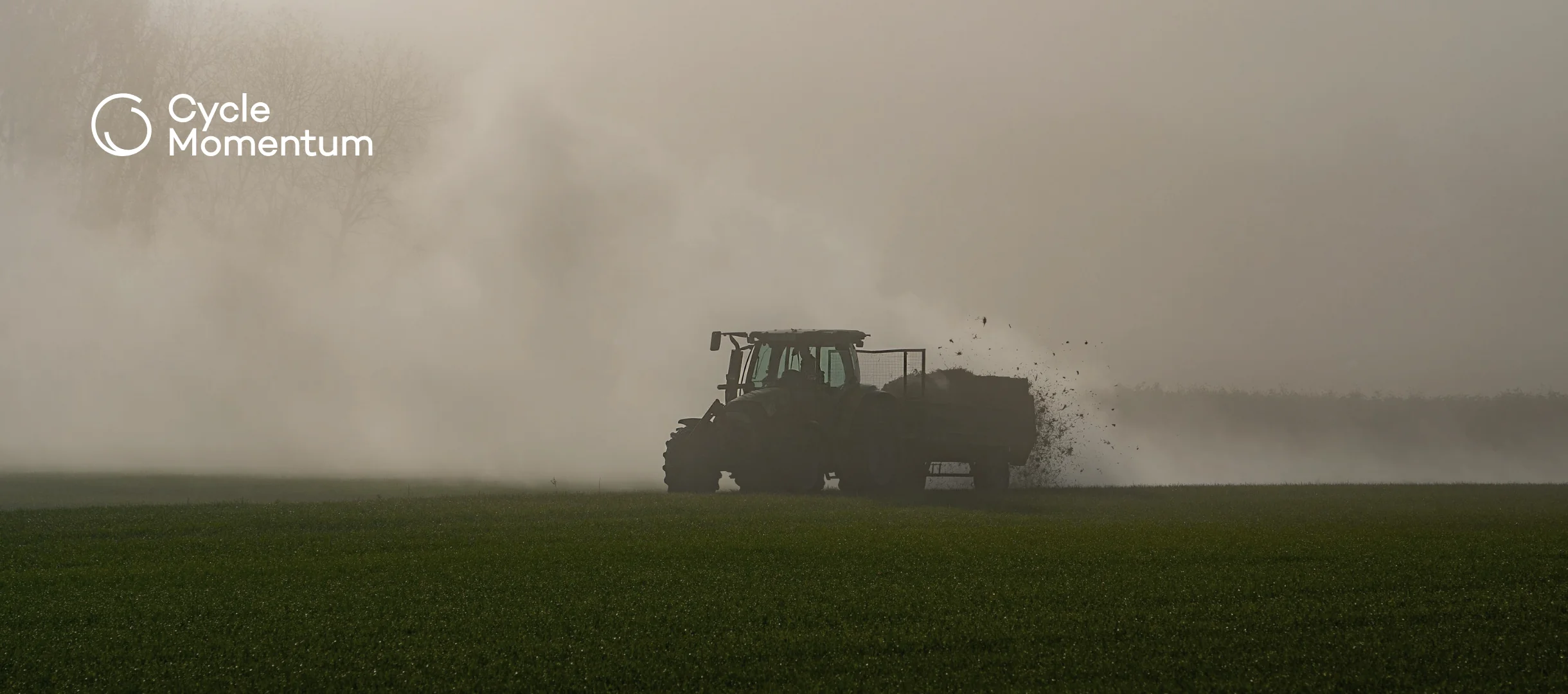
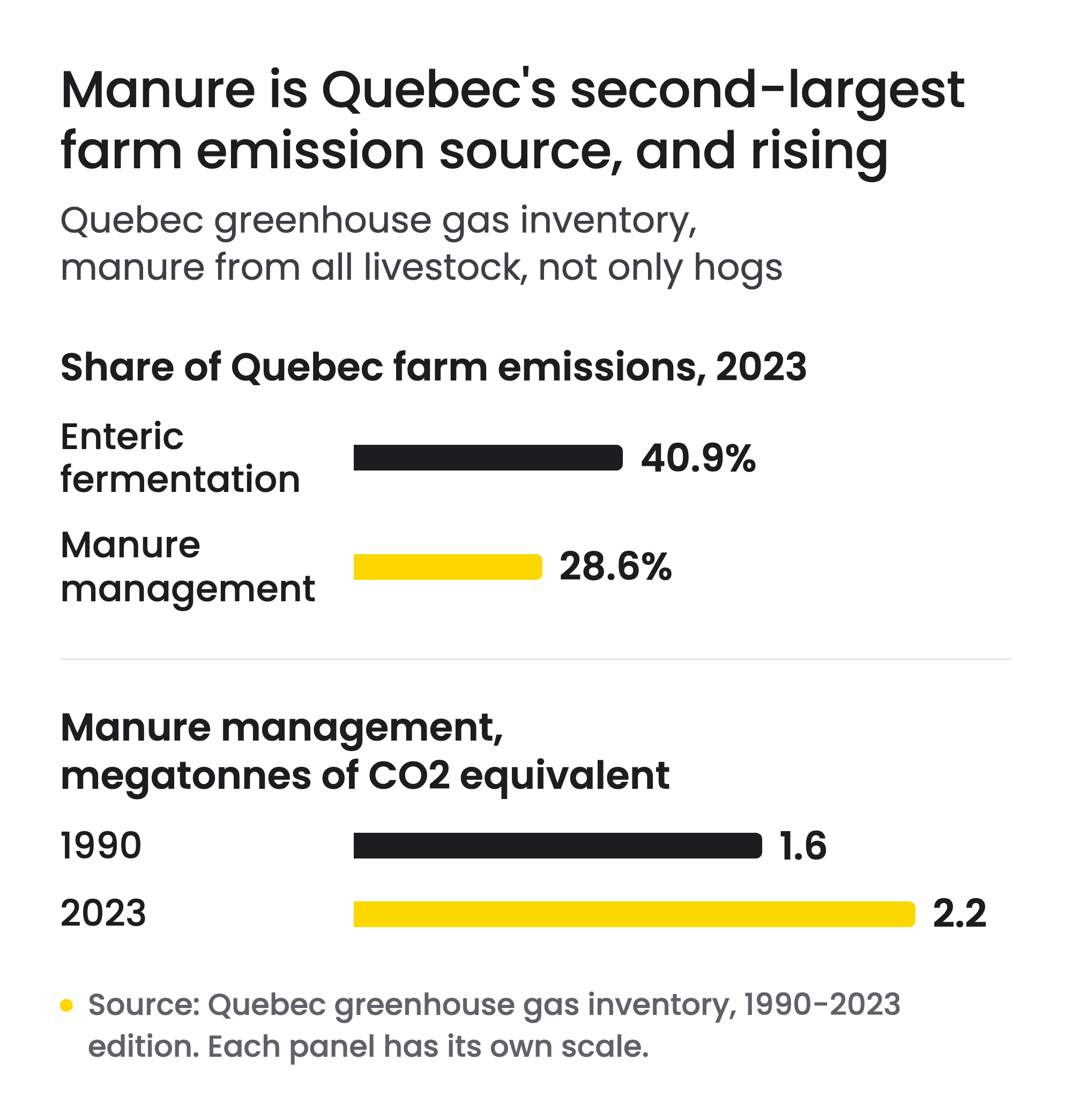
The cost is rising. Emissions from manure management rose 42.8% between 1990 and 2023, from 1.6 to 2.2 megatonnes of CO2 equivalent, according to Quebec’s greenhouse gas inventory. The inventory attributes the rise mainly to more animals and more manure to manage, in part from hog farming.
Manure management made up 28.6% of the province’s agricultural emissions in 2023. Only enteric fermentation weighed more, at 40.9%. That is the methane livestock release as they digest, and our profile on how forage shapes the methane cows emit covers it.
Nutrients are the second part of the manure equation. A 2022 federal research contribution to Solugen names the problem. Its goal is to make hog manure from a region with a surplus of phosphorus marketable as a fertilizer in Canada and the United States. Phosphorus also affects water quality. Along with nitrogen, it is one of the two nutrients that matter most for algae blooms, and farm runoff makes blooms more likely, as our explainer on blue-green algae in Quebec details.
Why is a fast organic nitrogen fertilizer hard to find?
Organic growers have few quick sources of nitrogen. They build fertility with legume cover crops, compost and manure. Organic farmers “rarely rely primarily on bagged N fertilizers,” writes Vern Grubinger of University of Vermont Extension in his guide to sources of nitrogen for organic farms. “However, many organic farmers do need to supplement these sources with N fertilizer.”
The supplements on his list behave very differently. Feather meal releases its nitrogen very slowly and cottonseed meal slowly. Blood meal and fish meal are rapid, though fish meal is smelly and dusty and may contain high salts. Chilean nitrate is rapid as well, but organic standards limit its use. Compost is slower still: in most cases only about 10% of its total nitrogen is available to a crop in the year it is applied. A grower who needs nitrogen in a hurry has a short list.
That short list is where Solugen sells its organic nitrogen fertilizer. It presents Azogen as a liquid nitrogen input certified and approved for organic agriculture, one that helps growers close the yield gap. Because it is liquid, it can go on by drip, band, sprinkler or foliar spray. That suits growers who feed crops through their irrigation lines, the practice known as fertigation.
How does Solugen turn hog manure into fertilizer?
The process has two outputs, according to the company. Starting with hog manure, Solugen extracts clean water, which is returned to the environment, and turns the remaining nutrients into Azogen. A 2021 federal AgriInnovate record describes the same idea, a plan to convert hog manure into purified water and commercialize fertilizer as by-products. Its $1,817,500 contribution went to a manure treatment centre in Saint-Patrice-de-Beaurivage.
That plant now runs around the clock, and the company describes it as modular and highly automated. Azogen is a fast-release liquid ammoniacal nitrogen fertilizer derived from hog manure, in the company’s words. Solugen’s technical sheet describes Azogen as OMRI listed, that is, reviewed by the Organic Materials Review Institute for use under the US National Organic Program. Growers can confirm the current listing in OMRI’s product directory.
Can a manure-based fertilizer cut emissions?
Possibly, though the link here is indirect. Replacing synthetic fertilizer with manures, compost or digestate could reduce emissions by 10% to 20%, according to a discussion document from Agriculture and Agri-Food Canada (AAFC). Solugen, however, markets Azogen to organic growers, who do not use synthetic nitrogen in the first place. Where one organic nitrogen fertilizer replaces another, such as feather meal, that estimate does not apply. The company also says it cuts more than 10,000 tonnes of greenhouse gas emissions a year, a figure we could not check independently.
Fertilizer use, meanwhile, has grown fast. Canadian fertilizer use grew 71% between 2005 and 2019, driven mainly by sales in Western Canada, according to the same document. Nitrous oxide emissions from applying fertilizer rose 54% over those years. Synthetic fertilizer accounted for 12.75 megatonnes of CO2 equivalent in 2019. These are Canada-wide figures over a different period from Quebec’s manure numbers, so the two do not compare directly.
How did Solugen get to this point?
It got here through a change of business model. Founder and CEO André Beaulieu-Blanchette started the company in 2017, and partners Guy Roy and Laurent Brochu joined the next year, according to a Université Laval profile from its TRACTION program. In 2019 Solugen showed its first hog slurry processing unit on a farm in Lotbinière, with research partner INRS. After the pandemic slowed its activities in 2020, it pivoted to recycling and fractionating nitrogen. The profile noted a limited market for nitrogen in Quebec, so the company aimed abroad.
The March 2026 round, led by Idealist Capital, included $20 million from the Canada Growth Fund. The investment is meant to expand the Saint-Patrice-de-Beaurivage plant and build a second Quebec facility, whose location has not been disclosed. Solugen keeps a sales office in Salinas, California, and says the capital will speed up its push into the US market. Nexterre has not published the scope of Solugen’s project.
A bigger plant is where the claims can be measured: how much manure the plants take in, how clean the returned water is, and an emissions figure checked outside the company. Phosphorus is the open question. Azogen grades such as 5-0-0 and 7-0-0 list zero phosphorus, so where the manure’s phosphorus ends up matters as much as the nitrogen. Readers should know that Cycle Momentum works on Nexterre as a partner. Turning farm by-products into inputs is part of what our green chemistry startup accelerator covers.