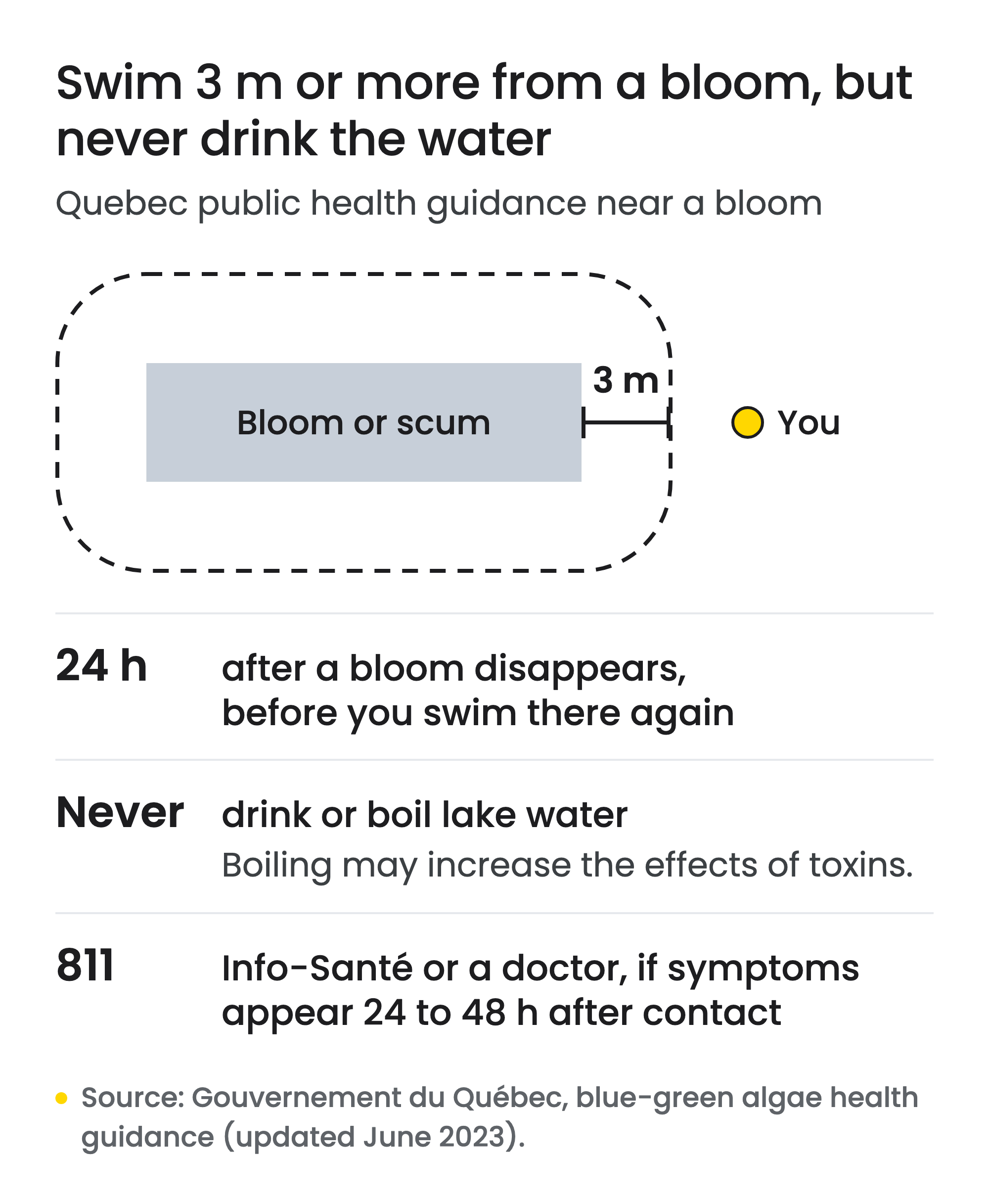
You can swim in a Quebec lake that has blue-green algae, as long as you stay where there is no bloom or scum. Near a bloom, keep at least 3 metres away. Never drink the lake water, and do not boil it to make it safe. Once a bloom disappears, wait 24 hours before swimming in that spot again. Those rules come from Quebec’s public health guidance, and they matter every summer.
Biocene Solutions, a Montreal startup, goes after the bloom itself. Its machine, Algo, pulls algae out of the water without chemicals and keeps them as biomass that could become products such as fertilizer. The Nexterre Program for clean agricultural technologies chose Biocene for its first phase in September.
Key takeaways
- Near a bloom, Quebec’s public health advice is to stay at least 3 metres away, never drink or boil the water, and wait 24 hours after the bloom disappears before swimming there.
- Blue-green algae are cyanobacteria. They bloom when warm water and extra nutrients, mainly phosphorus and nitrogen, let them multiply.
- Nearly 500 Quebec water bodies had blooms between 2004 and 2015, and most Canadian lakes are not monitored for blooms.
- Biocene’s Algo removes algae mechanically and keeps them as biomass. The company has not yet published removal rates or biomass composition.
Is it safe to swim near blue-green algae?
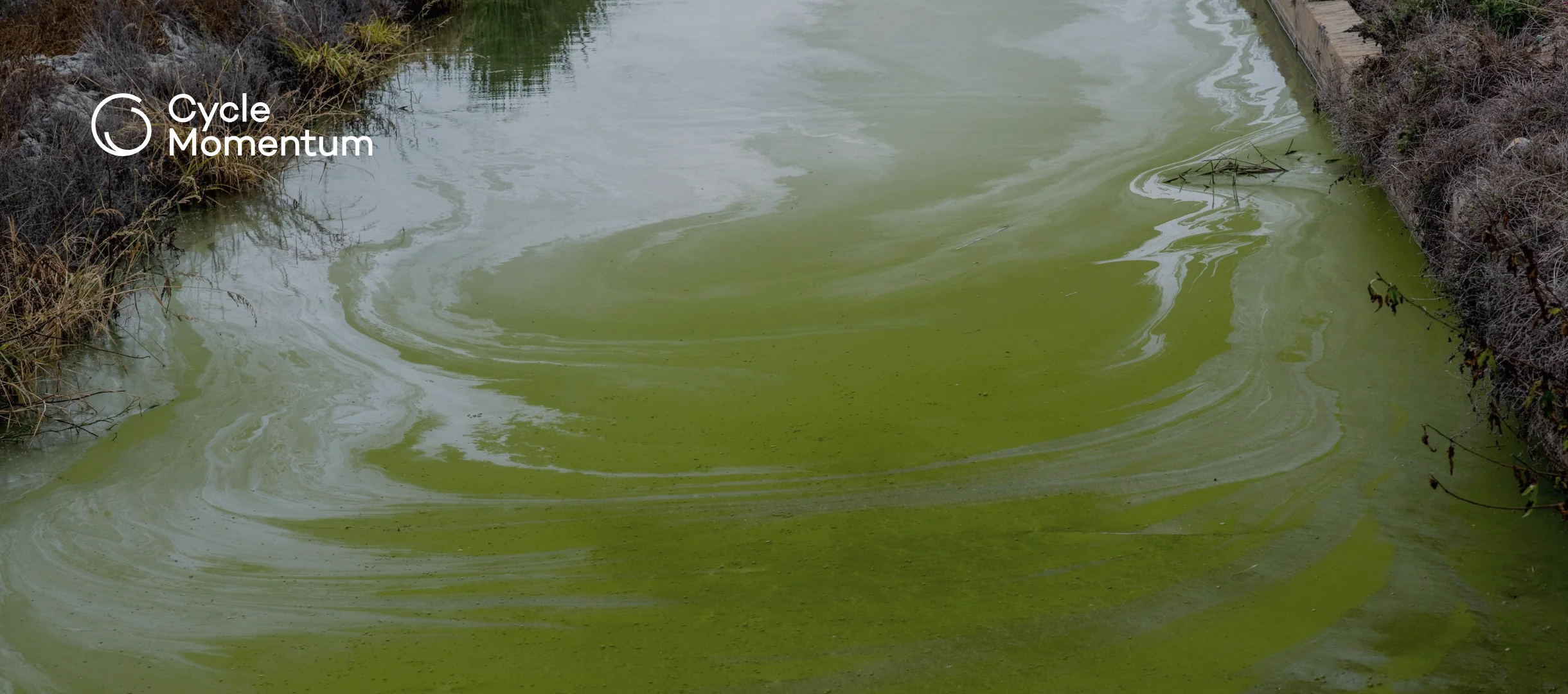
Yes, as long as you pick the right spot. Quebec’s guidance allows swimming and water activities in areas with no blooms or scum. Where a bloom is present, the advice is to keep at least 3 metres from it and avoid any activity that brings you into contact with it. After the bloom and scum have disappeared, you can swim there again, but only 24 hours later.
Lake water is a different matter. The province advises against drinking river or lake water at any time, and especially during a bloom. The same goes for making ice, cooking, brushing teeth and filling an animal’s water bowl. Boiling is not recommended either, because it “may increase the effects of toxins.” Water from an artesian well or a municipal supply can be used as usual, unless local authorities say otherwise.
Dogs are especially at risk, because they can swallow water while swimming and then lick algae off their coats. People should watch for stomach ache, diarrhea, vomiting, headache, fever, or skin and throat irritation. If symptoms appear 24 to 48 hours after contact, the guidance is to call Info-Santé 811 or see a doctor. A sick pet needs a veterinarian.
What are blue-green algae?
They are bacteria, despite the name. Cyanobacteria are microorganisms that have existed for over three billion years, according to Quebec’s environment ministry, and they live in the province’s lakes and rivers at low concentrations. “Normally they do not cause any problems,” the ministry adds. Under certain conditions they multiply quickly and become extremely abundant. That is a bloom.
The water turns green, sometimes red, brownish or turquoise, and can look like paint or broccoli soup. Some species produce toxins that can cause gastroenteritis or irritate the skin and throat. Biocene’s founders add an ecological cost: blooms can “block sunlight from aquatic organisms, effectively creating dead zones,” they told McGill’s Dobson Centre in 2024.
Why do Quebec lakes keep blooming?
Nutrients and heat are the short answer. Phosphorus and nitrogen matter most, according to a review by the National Collaborating Centre for Environmental Health (NCCEH). Blooms become more likely as more of them arrive from diffuse sources such as agricultural runoff and point sources such as sewage effluent. Warm summer water does the rest.
Quebec has counted blooms since 2004. The environment ministry’s 2015 report found that nearly 500 water bodies had been affected by blue-green algae blooms over that period. Of those, 56 were hit in 2015, and 17 of them for the first time.
Since then the count has become less complete. In 2016 Quebec cut back surveillance of water bodies that bloom routinely and of those not used for drinking water, and provincial authorities reported only two blooms in 2017, the NCCEH review notes. Most of Canada’s roughly two million lakes are not monitored at all, so many blooms “may go unnoticed or unreported.” Read the official numbers as a minimum.
Can you get rid of a bloom once it starts?
The lasting fix is on land, by cutting the nutrients that reach the water. Quebec’s bloom page points to rules on certain dishwashing detergents, pleasure craft and wastewater from isolated homes, and to guides on riparian strips and lake watershed plans. Doing nothing is expensive. Blooms on the Canadian side of Lake Erie could cost up to $272 million a year, according to Ontario’s environmental registry. A Canada-Ontario plan aims to cut the lake’s phosphorus load by 40%.
Watershed work is slow, and a lake that turns green every summer needs something sooner. Biocene works in that gap. Rather than eliminating the algae with chemicals, Algo cultivates them in a dedicated tank and collects them, Biocene says. Removal deals with the bloom in front of you. It does not stop new nutrients from arriving, so it can add to the work on land but cannot replace it.
How does Biocene’s Algo work?
Biocene’s Algo page describes three steps. A pump draws in algae-laden water from a pond, beach or lake. The water passes through what the team calls its “magic box,” where the algae are cultivated and collected, and clean water goes back out. The company says the device can be adjusted to any body of water.
The biomass is meant to be the product. Biocene lists organic fertilizers for agriculture among its uses, along with biofuels, bioplastics, biogas and pigments, but it has not published composition or yield data. Other Nexterre companies already turn waste into fertilizer: Solugen makes a liquid nitrogen fertilizer from hog manure, and Circulus Agtech turns insect frass and other organic waste into liquid fertilizer. A farm buyer will want to know what nutrients the algae contain, and how steady that is from batch to batch.
Biocene started as a passion project in McGill BioDesign, a student engineering club, and its co-founders are CEO Kimia Shafighi, CTO Hasan Sagheer and chief product officer Justin de Vries. It won the 2023 Weston Family Sustainability Startup Challenge. In 2024 it announced a pilot that took Algo from prototype to field deployment, without published results so far. Seasons limit the work: Biocene “can only really address the problem during the warmer months,” the founders told the Dobson Centre.
What should a lake demonstration measure?
Nexterre has not announced a demonstration site for Biocene, which is still in the program’s maturation phase. A convincing test on a Quebec lake would start with volume: how much water and algae Algo handles in a day. Then comes the effect, with blue-green algae and toxin levels near the machine compared against an untouched part of the same lake over a full season. Finally, the nitrogen and phosphorus in the harvested biomass would show whether it can work as a fertilizer.
Cycle Momentum counts Biocene among its alumni and is also one of Nexterre’s partners, so this profile comes from an interested party. Our water tech startup accelerator works with startups on problems like cleaner lakes and rivers.