On average, 40% of the water applied to plants in a Quebec greenhouse comes back out as drainage, according to the province’s agriculture ministry. That water carries the nutrient solution the roots did not absorb. Drainage is built into greenhouse fertigation, which feeds a crop through its irrigation water. Fertilizer is dissolved, injected into the line and delivered with every watering.
GrowClean, an engineering startup in Longueuil, is building a dosing station that mixes each fertilizer recipe from basic stocks and adjusts it in real time. The company calls the system affordable. It entered the Nexterre Program in September, in the maturation phase that prepares companies for field demonstrations.
The short version
- Drainage averages 40% of the water applied in Quebec greenhouses, and the nitrogen and phosphorus it carries can affect surface water and groundwater.
- Growers drain on purpose, to keep mineral levels and the air-water balance right in the root zone.
- Recirculating drain water cuts water and fertilizer use, but the solution has to be filtered, disinfected when needed and rebalanced before reuse.
- GrowClean’s station blends recipes in real time from basic fertilizers, with several precision pumps sharing one motor to keep the cost down.
- It is at proof-of-concept stage, with National Research Council contributions of $75,000, $75,000 and $80,000 since 2022.
What is fertigation?
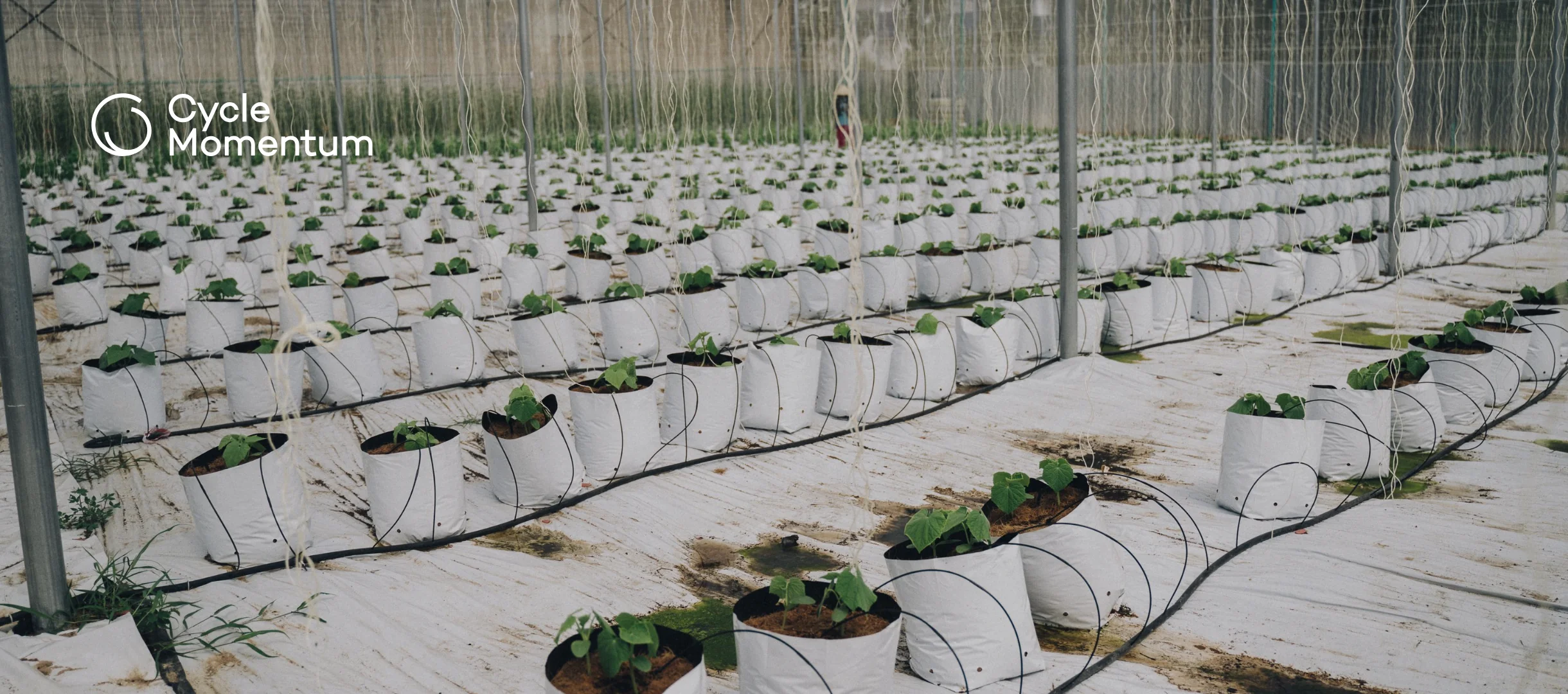
It is fertilization and irrigation in one step. Fertigation (fertilization + irrigation) is the newest way for nursery managers to apply fertilizer, according to a 2009 US Forest Service paper, and it has become standard practice in container nurseries. Field irrigation spreads water less evenly, so the method has not been widely used in bareroot nurseries.
In a greenhouse, nutrients and mineral salts are mixed into the irrigation water and delivered from above or from below. The paper splits any system into three parts: the concentration in the solution applied, the nutrients already in the water and the concentrated stock solution. Mixing those correctly is the dosing job. The authors also warn that excessive fertigation can damage crops and pollute the environment. Organic options exist too, such as a liquid fertilizer made from insect frass and other organic waste.
Why do greenhouses drain so much water?
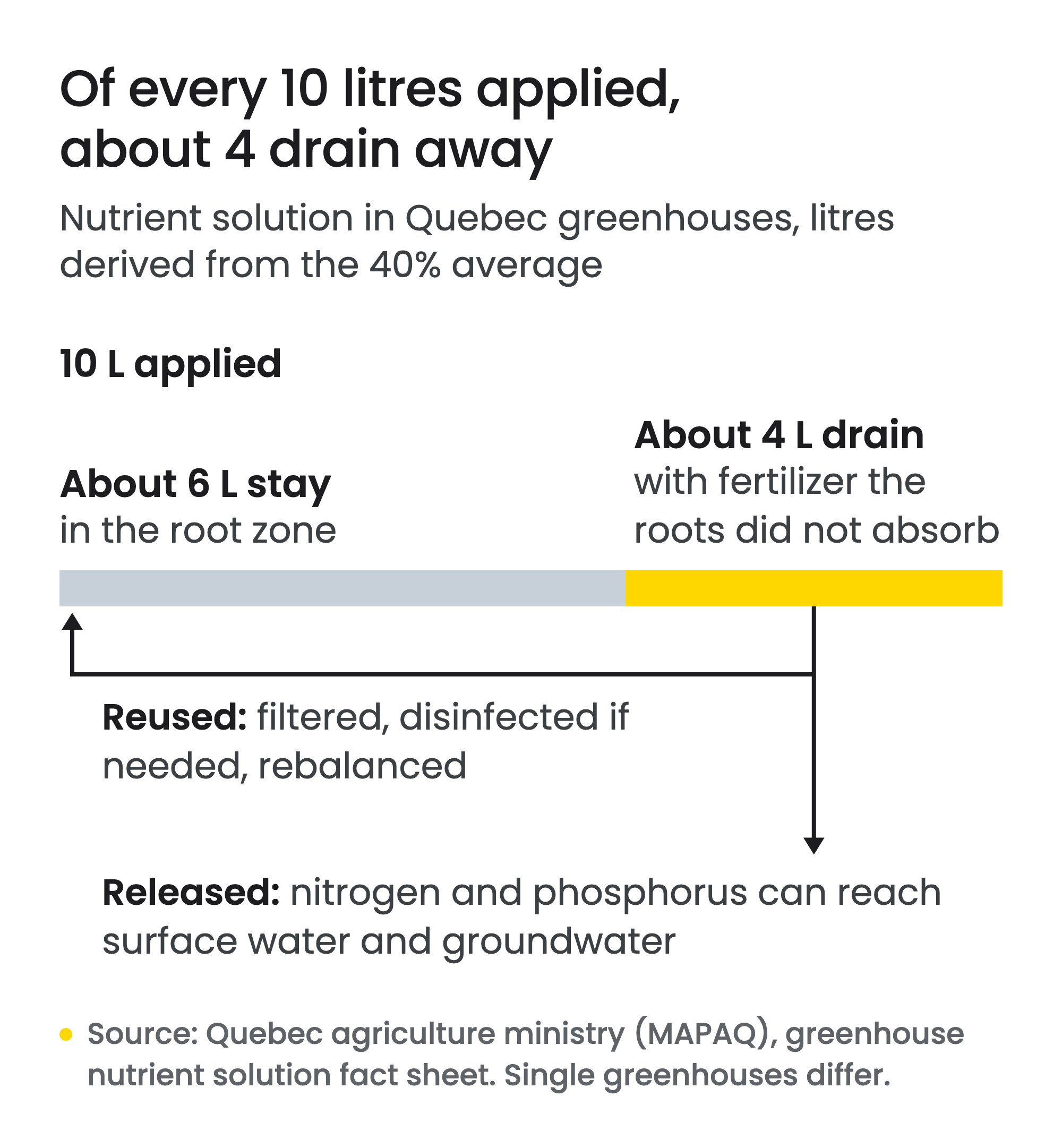
They do it on purpose. Draining keeps the right mineral content in the root zone and a good balance of air and water, according to a Quebec agriculture ministry fact sheet. The same sheet puts the leachate at 40% of the water applied, on average, and describes it as loaded with mineral elements, with organic matter and possibly plant pathogens.
Where it goes next is the environmental question. Leached fertilizer can seep under the greenhouse or run off around it, and flushing the irrigation system at the end of a crop adds more. Nitrogen and phosphorus are the main concern for surface water and groundwater. The ministry names eutrophication and contaminated drinking water sources as the chief risks, both avoidable by recovering and recycling the water.
Here is the 40% as a worked example, derived from the ministry’s average, so any single greenhouse will differ. Of every 10 litres of nutrient solution applied, about 4 litres drain away and about 6 stay in the root zone. The 4 litres leave with fertilizer the roots did not absorb. If the dose is mixed too strong, the excess goes into all 10 litres, the 4 that drain included.
How much harm can greenhouse drainage do?
Ontario has measured it. In 2010 and 2011, provincial staff sampled 32 greenhouse outfalls around Leamington and Kingsville. The results suggest that 65% of the greenhouses sampled had discharged high to extremely high levels of nitrate, phosphorus, potassium and copper. Sturgeon Creek, which receives greenhouse discharge, had 20 times the nitrate and 38 times the phosphorus found on average in comparable neighbouring watercourses. The data is more than a decade old.
Nationally, nitrogen fertilizer use has increased by 93% since 2005, according to Agriculture and Agri-Food Canada. The department is working with the sector toward a 30% cut in fertilizer emissions from 2020 levels by 2030. Those figures cover all of agriculture, not greenhouses alone.
What can a grower do with drain water?
Reuse it. With recirculation, the crop uses the same water and fertilizer as before, the ministry explains, but the share that would otherwise have drained is put back to work. Water withdrawals and fertilizer use can both drop a great deal. The catch is disease spread, which the sheet says is more of a problem in vegetable crops than in other horticulture. Filtering comes first, then disinfection when needed, using heat, UV light, slow sand filters or chemical oxidation.
A basic system collects the solution, stores it, filters it, disinfects it when required and mixes it with fresh water. The last step is to rebalance it to the crop’s needs. The sheet also recommends tracking the volume, pH and electrical conductivity of both feed and drain. Another Nexterre company, Sentinus, makes wireless stations that monitor fertigation from feed to drain.
How is GrowClean’s dosing station different?
GrowClean’s website describes a compact, modular system that creates custom liquid fertilizer recipes automatically: the grower keeps a few basic stocks, and the station blends what the crop needs. A 2024 National Research Council file describes a volumetric metering pump system for greenhouses designed to adjust recipes in real time for more precise farming and lower fertilizer discharges.
The 2026 file adds the engineering. The station uses several precision volumetric peristaltic pumps that can each run on their own but share one servomotor through a mechanical transmission. One motor does the work of several. That fits the company’s plan to cut costs through a design optimized for mass production. Its stated mission is to make automated precision agriculture accessible to as many producers as possible.
Who is behind GrowClean, and how far along is it?
GrowClean is small and led by engineers. Founder and CEO Mathieu Tanguay holds bachelor’s and master’s degrees in engineering and also serves as technical director. Its team page lists engineer Olivier Fortin as vice-president and François Yelle as technician. GrowClean Technology Corp. was incorporated federally in 2016, with its registered office in Longueuil.
Progress has come one prototype at a time. The National Research Council’s IRAP contributed $75,000 for a modular metering pump system in 2022-2023 and another $75,000 for a greenhouse prototype in 2024-2025. In 2026 it added $80,000 for a proof of concept meant for testing with the first potential customers. No customer or pilot site has been named yet, and the company invites growers to send details of their fertilization process.
A fertigation dosing station does not end drainage, which the crop needs. What it controls is the recipe in every litre, drained or not, and that can be measured. Feed and drain readings logged before and after the station goes in would show whether the recipe reaching the drip line matches its target. They would also show whether the same crop can be grown with less fertilizer leaving in the drain water.
Nexterre’s Phase 2 offers financial support for demonstrations like that. Zone Agtech leads Nexterre with Écotech Québec and Cycle Momentum, so this is a partner’s view, and the product claims are GrowClean’s. Our agtech startup accelerator is where we work with founders who build equipment for growers.