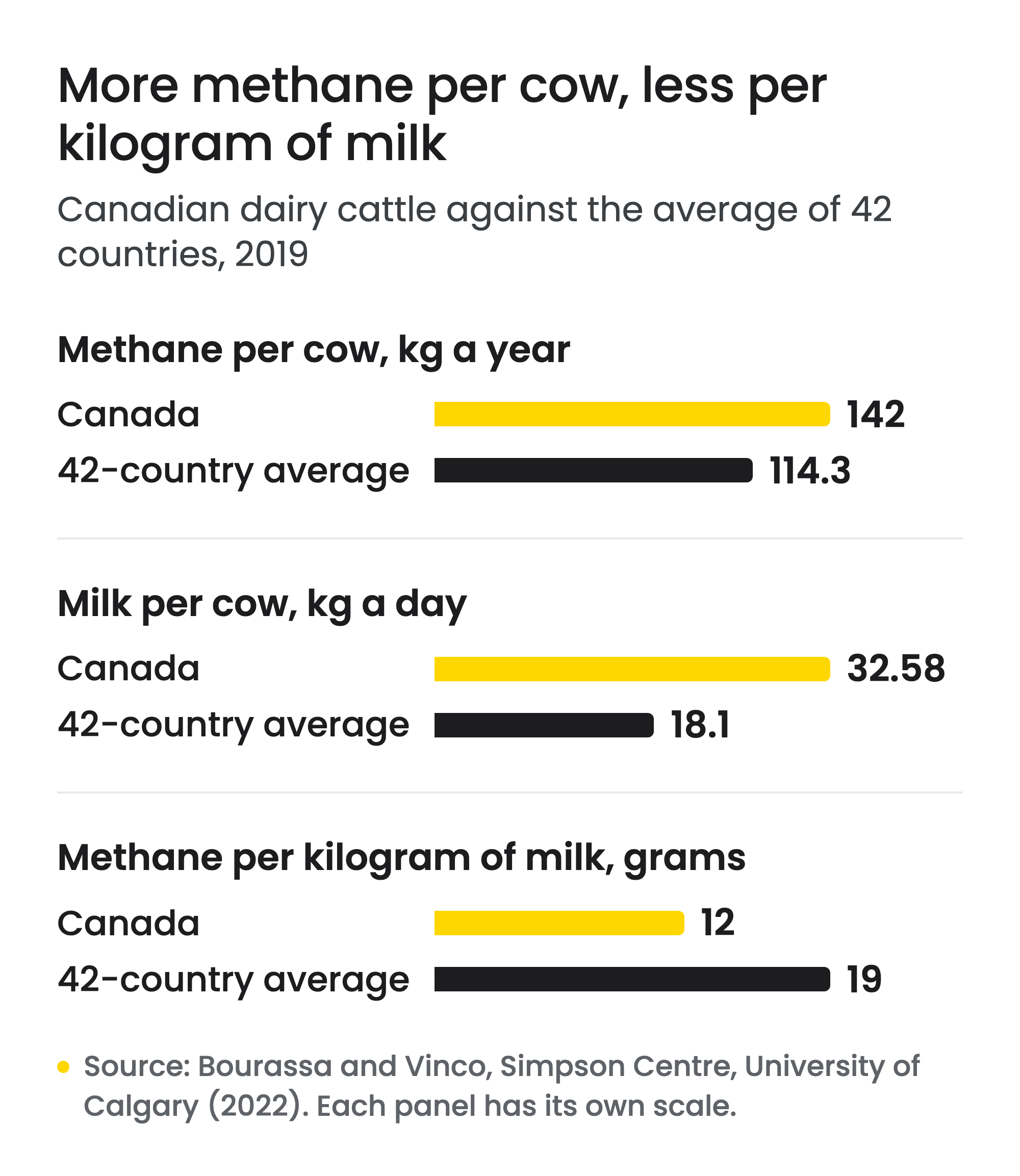
Counted per animal, Canadian dairy cattle emit more methane than most of their peers. Each head gave off about 142 kg in 2019, 25% more than the 114.3 kg average across the 42 countries compared in a 2022 University of Calgary review. Counted per kilogram of milk, the ranking flips: about 12 grams for Canada against 19 for the group, because each Canadian animal produces far more milk. Methane emissions from cows depend on both numbers, and on what the animals eat.
Mon Système Fourrager (My Forage Systems) builds software that follows a livestock farm’s forage from the field to the feed bunk. It is adding a module that estimates the farm’s greenhouse gas emissions, especially enteric methane from digestion. Since September, the company has been in Phase 1 of the Nexterre Program, where technologies are readied for field demonstrations.
At a glance
- Agriculture produces 30% of Canada’s methane, and 86% of that comes from enteric fermentation in ruminants such as cattle and sheep.
- Per head, Canadian dairy cattle emitted 25% more methane than the Annex I average in 2019. Per kilogram of milk, they emitted about 12 grams against 19.
- Better forage can lower methane: by a potential 8% when crude protein rises from 6.9% to 13.6%.
- Mon Système Fourrager centralizes field, harvest, silage and lab data, and is building an emissions module on Holos, the federal farm model.
Why do Canadian dairy cattle emit more methane per head?
They are bigger and they produce more. High milk productivity raises an animal’s energy needs, which raises enteric emissions, the working paper from the university’s Simpson Centre explains. Canadian dairy cattle averaged 32.58 kg of milk a day in 2019, against 18.1 kg for the Annex I group, the highest of any country reviewed. They also weighed about 659 kg, against 564 kg. The group is the Annex I parties to the UN climate convention.
Per head, Canada had the 9th highest emission factor in 2019, close to the United States at 147 kg and Germany at 139 kg. The paper also estimates an intensity measure: daily methane divided by daily milk. On that basis Canada ranked second lowest, at 12 grams of methane per kilogram of milk against a group average of 19. The gap is narrowing, though. Since 1990, the group’s intensity has fallen 31% and Canada’s 19%.
Where does Canada’s farm methane come from?
Mostly from digestion. Agriculture represents 30% of Canada’s total methane emissions, 86% of it from enteric fermentation, according to an Agriculture and Agri-Food Canada briefing note. The other 14% comes from manure, the subject of our profile of Solugen’s hog manure fertilizer. Cattle produce about 96% of Canada’s enteric emissions, the Simpson paper adds. In the beef sector, the cow-calf herd, which eats mostly high-fibre forage, produces up to 78% of cattle methane, a University of Manitoba factsheet estimates.
Does better forage reduce methane emissions from cows?
It does, within limits. Between 2% and 11% of the feed energy offered to cattle is lost as methane, according to the federally funded Manitoba factsheet. On low-quality hay, cattle can lose up to 1 in 10 bales worth of feed energy as methane. Feeding high-quality forage has the potential to cut methane by 8% when crude protein rises from 6.9% to 13.6%. The factsheet’s advice is to harvest at peak quality: legumes in early bloom, grasses in early heading.
Quebec research points the same way. Methane production is 25% lower when cows eat legume-based forages or legume and grass mixtures rather than mostly grass. Chaouki Benchaar, an AAFC research scientist in Lennoxville, reported that in Bovins du Québec in 2005. He also reported 30% lower methane losses on early-season pasture than late-season pasture, and with silage rations rather than dry hay. He traced the pasture and legume effects to more digestible carbohydrates.
Digestibility is the common thread, and farmers manage it. The Simpson paper links the low feed digestibility reported for Canadian non-dairy cattle, 63.7% against an Annex I average of 66.4%, to forage that is “likely” low quality. None of this makes a cow climate-neutral. It does mean the hayfield shows up in the barn’s methane.
Why do forage farms need better data?
Cutting methane emissions from cows through forage depends on knowing what was cut, when, and what the lab found in it. The Manitoba factsheet’s advice starts there: test forages for nutrient composition so rations can be formulated accurately. Quebec has 15,416 forage producers and 683,500 hectares of forage crops, by 2024 figures, second only to grains by area.
Digital tools have been slower to reach them. Statistics Canada found that 32% of forage farms used GPS technology in 2021, against 84% of field crop farms. Records kept in notebooks and lab PDFs are hard to compare from one season to the next, and hard to feed into an emissions estimate.
What does Mon Système Fourrager do?
The company calls its product an integrated management platform for the producer and their agronomist, covering the entire forage system. Fields can be drawn on a map or imported from La Financière agricole du Québec, lab results import automatically for Eurofins EnvironeX clients, and data can be pulled from PDF reports. A forage balance shows in real time how many days of feed the farm has left.
Its emissions module, still in development, integrates version 4.0 of Holos in what the company calls a probabilistic framework. Holos is AAFC’s free software that estimates greenhouse gas emissions and changes in soil carbon in Canadian farming systems, including enteric fermentation, the source of methane emissions from cows. It is built to test changes such as different livestock diets or perennial forages in a rotation. Soil carbon is slow to confirm in the field, as our look at soil organic matter in Quebec explains.
A producer plan costs $300 a year, next to a free tier. Rather than selling farm by farm, the company works mainly through forage labs and agronomists who already collect the data.
Founder Maxime Leduc describes himself as a beef cattle and sheep producer in the Laurentides. He says the idea came during his postdoctoral internship at Lactanet. The company has a few hundred users, mostly in Quebec, Farmtario reported in March 2026.
Most of its public funding is tied to methane. In July 2024 it was one of 13 semi-finalists in AAFC’s Agricultural Methane Reduction Challenge, and Impact Canada now lists it among the challenge’s five finalists, which receive funding to develop their solutions further. Federal records show $153,846 from the challenge in 2024 and $300,000 in 2025. The second grant went to “EcoSmart Forage: a decision support tool for methane mitigation and profitability.” In March 2026 the company joined Cohort 5 of the Cultivator agtech accelerator in Saskatchewan.
Linking Holos to records a farm already keeps is the claim to test. A convincing result would show the methane estimate moving when the forage does, after an earlier cut or a switch to more legumes, without anyone retyping lab results. It would also show its margin of error. National emission factors carry uncertainties of plus or minus 6% to 50%, the Simpson paper notes, so a farm-level estimate needs a range narrow enough to act on.
The company has not said what it will develop during Nexterre. Cycle Momentum works on Nexterre alongside Zone Agtech and Écotech Québec, and readers should weigh that interest. Data-driven farm management is one of the fields our agtech startup accelerator works in.