A fog net is a sheet of fine plastic mesh, often 10 metres wide and 4 metres tall, strung between two posts across the wind on high ground where fog is frequent. Droplets catch on the fibres, merge and run down into a gutter, then a tank, with no pump or power. Where fog is reliable, operational projects typically average 3 to 10 litres of water per square metre of mesh a day.
Permalution, a Quebec company led by founder and CEO Tatiana Estevez, builds fog and cloud water collectors. It also maps and measures fog to choose sites, and lists agriculture among its applications. The Nexterre Program admitted it in September to its maturation stage, alongside 11 other companies.
In brief
- Operational projects typically average 3 to 10 litres per square metre of mesh a day. The sites in this article run from 1.9 on a Moroccan coast to 30 in Oman’s short monsoon.
- The main problems in fog projects are upkeep ones: slack cables, poor-quality cables and badly installed mesh.
- In Chile, fog water already irrigates crops through gutters, storage ponds and hoses.
- Permalution sells 20 m² and 100 m² collectors plus fog mapping and on-site measurement. We found no published fog collection data for Quebec.
How does a fog net work?
Fog is a cloud that touches the ground, made of droplets 1 to 40 microns across. Hung vertically toward the fog-laden wind, a fog net intercepts them, and they coalesce and fall into a gutter. Fog harvesting is a passive, low-cost, and low-maintenance approach to obtain fresh water, according to a 2025 study in Frontiers in Environmental Science.
The catch depends on the fog’s water content, the size of its droplets, the mesh and the wind speed. That list comes from a 2012 review of projects worldwide in the journal Ambio. Height helps. Winds are stronger higher up, and the fog there often holds more water.
Where does fog harvesting work?
It works where fog arrives often and fresh water is scarce. Collection rates vary dramatically from site to site, the Ambio review found, but yearly averages of 3 to 10 litres per square metre a day are typical of operational projects. In Tojquia, in Guatemala’s western highlands, 35 collectors averaged 6,300 litres a day through the dry season. That came from 1,400 m² of mesh, or 4.5 litres per square metre.
Location matters within one region too. In a two-year Moroccan pilot, an inland site in the Anti-Atlas mountains, 30 km from the coast and 1,225 metres up, collected more than 7 litres per square metre a day. Season matters too. An experiment in Oman’s mountains averaged 30 litres per square metre a day during the monsoon, but the fog came for only about two months a year.
Farms already use the water. In Chile’s Peña Blanca farming community, it runs off the mesh into gutters, then to storage ponds, and through hoses to irrigation areas, the FAO reports. The Cerro Grande Ecological Reserve there has 34 fog catchers with 306 m² of mesh, able to collect up to 650,000 litres a year, mostly in spring. Spread over a year, that is up to about 5.8 litres per square metre a day, by our calculation.
Where does fog harvesting fall short?
It can fall short at the wrong site. The Moroccan pilot’s coastal site, 4 km from the sea, collected only 1.9 litres per square metre a day. Around Alto Hospicio, a city in Chile’s Atacama Desert, the 2025 Frontiers study modelled potential yields of 0.2 to 4.9 litres, and up to 10 in the best areas. The study’s own collectors in the city recorded rates so low that the model was calibrated on a fog oasis 65 km south.
The authors conclude that fog water is most suitable as a complementary supply. Output also swings from day to day. Chile’s El Tofo array averaged 15,000 litres a day, yet some days it produced over 100,000 litres and others little or none.
Upkeep is the weak point the Ambio review names: slack cables, poor-quality cables and mesh badly installed from the start. El Tofo once supplied about 100 families through taps in their homes, until maintenance stopped amid village politics and demands for a pipeline and a desalination plant.
Wind is the other engineering problem. The 1,627 m² facility begun in 2017 on Mount Boutmezguida, the inland Moroccan site, needed strong foundations to withstand gusty winds of up to 120 km/h, the Munich Re Foundation reports.
What does Permalution build?
Permalution sells two collector sizes. By the company’s figures, its 20 m² Premium Fog Collector averages 150 to 400 litres a day, and its 100 m² Industrial Fog Collector 750 to 2,000. Both work out to 7.5 to 20 litres per square metre a day, by our calculation. That runs from the upper part of the typical range to twice its top. The product page does not say what kind of site those averages come from.
Its site service is meant to answer that. A Fog Atlas maps fog hotspots in a region. Then Water Radars gather data at the chosen spot to estimate yields, cost-benefit and cost per litre. The Ambio authors ask for similar discipline: a 1 m² standard fog collector run on site for at least 12 months. Sponsors in a hurry, they note, sometimes measure only through the dry season.
For farms, Permalution says it partners with the top providers of pumps and drip irrigation systems. Its most detailed case is in Mexico’s Sierra de San Juan protected area, where it has tested collectors since 2019. A greenhouse irrigated with fog water there helped propagate endangered orchids, and 42 were reestablished in their natural ecosystem, the company reports.
Estevez traces the idea to 2015, when she was backpacking in California during a drought. In 2022 the company won the Best Woman in Tech Investment prize at Startup Fest, which it says allowed it to set up a manufacturing plant in Quebec.
Could fog nets water Quebec farms?
Quebec farms do need new water in some years. Agriculture and Agri-Food Canada’s drought monitor groups Ontario and Quebec as its Central Region. By the end of September 2025, 97% of the farmland in that region was abnormally dry or in drought. In August, southeastern Quebec around Sherbrooke was among the driest areas, at less than 40% of normal precipitation.
Whether fog nets can help here is an open question. Documented projects cluster in arid and semi-arid climates where fresh water is scarce, and we found no published fog collection measurements for Quebec. The idea is untested here, not disproven. Some local growers catch water from the sky in a simpler form: Serres Toundra says it irrigates its cucumber greenhouses with collected rainwater.
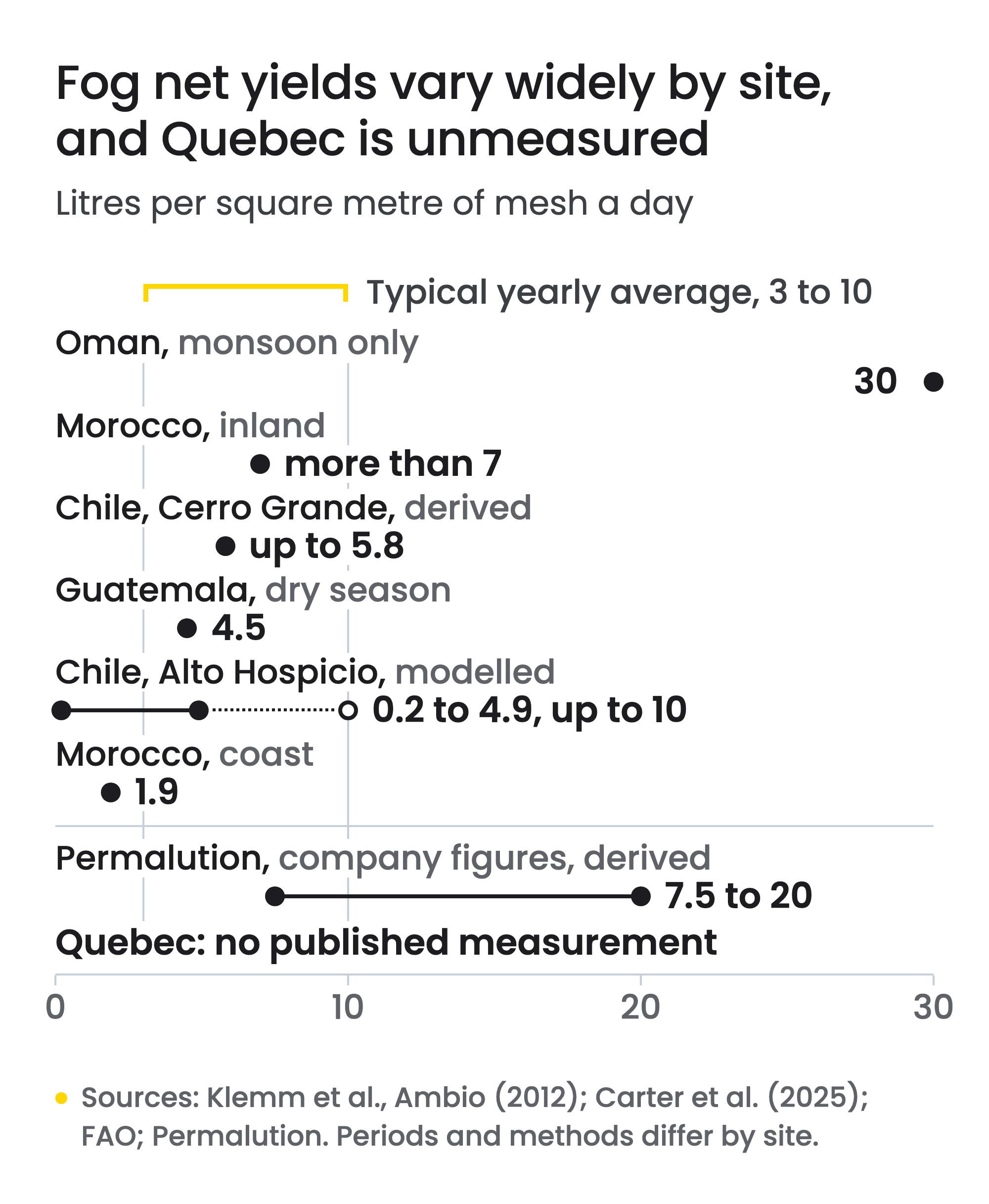
A measurement campaign would settle it. The test is a full year of standard fog collector readings at a Quebec farm site, in litres per square metre per day. Wind and humidity belong in the same log, much as a field weather station tracks a farm’s own microclimate. Growing-season results inside the 3-to-10 band would justify the first fog net on a Quebec farm. A few foggy autumn mornings would not.
Permalution has not published what it will test in Nexterre. This profile is written from inside the program: Cycle Momentum is one of Zone Agtech’s two partners in Nexterre, with Écotech Québec. Water security is one of the areas our climate tech startup accelerator works on.