A Quebec farmer who changes a rotation this year may not see the result in a soil test for five to ten years. That is how long better practices can take to show up in lab analyses, according to a soil-health adviser at the province’s agriculture ministry. Meanwhile, soil organic matter has been falling across the province.
Satellite data is one route researchers are testing to estimate soil carbon across whole regions. SpectrAI applies artificial intelligence to spectral and visual data, according to the Nexterre announcement. It was selected for the Nexterre Program in September, in the program’s maturation phase. The web address spectrai.ca now leads to a company that estimates soil carbon from satellite and field data.
At a glance
- Better practices can take five to ten years to show up in soil analyses, which Quebec requires every five years per field.
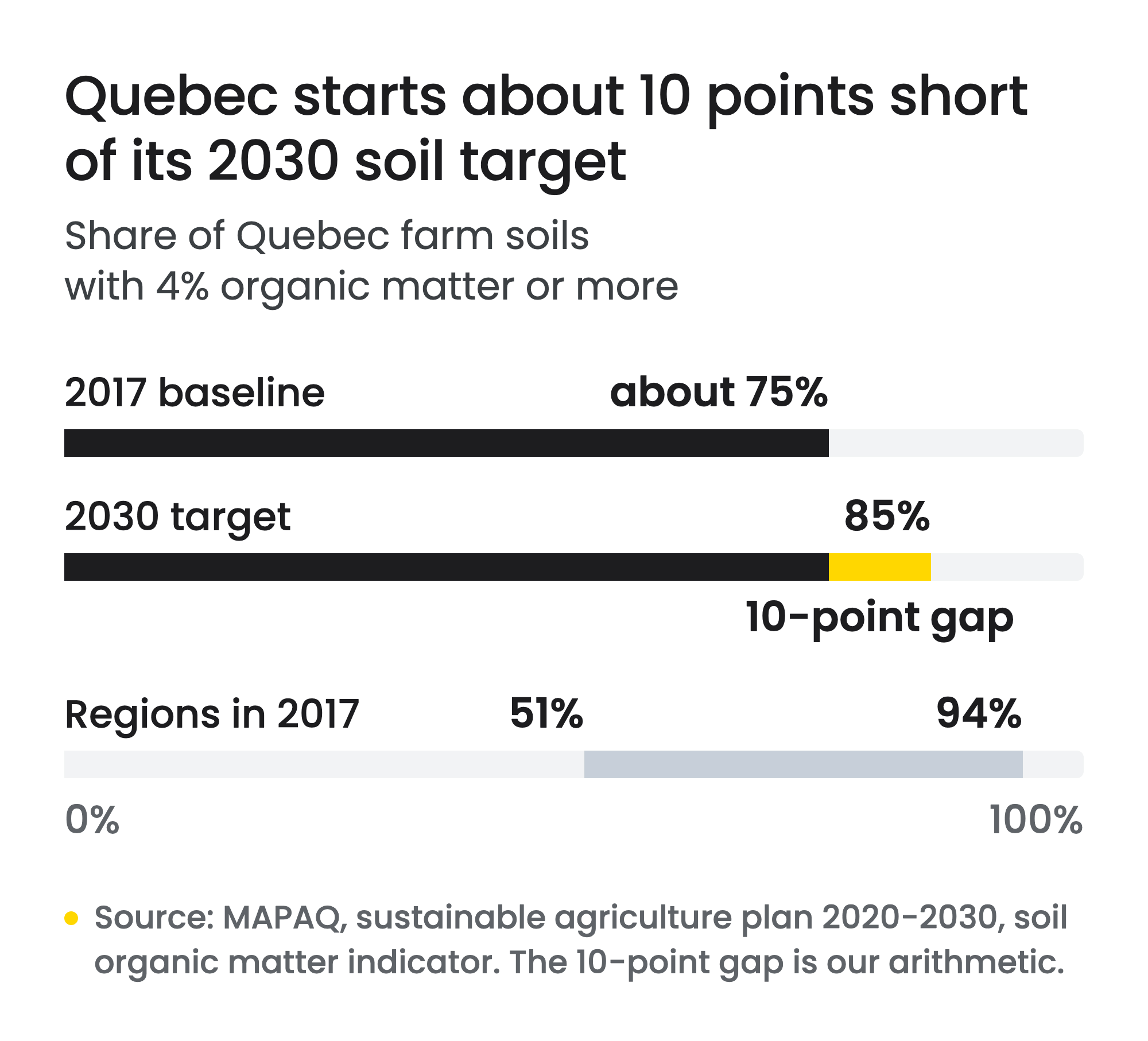
- About 75% of Quebec farm soils had at least 4% organic matter in 2017. The 2030 target is 85%.
- A Saskatchewan satellite model reached an R2 of 0.71 for soil organic carbon, but 0.27 for carbon stocks.
- The address spectrai.ca now redirects to Sidralys, a soil-carbon company. No public source confirms that SpectrAI and Sidralys are the same company.
What does soil organic matter do?
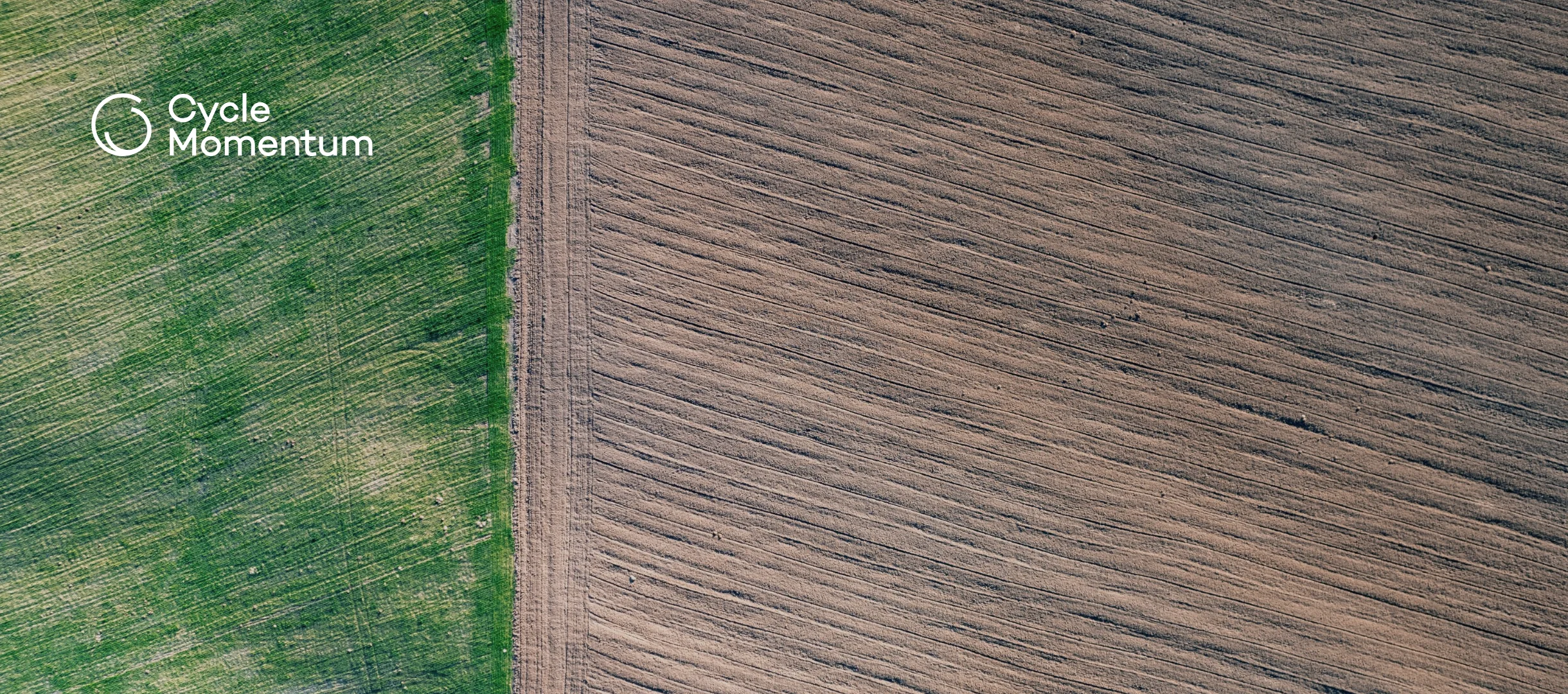
It holds soil together. Soil organic matter is critical to soil health and fertility, according to Agriculture and Agri-Food Canada (AAFC). Along with plant roots, it binds soil particles, which steadies the structure, limits erosion and helps the soil store and move air, water and nutrients. It also acts as a sink for carbon dioxide drawn from the atmosphere. Losing it can mean weaker structure, more erosion and lower fertility.
Organic matter is made up mainly of carbon, between 50% and 60% of its dry mass, according to a March 2026 article by Marie-Eve Bernard, an agronomist at Quebec’s agriculture ministry (MAPAQ). It is the main source of energy for soil organisms, and it is central to drainage and to the nitrogen, phosphorus and sulphur cycles.
Why are Quebec’s farm soils losing it?
Start with the hayfields. Quebec’s hay and pasture area shrank by nearly 39% between 2006 and 2020, according to Statistics Canada figures cited by MAPAQ. Over the same period, grain corn, silage corn and soybean areas grew sharply, and soil organic matter fell almost everywhere in the province.
Roots explain much of the link, the ministry’s article says. Root carbon is four to five times more likely to become stable organic matter than crop residue left on the surface. Up to 45% of it can convert, against about 15% to 20% for cover crop shoots and manure, and 8% to 12% for straw. Cover crops help because they keep living roots in a field for longer. Hay and pasture are also forage crops, and another Nexterre company builds forage-tracking software for livestock farms.
The losses are uneven. Soil organic matter decline would affect nearly half of the cropland in Quebec’s South region, according to a July 2026 report by IRDA, the province’s agri-environmental research institute. That is about 468,000 hectares across the Montreal plain and Centre-du-Québec. The report puts the share at 22% in the Centre region and 20% in the East, and presents them as estimates.
Quebec has set a target. Its sustainable agriculture plan aims for 85% of farm soils at 4% organic matter or more by 2030. At the 2017 baseline, close to 75% of soils were above 4%, after 15 years of decline in that share. Regional starting points ranged from 51% to 94%, depending on the type of farming in each region. By our arithmetic, that left about 10 percentage points to gain province-wide.
Why do soil tests show progress so slowly?
They depend on lab samples taken years apart. Chemical soil analyses in Quebec are regulated by the environment ministry and must be done every five years in every cultivated field. The provincial indicator was built from those results: ministry databases covering 2000 to 2017 and just over 80% of the province’s soil analyses.
Soil organic matter also builds slowly, at a rate that depends on soil type, rotations, tillage intensity and climate, among other factors, Bernard writes. Structure and water infiltration can improve within a few years, but the organic matter figure lags. For a practice adopted in 2026, a clear result may not reach soil tests until 2031 to 2036 (our arithmetic), after the 2030 target date. Until then, the lab report cannot confirm what works.
How well can satellites estimate soil carbon?
They do reasonably well over large areas, with weaker results for topsoil and carbon stocks. A University of Saskatchewan team trained models across that province on historical soil data combined with satellite imagery, climate data and terrain. For soil organic carbon across all horizons, the model reached an R2 of 0.71 with an error of 0.61 percentage points, where an R2 of 1 would be a perfect match. The authors call that reasonable next to similar studies.
Accuracy fell for the topsoil horizon, to an R2 of 0.49, and to 0.27 for whole-profile carbon stocks. The historical sample points also carried a location uncertainty of about 300 metres. Crop residue adds a third problem. When it covers more than 20% of a pixel, direct estimation becomes difficult. Residue-free pixels are now rare in Saskatchewan because conservation tillage is so widespread.
That limit may matter in Quebec too, where, along with Ontario, AAFC reports the highest carbon gains from conservation tillage. The practice that helps soils hold carbon also covers the bare ground a satellite needs to see. Lab samples remain the reference for checking any model.
What is known about SpectrAI?
Very little has been published. The only federal corporation by that name, SpectrAI Inc., is registered in Montreal. An archived March 2025 copy of the spectrai.ca website shows the SpectrAI name and the tagline “Remote Vision for a Brighter Horizon”. SpectrAI Inc. also received a federal CanExport Innovation grant for 2025-2026, to seek research partnerships abroad.
The address spectrai.ca now redirects to Sidralys, which describes itself as merging remote sensing with artificial intelligence to empower farmers, verify carbon sequestration and drive regenerative agriculture. We found no public source confirming that SpectrAI and Sidralys are the same company. What follows describes the Sidralys product, not a verified SpectrAI one.
Physical sampling campaigns are slow, labour-intensive and cost-prohibitive, according to Sidralys. Its SoilSat AI combines georeferenced field measurements with multi-source satellite and geospatial data to estimate soil organic carbon. Its one validation example comes from a field in Ontario. Performance can vary with climate, soil, crop systems, sampling density and regional calibration data, the company adds, the same dependence the Saskatchewan study shows. Neither website names a team or customers.
Nexterre has not published the scope of SpectrAI’s project. Phase 1 is a maturation stage, and the companies moving on to supported field demonstrations will be announced in December. Other companies in the cohort analyse images too, such as CropMind with its orchard cameras that count buds and flag disease.
For a satellite model, the convincing result would come from Quebec fields. A fair test would predict soil organic matter where recent lab results exist, check it against samples the model never saw, and report the error for topsoil and carbon stocks. Quebec’s own lab record is the natural benchmark. A note on our position: Cycle Momentum is a Nexterre partner, and the product descriptions here are the companies’ own. Startups that measure soil and carbon fit the scope of our climate tech startup accelerator.