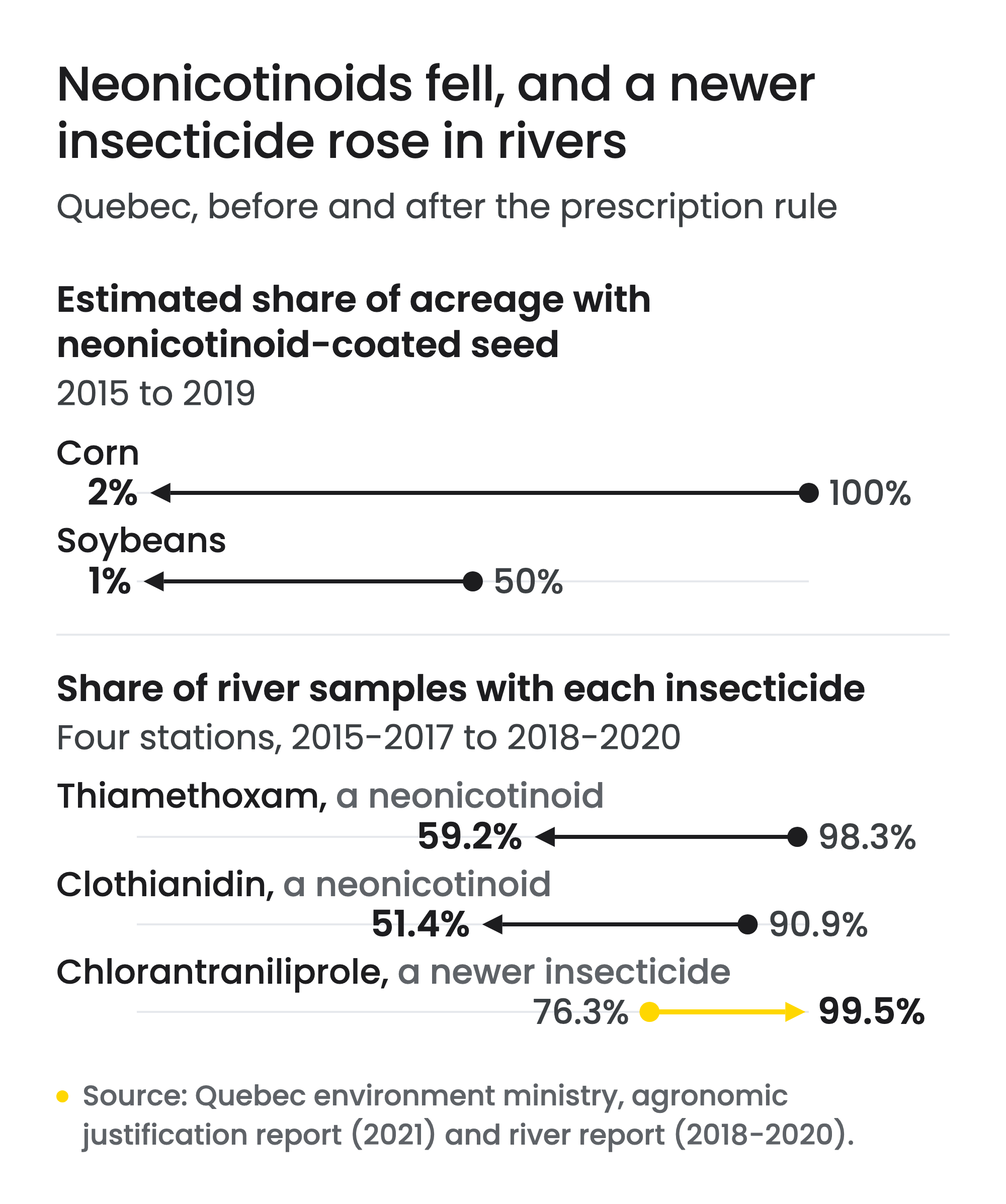
In 2015, an estimated 100% of Quebec’s corn acreage was sown with seed coated in a neonicotinoid insecticide. By 2019 the share was 2%, and soybeans had gone from 50% to 1%. The drop followed a provincial rule that requires an agronomist’s prescription for the riskiest pesticides, coated seed included. That history matters for any new seed treatment. In Quebec field trials, the default coating was rarely useful.
Bleiz, a Saint-Hyacinthe company, is working on a treatment with no chemical coating. Its device exposes seeds to controlled electrical energy, which the company says can improve germination and plant performance and reduce chemical inputs. The device is now in the Nexterre Program, which Bleiz entered in September at the maturation stage.
Key takeaways
- Neonicotinoid-coated seed fell from an estimated 100% of Quebec corn acreage in 2015 to 2% in 2019, once an agronomist’s prescription became mandatory.
- In 84 Quebec fields from 2012 to 2016, treated and untreated corn and soybeans showed no significant difference in yield.
- Two neonicotinoids turned up in far fewer river samples after the rule, but chlorantraniliprole, a newer seed-treatment insecticide, was found in 99.5% of them.
- Lab studies of electric-field and plasma treatments report germination gains of about 10%, and neither tested insect control.
- Bleiz treats seed with electrical energy instead of a chemical, and has not published IonMetrik trial results.

What is a seed treatment?
Seed treatments are substances or specific techniques that are applied to the seeds or seedlings before they are planted, according to Canadian Food Focus, a site about food and farming. Farmers use them against specific diseases and pests and to help a healthy crop establish. Most are fungicides, insecticides or antimicrobial products. Corn and soybean seed usually carries both an insecticide and a fungicide, Quebec’s environment ministry notes.
What did Quebec change?
The rule arrived in steps. Quebec amended its Pesticides Management Code in February 2018 and phased in the new requirements from March. Five products became off-limits on farms unless an agronomist recommends them: the herbicide atrazine, the insecticide chlorpyrifos and three neonicotinoids, clothianidin, thiamethoxam and imidacloprid. Seed of eight crops coated with them is covered too, corn and soybeans included. From 2019, every product on the list needed a prescription.
Help came with the rule. Quebec’s agriculture ministry funds 85% of integrated pest management advisory services and publishes a yearly list of corn hybrids not treated with insecticides. The environment ministry calls Quebec the only province with such a requirement. By its 2021 estimate, coated seed fell to 2% of corn acreage and 1% of soybean acreage in 2019, from 100% and 50% in 2015. The new process may have contributed, the ministry says.
Did Quebec fields need treated seed?
Rarely, according to a 2020 study in PLoS ONE. At the time, its authors write, coated seed went on more than 500,000 hectares of Quebec cropland each year. Their trials ran from 2012 to 2016 in 84 fields across seven regions, all on commercial farms. Pest pressure was low. In 92.6% of corn fields and 69% of soybean fields, bait traps caught less than one wireworm each.
Yields did not move either. Treated and untreated crops showed no significant difference in plant stand or yield. The authors concluded that neonicotinoid seed treatments in field crops in Quebec are useful in less than 5% of cases. They should not be used preventively, the study adds. Treating only where scouting shows a real threat is the same principle behind monitoring-based spray decisions in apple orchards.
What happened in the rivers?
The environment ministry’s 2018-2020 river report for corn and soybean areas was its first since the rule took effect. At four long-term stations, thiamethoxam turned up in 59.2% of samples and clothianidin in 51.4%. In 2015-2017 the shares were 98.3% and 90.9%. Concentrations of both fell in all four rivers. The rule probably explains part of the drop, the ministry says, and dry early seasons may also have kept pesticides in the fields.
Those gains are still fragile, the report warns. Depending on the river, 54% to 99% of samples exceeded a criterion for protecting aquatic life, and neonicotinoids caused most of those exceedances. Meanwhile chlorantraniliprole, a newer insecticide registered for corn seed treatment, rose from 76.3% to 99.5% of samples. The ministry ties it to growers replacing neonicotinoid coatings. It warns against trading one problem for another. Quebec has since closed that gap: from August 1, 2025, an agronomist’s prescription is required for seed of eight crops coated with any insecticide, a MAPAQ field crops bulletin notes.
Health Canada began receiving large numbers of bee incident reports in 2012, and many were linked to dust generated during planting of neonicotinoid-treated corn and soybean seed. In February 2026, new water monitoring data led Health Canada to widen its clothianidin review to aquatic risks.
What do electric and plasma seed treatments do?
They act on the seed itself, and the evidence so far comes from laboratories. In a 2025 Scientific Reports study, maize seeds spent three minutes in a high-voltage electrostatic field before germinating under chilling stress. At 1.6 kV/cm, germination potential, rate and index rose by 11.7%, 11.2% and 10.5%, and the vigour index by 31.7%. Past the best setting, stronger fields gave smaller gains, so dose matters.
Plasma has been tested in Canada too. University of Alberta researchers found that plasma-activated water improved seed germination by 10 to 13 per cent, and that plasma cut two grain toxins by 54 per cent. Their target was barley steeping for malting, not planting. Neither study measured insect control. These methods are not a like-for-like replacement for an insecticide coating. In greenhouses, another Nexterre company makes UV-C equipment against botrytis grey mould.
What is Bleiz building?
Bleiz describes IonMetrik as a seed treatment technology that uses controlled electrical energy to improve plant performance. Its stated aims are higher germination rates, better farm profitability and less use of chemical inputs. The company says its electric fields influence the seeds’ gene expression, a claim it has not backed with published data. A companion platform, IonGenik, analyses the data the device produces.
Plasma shows up in Bleiz’s story too. In a November 2025 Radio-Canada segment, partner and general manager Mathieu Pellerin described using low-temperature electrified plasma, notably to disinfect seeds before storage. Disinfecting seed is closer to the work of a fungicide or antimicrobial product than to insect control. Founded in 2021 in the Eastern Townships and now based in Saint-Hyacinthe, the company had just received a $75,000 Quebec grant to treat seeds with electricity.
In March 2025, Bleiz opened a trial program for growers and researchers. It offers equipment loans, pre-treated inputs, monthly rental and expert advice. No results from those trials have been published.
What trial would convince growers?
The Quebec field study already shows the format. Each site was sown with alternating strips of treated and untreated seed, repeated three times, on plots 200 to 300 metres long. A Bleiz trial built the same way would add a strip of conventionally treated seed and track emergence, plant stand and yield over more than one season. If the company claims any effect on pests, wireworm counts belong in it too. Growers who dropped the coating would want results that hold across farms and years.
Nexterre’s second phase funds demonstrations of that kind, and nine of the twelve Phase 1 companies will be named to it in December 2026. Cycle Momentum is one of the program’s partners, so this profile is not written from the sidelines, and the IonMetrik claims are Bleiz’s own. Startups replacing chemical farm inputs are the companies our agtech startup accelerator is built to work with.