January at Roberval, on Lac-Saint-Jean, averages -15.7 °C and brings nearly half a metre of snow, according to federal climate normals. Up the road in Saint-Félicien, Serres Toundra picks cucumbers year-round, seven days a week. The Quebec government calls it the province’s largest producer of greenhouse cucumbers, and it is now building a fourth greenhouse.
The company was selected in September for Phase 1 of the Nexterre Program, which Zone Agtech leads to develop and demonstrate clean agricultural technologies. It is the only grower among the 15 companies chosen. The other 14 develop technologies. Nexterre describes it as relying on controlled growing conditions to support local production and reduce dependence on imports.
In brief
- Serres Toundra grows mainly English, mini and Nordic cucumbers in Saint-Félicien and reports 28 hectares of production area and 225 people.
- On federal climate normals, a Lac-Saint-Jean greenhouse faces about 1.6 times the heating demand of one in southern Ontario, by our arithmetic.
- The company irrigates with rainwater and heats part of its greenhouses with hot water from a nearby plant, but it publishes no water or energy figures.
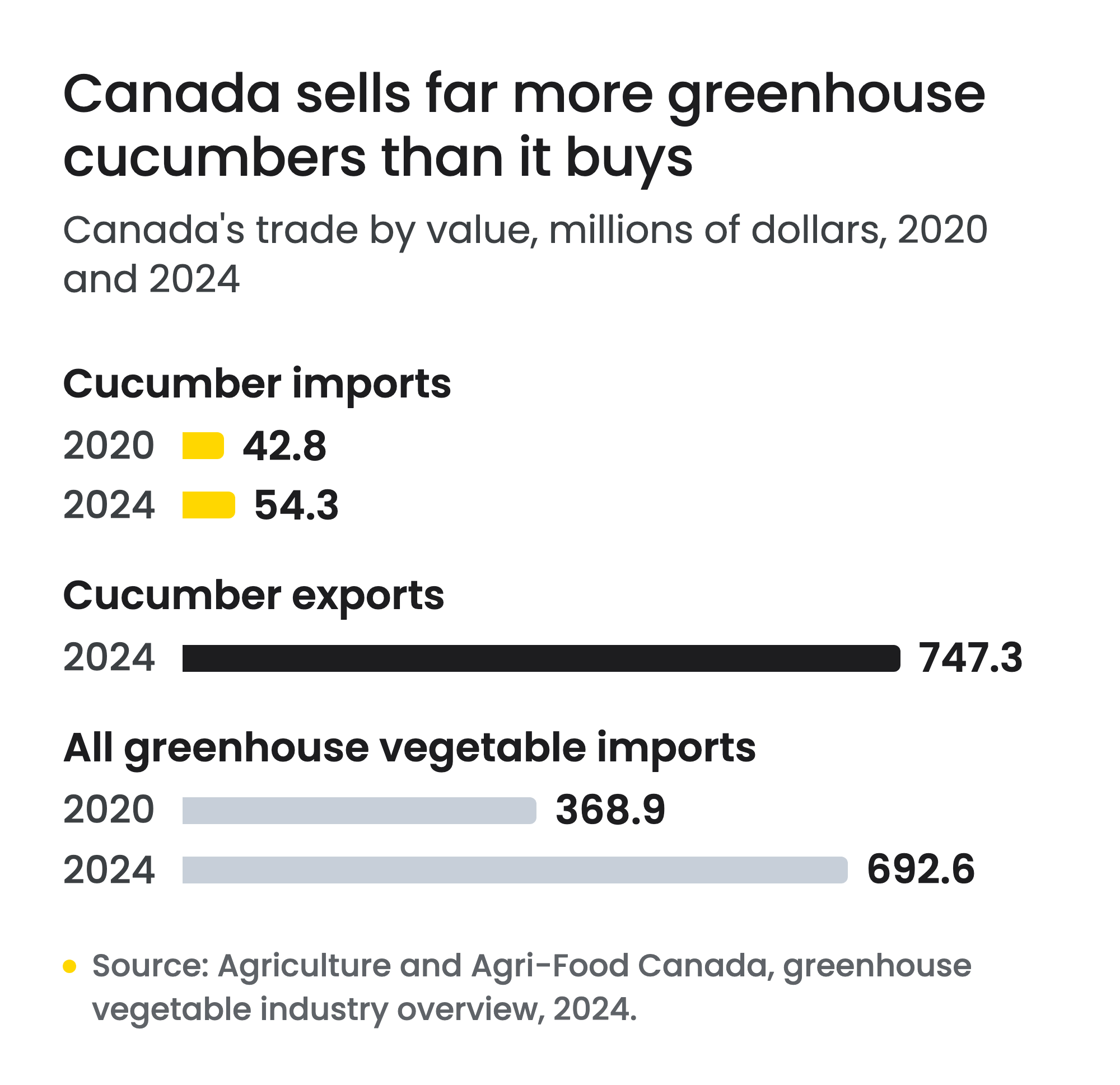
- Canada’s greenhouse cucumber exports reached $747.3 million in 2024, against $54.3 million of imports, even as its greenhouse vegetable imports nearly doubled from 2020.
- A fourth greenhouse, 8.5 hectares of cucumbers costing $76 million, received a $10 million Quebec loan in July 2026.
What does a Lac-Saint-Jean winter mean for a greenhouse?
Mostly, it means heat. The same normals give Roberval 5,619 heating degree-days a year, which add up how far each day’s average falls below 18 °C. At Harrow, in southern Ontario, the figure is 3,425. Ontario grows 72% of Canada’s greenhouse vegetables. On that measure, a greenhouse on Lac-Saint-Jean faces about 1.6 times the heating demand of one in that part of Ontario, by our arithmetic.
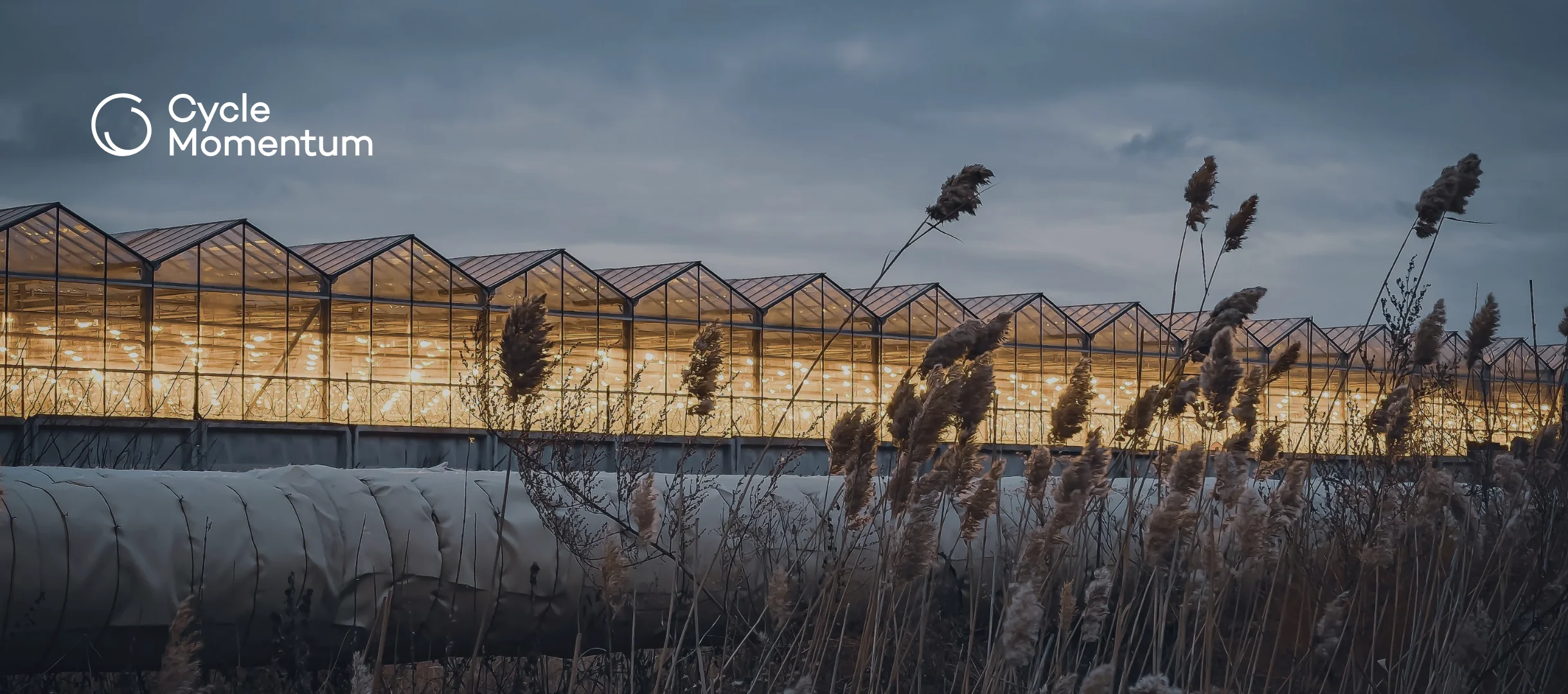
Serres Toundra says it covers part of that load with recovered heat. It takes hot water from a nearby plant to heat some of its greenhouses, which it says reduces its CO2 emissions. The company does not name the plant. A Domtar economic profile of the region, using 2022 data, places the greenhouses very close to its Saint-Félicien pulp mill and says Resolute held a 49% stake in them as a joint venture.
The greenhouses also run on artificial light. DLI, the Dutch company that supplied the fixtures, reports that in 2026 Serres Toundra replaced its high-pressure sodium lamps with energy-efficient LED fixtures. Water is the easier part. The company says it uses no drinking water on its crops, which are irrigated from an outdoor basin that collects rainwater. In a hydroponic greenhouse that water also carries the fertilizer, a practice called fertigation, which our profile of GrowClean’s fertilizer dosing station explains.
None of these practices comes with published figures. Serres Toundra has not released water, energy or emissions data, so they show the direction it has chosen rather than proven savings. Packaging and waste follow the same pattern. The company says it was among the first to swap styrofoam trays for recycled cardboard on its mini cucumbers. Cucumbers that cannot be sold fresh become relish, spreads and salsas, it adds.
How did Serres Toundra grow?
The company dates itself to 2016 and is led by Éric Dubé, its president and CEO. Its team spent close to six months in the Netherlands before building its complex, according to its website. The milestones so far:
- 2015-2016: Canada Economic Development for Quebec Regions commits a $4 million repayable contribution to a hydroponic complex designed to grow cucumbers year-round, a first phase worth more than $38 million.
- October 2016: the first cucumbers are picked from a first greenhouse module of 85,000 square metres, according to Zone Boréale, a regional business network.
- 2020: the Mercure award for company of the year in the SME category at the Mercuriades business awards.
- 2026: 28 hectares of production area and 225 people, by the company’s count, with cucumbers sold across Quebec and in some regions of Ontario and New Brunswick.
- July 2026: a $10 million Quebec loan toward phase 4, a greenhouse for cucumbers only.
Does Canada depend on imported greenhouse cucumbers?
It depends on them less than the headline numbers suggest. Canada’s greenhouse vegetable imports rose every year, according to AAFC’s 2024 statistical overview of the sector. They went from $368.9 million in 2020 to $397.6 million, $428.3 million and $554.7 million, then reached $692.6 million in 2024. That is an 88% increase in four years, by our arithmetic. Mexico supplied 85.6% of the 2024 value.
Peppers and tomatoes accounted for most of it, with 47.9% and 42.7% of 2024 imports. Cucumbers made up 7.8%, or $54.3 million, against $42.8 million in 2020, and in tonnes they were lower in 2024 than in 2020. Canada sells far more than it buys here: its greenhouse cucumber exports reached $747.3 million in 2024.
What is Serres Toundra building next?
It is building its fourth greenhouse. In July 2026 the Quebec government announced a $10 million loan toward an 8.5-hectare greenhouse that will cost $76 million and grow only cucumbers. The loan comes from the ESSOR program, administered by Investissement Québec. According to Quebec’s July 2026 announcement, the project will raise total production, meet growing local demand and bring economies of scale. Dubé tied it to demand for both fresh cucumbers and the company’s relish.
Quebec frames the project as food self-sufficiency. The province’s greenhouse vegetables were worth $280.6 million at the farm gate in 2024, up from $157.3 million in 2020, according to AAFC. Agriculture minister Donald Martel said government support since 2018 has helped double Quebec’s year-round greenhouse fruit and vegetable production. Projects like this one reduce dependence on imports, especially in winter, he added.
A new greenhouse is also when a grower settles its heating, lighting and climate control systems for years to come. Nexterre has not published what Serres Toundra will develop or test in the program.
For Quebec shoppers, local winter supply shortens the route a January cucumber takes, from Saint-Félicien to the store with no border to cross. Its footprint is the open question, because a greenhouse here needs more heat than one in southern Ontario. The result that would settle it is a published one: energy and water per kilogram in phase 4, and the share of heat recovered from the nearby plant.
Zone Agtech runs Nexterre with two partners, Écotech Québec and Cycle Momentum. This profile is therefore not an independent assessment, and the environmental practices above are as the company describes them. Our food tech startup accelerator works with companies that change how food reaches Quebec tables, winter included.