In Quebec, the fungicides used against grey mould are losing ground. In a provincial survey published in April 2026, 67% to 88% of the Botrytis cinerea strains tested in four fruit crops resisted at least one of the fungicide groups it targeted. Botrytis is the fungus behind grey mould, and it also attacks greenhouse tomatoes, peppers and lettuce when the air turns cool and humid.
ADSOL (Advanced Solutions), a Quebec company specializing in LED lighting and photonics, offers growers a different tool. One of its UV-C lamps, it says, destroys botrytis without chemical residue. It is one of 12 companies in the maturation phase of the Nexterre Program, announced in September.
In brief
- Grey mould thrives in cool, wet greenhouses, and its spores can infect a wet leaf within 5 to 8 hours at 15 to 20 °C.
- In a MAPAQ survey of field small fruits and grapevine, 67% to 88% of the strains tested resisted at least one targeted fungicide group. Greenhouse crops were not part of it.
- One-second UV-C flashes cut lesion areas by 41% on tomato and 42% on lettuce leaves in an independent study, though in tomato the effect fell to 17% a day later.
- Too much light hurts: in an Oregon trial, a longer UV-C dose injured tomato plants and lowered yield.
- ADSOL’s efficacy figures are its own, and its grey mould trials with Biopterre have not published results.
Why is grey mould so hard to stop in a greenhouse?
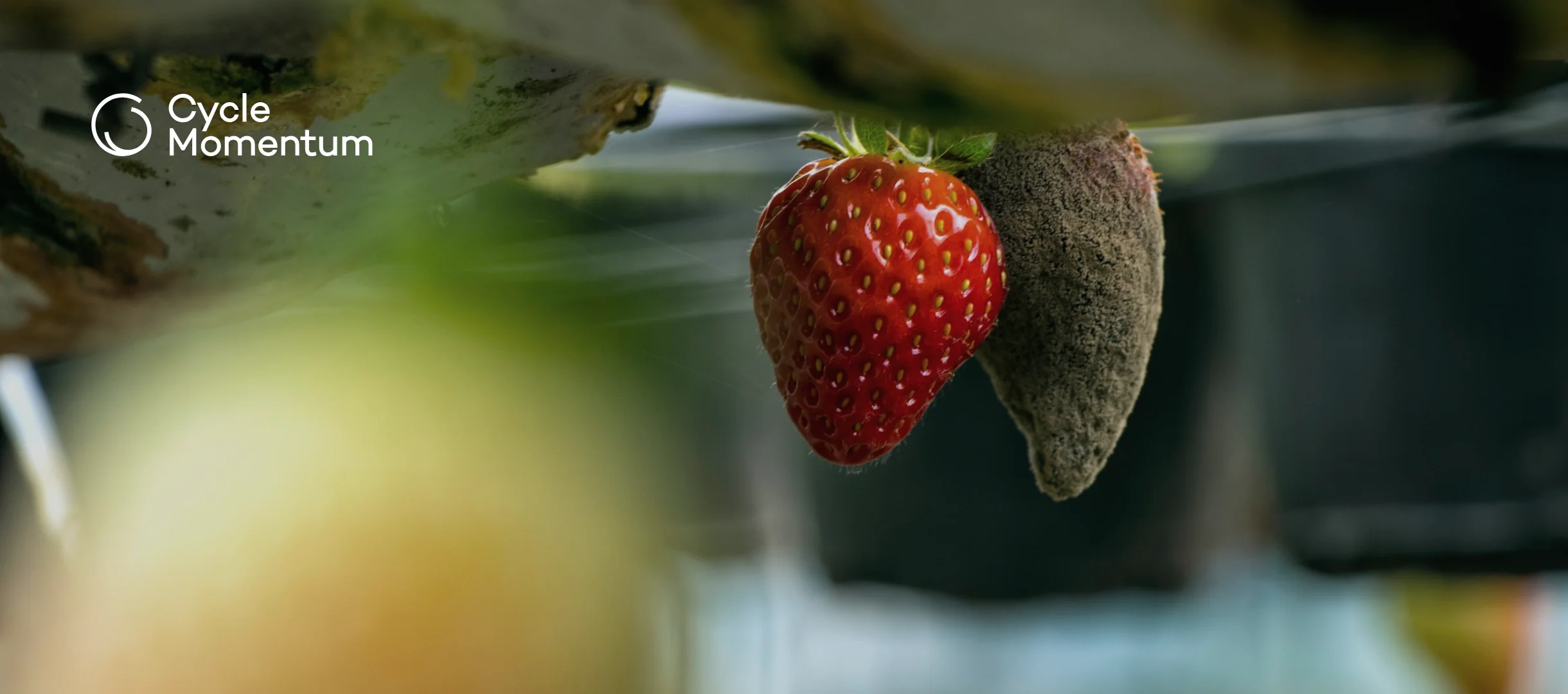
It moves fast once the air is damp. Grey mould can be a serious problem on greenhouse tomatoes under cool and wet conditions, according to British Columbia’s agriculture ministry, and humidity above 80% strongly favours it. On a wet leaf at 15 to 20 °C, spores germinate and enter the plant within 5 to 8 hours. A new infection can produce masses of spores within a few days, so several cycles can run in one season.
Those spores travel on air currents, overhead irrigation, sprays, pruning tools, machinery and workers. Infections through fruit stems and pruning scars can lead to stem canker, the most destructive stage, with substantial crop losses. Between crops, the fungus survives in soil, growing media, plant debris and weeds for months or years.
How do growers keep grey mould in check?
Climate and hygiene come first, the BC factsheet says. It advises spacing plants and stripping lower leaves in shaded areas so air can move. Heat and ventilation should stay up on nights when the temperature drops, overhead irrigation should be avoided, and structures, machinery and tools need disinfecting between crops. Heat and vents are what greenhouse climate computers run from the grower’s setpoints.
Fungicides come next. The factsheet recommends mixing chemical and biological products, and rotating chemical groups so the fungus does not build resistance to any one of them. Even a good program may fall short when disease pressure is high.
Each spray also carries an environmental cost. Herbicides lead Quebec’s farm pesticide sales by weight, as our profile of a robotic weeder explains. Fungicides, though, account for more than half of the 44% rise in the province’s environmental risk indicator for farm pesticides since 2006-2008, according to the environment ministry’s 2024 sales report. Orchards show a similar warning sign: 70% of Quebec apple scab samples were insensitive to the fungicide Nova in a federal study, as our post on apple scab and fire blight notes.
How widespread is fungicide resistance in Quebec?
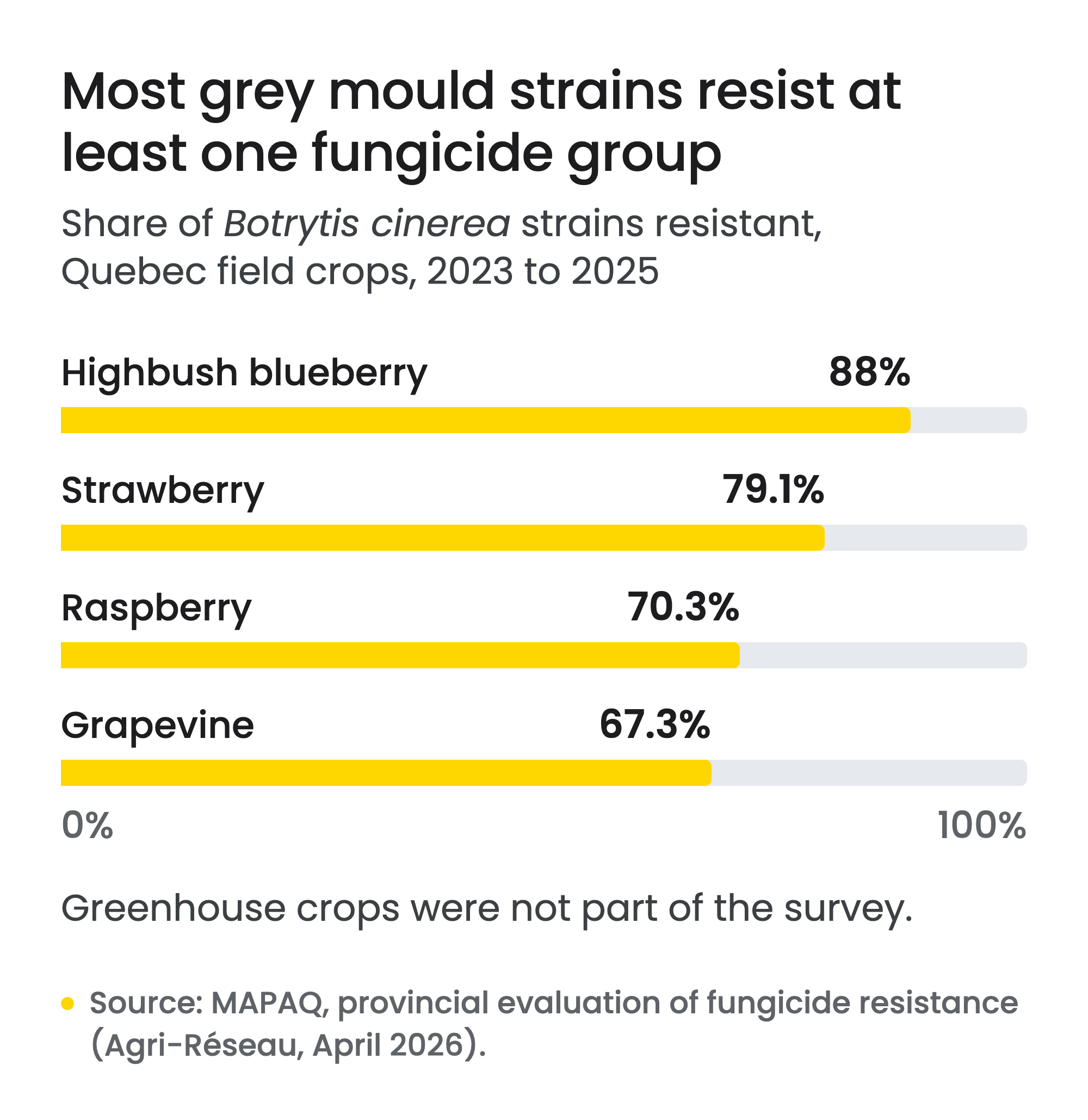
It is widespread, at least in field fruit crops. From 2023 to 2025, MAPAQ’s plant protection laboratory ran 1,312 molecular tests on 438 samples of diseased fruit, covering grey mould and anthracnose, sent in by agronomists from ten regions. The crops were highbush blueberry, strawberry, raspberry and grapevine. For Botrytis cinerea, the share of strains resistant to at least one targeted fungicide group reached 88% in highbush blueberry, 79.1% in strawberry, 70.3% in raspberry and 67.3% in grapevine.
Groups 11 and 7 had the most confirmed cases. More than 80% of strains resisted group 11 in several region and crop combinations, and the ministry now advises keeping that group for last-resort situations. It names repeated use of the same fungicide group as one of the main causes, and it calls its picture representative but probably an underestimate. These are field crops, not greenhouse ones, so the survey shows how common resistance has become in this fungus in Quebec fields, not in greenhouses.
Can UV-C light control botrytis?
Independent research says it can help, within limits. Avignon University tested it in its greenhouses, in a study published in PLoS ONE in 2020. There, single one-second flashes of UV-C light reduced lesion areas by 41% in tomato and 42% in lettuce, two days after inoculation with botrytis. The plants were inoculated 48 hours after their last treatment. So the light worked by priming the plants’ own defences, not by killing spores.
The effect faded fast. In tomato, the reduction fell to 17% a day later. One-second flashes beat a single 60-second dose, and repeated treatments beat single ones, the authors concluded.
How much UV-C is too much?
Dose is the catch. Oregon State University Extension tested UV-C against powdery mildew, a different fungal disease, on high-tunnel tomatoes in 2020. Applied twice a week after sunset, it provided greater disease control than weekly potassium bicarbonate, the grower standard. The first run, though, started at 90 seconds per plant and had to drop to 60 because of plant injury. Those plants had the fewest fruit, and their yield was significantly lower than the standard’s.
A second run at 60 seconds showed no difference in plant height or fruit number. More research is needed on treatment time, application methods and automation, the extension service concludes, partly to keep workers away from UV light.
What does ADSOL offer growers?
Its catalogue lists 60 items, from horticultural LED fixtures to a mobile UV-C cart built to run along greenhouse aisles over tomatoes, peppers, roses and strawberries. A portable UV-C lamp destroys powdery mildew, botrytis and fusarium without chemical residue, according to the company. For large greenhouses it offers a guided robot for automated treatment, the kind of automation the Oregon team called for.
Targeted UV-C reduces pathogen load by 40 to 99% without chemical residue, ADSOL says. We found no independent test of its equipment. In September 2025 it announced trials with Biopterre on grey mould and damping-off, two of the most damaging greenhouse diseases. They aim to set the best protocols for preventive or curative use, and we found no published results.
The public funding we found went to another problem. In 2022 and 2023, the National Research Council awarded it $150,000 and then $1 million under an Innovative Solutions Canada challenge on airborne transmission of respiratory viruses in buildings without mechanical ventilation. The project title names LSVS, a visible-light technology at 400 to 430 nm that the company says activates porphyrins in microbial cells.
ADSOL already offers a UV-C pilot project, a temporary installation with measurements and a final report. The version that would convince a tomato grower has three arms: untreated plants, the usual fungicide program and UV-C. It would count lesions and stem cankers, and it would weigh the harvest, because the Oregon trial showed that light can beat a disease and still cost fruit.
Cycle Momentum is one of Nexterre’s partners, has not tested these products, and reports ADSOL’s performance figures as claims. Startups working on residue-free crop protection are the kind our clean tech startup accelerator works with.