Suppose a Quebec packer ships fresh cucumbers to the United States, and the US Food and Drug Administration, tracing an outbreak, asks for its records. From July 20, 2028, the Food Traceability Rule, known as FSMA 204, gives it 24 hours to send them as an electronic sortable spreadsheet. OPTEL Group, a Quebec City company, markets software for that kind of request, and its tools reach back to the farm.
OPTEL has tracked products through supply chains since 1989, and pharmaceuticals head its list of industries. Its agri-food work starts further upstream, with a platform that records where a raw material was grown and how. In September, the Nexterre Program placed it among the 12 companies in its maturation phase.
What exporters need to know
- The FSMA 204 compliance date is July 20, 2028, and the rule applies to foreign businesses that send listed foods to the United States.
- Businesses that handle foods on the FDA’s Food Traceability List, from harvest onward, must keep records for set events and give them to the FDA within 24 hours of a request.
- Meeting Canada’s own traceability rules does not equal FSMA 204 compliance, the Canadian Food Inspection Agency warns.
- The United States took 71% of Quebec’s record $13.3 billion in agri-food exports in 2025.
- OPTEL Group’s Optchain traces raw materials from farm to factory. Its farm-level claims are its own, and no Quebec farm customers are public.
What does FSMA 204 require?
It requires records at each step a listed food passes through. Under the rule, businesses that manufacture, process, pack, or hold foods on the Food Traceability List must keep records with key data elements for specific critical tracking events. They must also provide that information to the FDA within 24 hours, or within a reasonable time the FDA agrees to. The rule covers foreign as well as domestic firms, from farm to table.
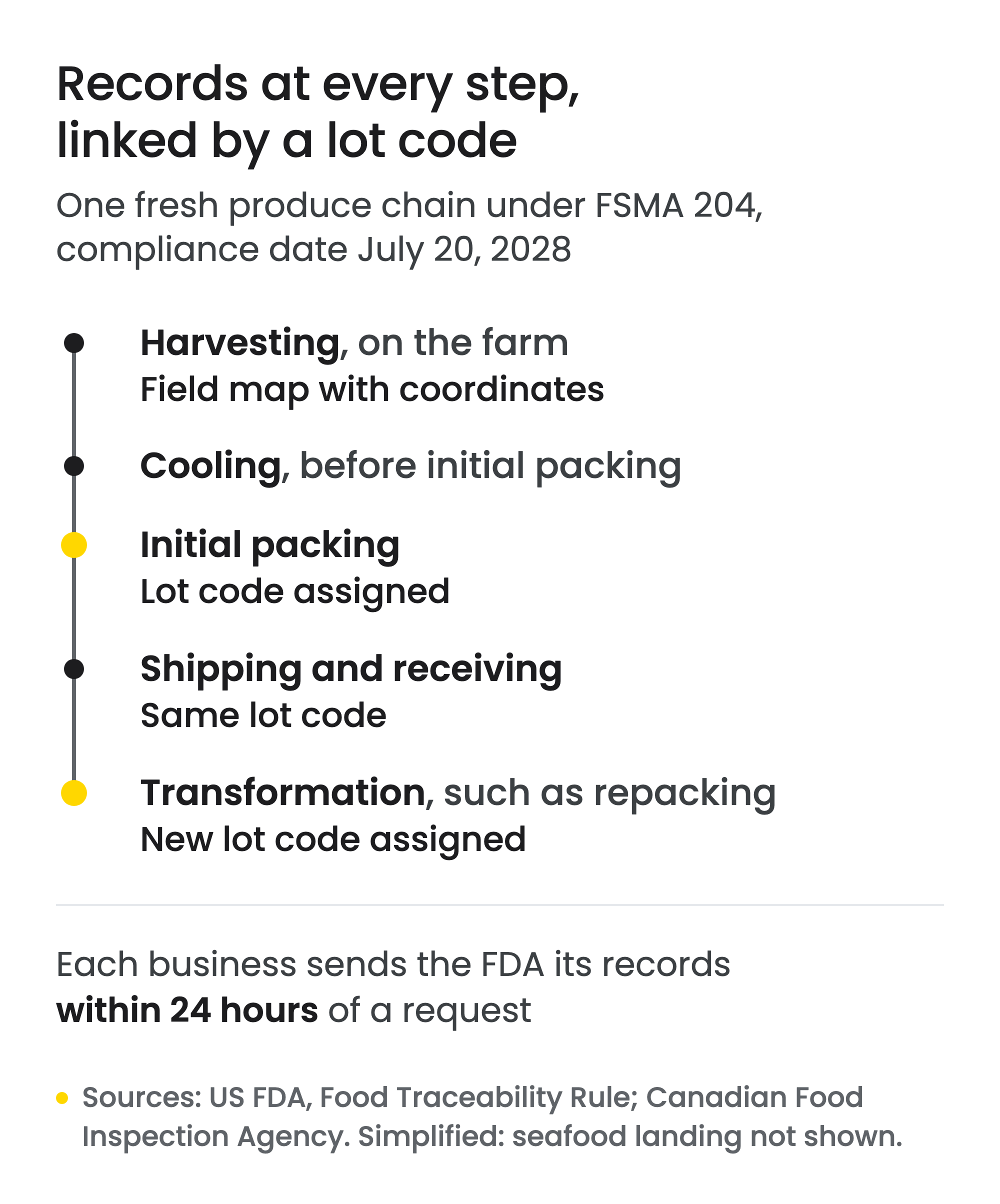
The tracking events are harvesting, cooling before initial packing, initial packing, shipping, receiving and transformation, plus first land-based receiving for seafood. A traceability lot code is assigned when a raw crop is first packed or when seafood first lands. A new one is assigned when a food is transformed, for example by processing, repacking or relabelling. Every later record carries the code, and shipping does not create a new one.
Each business also needs a traceability plan. A farm’s plan includes a map with the name and location of each field where it grows a listed food, including geographic coordinates. During an outbreak, a recall or another threat to public health, the FDA can also ask for an electronic sortable spreadsheet of the relevant records, due within 24 hours.
The compliance date moved by 30 months to July 20, 2028, and Congress has directed the FDA not to enforce the rule before then. Details are still moving. The FDA has scheduled a public meeting for November 6, 2026 on lot-level tracking and possible flexibilities for compliance.
Does FSMA 204 apply to Quebec exporters?
It does, for foods on the list. The Canadian Food Inspection Agency’s guidance for exporters says both domestic and foreign food businesses must keep the data. FSMA 204 “will impact many food sectors in Canada,” the agency adds. The list covers many whole fresh fruits and vegetables, among them cucumbers, peppers, tomatoes, leafy greens and herbs. Soft cheeses, finfish, shellfish, shell eggs and nut butters are on it too. Some of those crops grow in Quebec greenhouses all year, as our profile of a Lac-Saint-Jean cucumber grower shows.
Two warnings in the CFIA guidance deserve attention. Meeting Canada’s traceability requirements under the Safe Food for Canadians Regulations “does not equal compliance with this rule,” the agency notes. Non-compliance “could result in loss of market access” until a company shows the FDA that it complies.
Quebec has a lot riding on that. The province’s agri-food exports reached a record $13.3 billion in 2025, with the United States taking 71% of foreign sales, according to Quebec’s agriculture ministry.
Is this a food safety rule or an environmental one?
Food safety comes first. The FDA says the extra records are meant to allow faster identification and rapid removal of potentially contaminated food, with fewer foodborne illnesses and deaths as the result. Recalls show the stakes in Canada. The CFIA counted 504 food recalls in fiscal 2025-26, up from 233 the year before, and attributes the jump to the many recalls linked to a Salmonella outbreak in imported pistachios.
The environmental link is indirect, and it runs through the same farm records. OPTEL says its sourcing software is built to answer questions such as whether farmers are using the right pesticides and fertilizers, whether deforestation is happening and whether regenerative practices are being applied. For the EU’s deforestation rules, it says it can link each batch to the coordinates of the plot where it was harvested. The FDA’s farm map asks for the same kind of field data. OPTEL has not published Quebec results for either use.
How does OPTEL Group trace food back to the farm?
For food and beverage companies, OPTEL Group offers traceability from farm to manufacturing, with agricultural data digitization and easier outbreak and recall investigations among the stated benefits. The company says its raw-material tools show who the producers are, along with their farming practices and potential environmental impact. Its FSMA offer names growers, producers, processors and retailers as users, and it says the platform raises automatic alerts when it detects a risk.
Part of that reach was bought. In 2018 OPTEL acquired GeoTraceability, a company that worked with initiatives for food production in the developing world. OPTEL says the deal closed its end-to-end loop by adding the first link in the supply chain, raw materials.
Louis Roy founded OPTEL in 1989 after graduating in electrical engineering and physics and is still its CEO. The company operates as Optel Vision inc. from Quebec City, with facilities in Germany, Ireland, India and Brazil. In a February 2026 release it put its systems on more than 8,000 production lines in more than 50 countries.
Fondaction and BDC Capital financed the company in 2023. Their announcement named agri-food among the regulated industries OPTEL already serves and said the money would help it expand its digital traceability solutions to new sectors.
Why is farm-level data the hard part?
The farm is the first link in the FDA’s chain, and it is where OPTEL Group’s own pitch begins, with agricultural data digitization. Farm records can be manual. A 2013 Quebec pepper crop guide has greenhouse growers type plant measurements into a spreadsheet each week, as our profile of a greenhouse records startup notes. The FDA’s farm map, with coordinates for every field, adds to that work.
OPTEL has not said what it will do in Nexterre, and it has not named Quebec farm or food customers. A useful result would be a mock FDA request run with real Quebec producers. Harvest records and field maps would be captured once at the farm and linked to a lot code at packing. The test is whether the spreadsheet then reaches the FDA’s format within 24 hours. No such test has been published.
Cycle Momentum works on Nexterre with Zone Agtech, which leads the program, and Écotech Québec, so we are not a neutral observer here. Our food tech startup accelerator works with startups on supply chain problems like this one.