Montreal, June 9, 2026 – Boréa Aquatech and BeNat are officially the first two companies created and financed through the Lab-à-Startup program. The milestone arrives two years after 2 Degrés and Cycle Momentum announced their collaboration to build a structured path from university research to market in clean technologies.
Key takeaways
- Boréa Aquatech, built on research validated with Université Laval, is developing circular, low-footprint indoor shrimp farming in Quebec, a local answer to the roughly 50,000 tonnes of shrimp Canada imports every year.
- BeNat, from Université de Sherbrooke research, produces supplementary cementitious materials that replace up to 40% of cement and cut concrete’s carbon footprint by more than 50%.
- Both companies were structured and financed through Lab-à-Startup, the Clean Technology Consortium’s research-to-market program launched in 2024 to close the gap where promising research too often stalls.
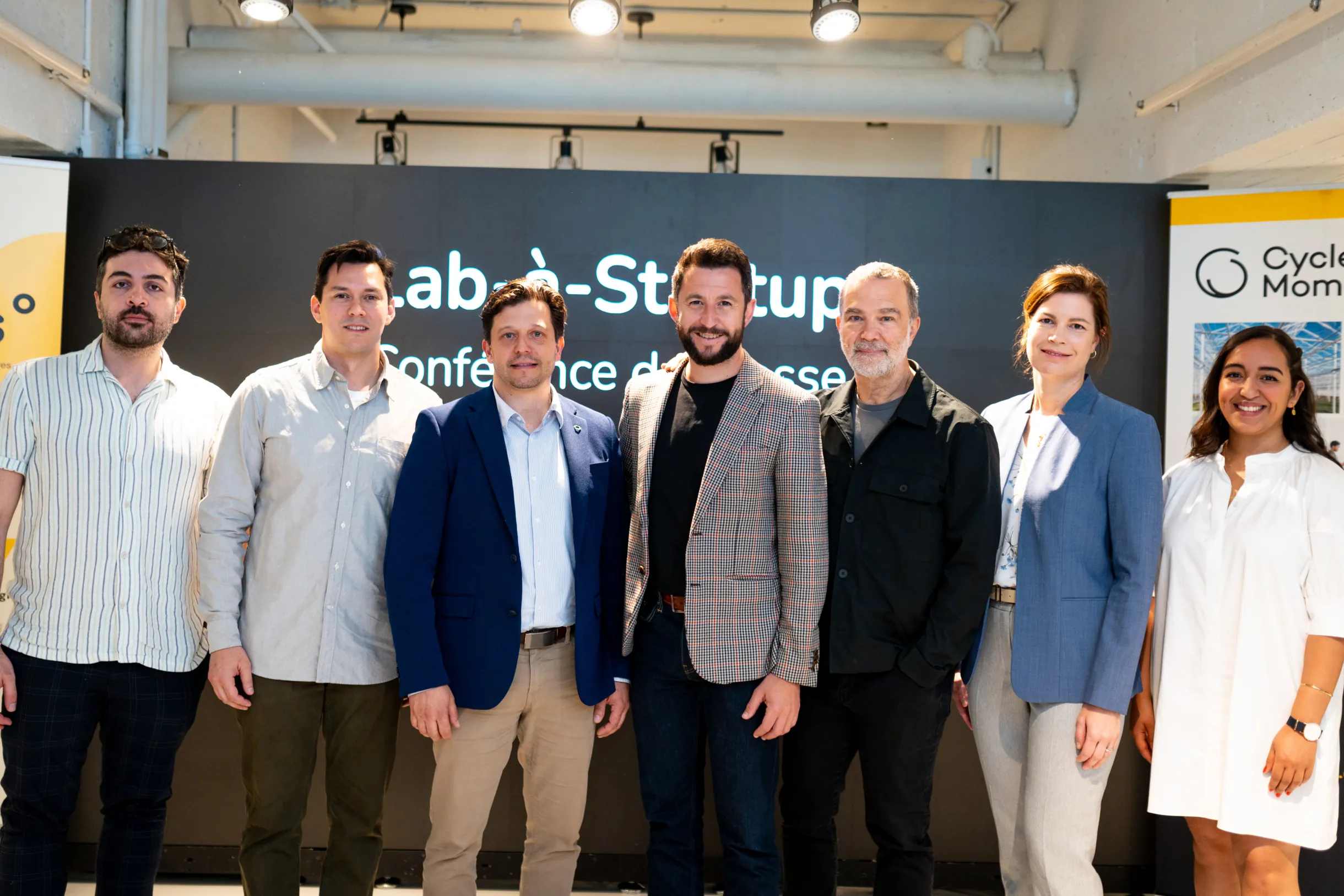
The creation and financing of these first two companies is the program’s first tangible proof that it can turn research innovations into viable, structured businesses ready to deploy on the market.
“Two years ago, we officially announced the Consortium with a strong ambition: to deploy a collaborative model capable of transforming innovations into viable companies. Today, with the creation of Boréa Aquatech and Benat, we are reaching a major milestone for the Lab-à-Startup program, which constitutes proof that by bringing together researchers, entrepreneurs and partners, it is possible to transform an idea from research into a company ready to deploy on the market. The adventure is only beginning!” – Alexandre Guindon, CEO and founder of 2 Degrés
“The creation of Borea Aquatech and Benat concretely demonstrates the relevance of the Lab-à-Startup model: structuring from the outset innovations from research to make them companies capable of responding to real industrial needs. At Cycle Momentum, we believe that it is by closely bringing together researchers, entrepreneurs and partners that we can accelerate the market launch of high-impact solutions and build the technological champions of tomorrow.” – Patrick Gagné, President and CEO of Cycle Momentum
Why is the research-to-market gap so hard to cross?
Most university innovations never become companies. Discoveries routinely stall between prototype and product, at a maturity level too advanced for research grants yet too early for commercial investors, a stage known across the industry as the “valley of death.” Institution-affiliated gap funds have channelled $557 million into more than 6,000 university technologies and startups precisely because that stage is where promising research dies (innovosource, Mind the Gap).
Clean technologies have it hardest. Because they are capital-intensive and often hardware-based, analysts describe up to three successive valleys of death between a cleantech prototype and a scaled product. Launched in 2024, Lab-à-Startup answers that structural problem in Quebec: the program pairs researchers with entrepreneurs in residence and ecosystem partners so that high-growth, high-impact companies are structured around real market needs from day one, with intellectual property transfer, co-founder recruitment and financing built into the process.
Boréa Aquatech: can shrimp farming become local and sustainable?
Boréa Aquatech develops a sustainable solution for shrimp farming in indoor farms, based on an approach validated with Université Laval. Founded in 2025 and led by CEO Valérie Robitaille, the company wants to transform aquaculture through a circular, high-performance model with a low environmental footprint.
The market context explains the ambition. Canada imports on the order of 50,000 tonnes of farmed shrimp per year, nearly all of it frozen and shipped from overseas farms (Aquaculture North America). Land-based recirculating aquaculture systems close that distance: they recycle water continuously and can produce dozens of kilograms of shrimp per cubic metre, without the antibiotic and traceability concerns that follow imported product. Boréa’s bet is that a fresh, local, transparent supply chain can win Quebec consumers over the frozen import.
“At Boréa, we want to offer Quebecers a new local, fresh and gourmet culinary option. Shrimp, often imported and frozen, can be rediscovered with more freshness, transparency and pleasure. Produced under the right conditions, it also represents a sustainable protein. Thanks to Lab-à-Startup and Université Laval, we are building a new generation of aquaculture, rooted here, in innovation and the taste for good products.” – Valérie Robitaille, founder and CEO of Boréa Aquatech
How does BeNat cut concrete’s carbon footprint by half?
Concrete is the most used man-made material on Earth, and it comes at a climate cost: the sector accounts for roughly 8% of global CO2 emissions, and cement, though only 10 to 15% of the mix, is responsible for close to 90% of them (EESI). Every tonne of cement that can be displaced from a concrete recipe is a direct emissions win.
That is exactly where BeNat operates. The company turns industrial residues into supplementary cementitious materials (SCM), using a technology developed by Prof. Ammar Yahia and Mojtaba Kohandelnia, PhD, at the Université de Sherbrooke. Its materials can replace up to 40% of the cement in concrete, cut the resulting carbon footprint by more than 50%, and shorten hardening time, which raises productivity for concrete manufacturers. For prefabricated and modular construction, faster hardening also means faster construction sites, a lever on both climate and housing affordability.
“At BeNat, we are developing cementitious materials to tackle two major challenges: climate change and the housing crisis. Our materials display a significantly lower carbon footprint than cement and are competitive in terms of costs, but above all, they improve productivity and reduce the costs of prefabricated concrete. By unlocking the full potential of prefabricated and modular construction, our innovations make it possible to accelerate construction sites and make construction more affordable.” – Navi Cohen, co-founder and CEO of Benat
What this milestone means for Quebec’s clean-tech pipeline
With Boréa Aquatech and BeNat, the Lab-à-Startup model moves from promise to proof: university research in Quebec can be structured into financed companies that answer real industrial needs. The two startups join a broader pipeline at Cycle Momentum, which has accelerated more than 135 climate tech startups spanning sectors from agtech and food tech to green chemistry and clean technologies.
It also confirms a repeatable route for researchers: where a typical accelerator selects existing startups, Lab-à-Startup creates them, from identifying commercializable research and validating the market to recruiting co-founders, transferring intellectual property and closing first financing. The next companies are already taking shape inside the program’s pilot projects.
About Lab-à-Startup
The Lab-à-Startup program helps researchers transform their innovations into viable and promising companies in the clean technology sector. Drawing on the expertise of seasoned entrepreneurs and close collaboration with academic, industrial and municipal partners, it deploys pilot projects that accelerate the transition from laboratory to market. Lab-à-Startup is an initiative of the Clean Technology Consortium, carried jointly by 2 Degrés, Cycle Momentum and IVÉO.
The initiative is made possible thanks to the support of the Ministry of Economy, Innovation and Energy, as well as the Fonds du Grand Mouvement de Desjardins, a strategic partner of Cycle Momentum in this initiative.
Discover the startups Cycle Momentum supports or learn more about the Lab-à-Startup program.