The Circle of Allies for Climate is Cycle Momentum’s peer network for senior executives who own the decarbonization file inside large industrial companies. Launched in July 2024, it now counts 20 industrial members, from Rio Tinto and ArcelorMittal to Hydro-Québec, Boralex and Veolia, who meet to compare strategies, hear from climate-tech experts and get first access to the start-ups Cycle Momentum accelerates. This article explains what the Circle is, why it exists, who is in it, what members receive and how it connects to the open innovation pilots Cycle Momentum runs with industry.
Key takeaways
- What it is: a members-only circle of executives responsible for decarbonization in hard-to-abate sectors such as construction, mining, transportation, energy, packaging and agriculture, created by Cycle Momentum and announced on July 4, 2024.
- Why it matters in Quebec: industry is the province’s second-largest emitter at 24.7 Mt CO2e, or 31.7% of 2023 emissions, and more than half of that comes from industrial processes rather than fuel combustion.
- Who is in it: 20 industrial members, including Alstom, CAE, Énergir, Kruger Energy, Pomerleau, Safran, Saint-Gobain and Schneider Electric.
- What members get: peer exchange, thought leadership sessions, curated access to GHG-reducing start-ups and tailored climate-tech events.
- Where it leads: Circle members are also the industrial partners behind Cycle Momentum’s open innovation challenges, such as the two wind-blade recycling pilots co-funded by Mission Allies.
What is the Circle of Allies for Climate?
The Circle of Allies for Climate is an initiative by Cycle Momentum that brings together senior executives actively committed to the decarbonization efforts of their organization. Its stated mission is to accelerate the transition to a sustainable future by significantly reducing greenhouse gas emissions in energy-intensive sectors such as construction, mining, transportation, energy, packaging, agriculture and waste management, through the adoption of clean technologies.
The launch was announced during the ClimateTech Innovation Event held on June 18, 2024 at the Grand Quai of the Port of Montreal, as part of the Climate Solutions Prizes, in front of more than 25 senior executives from large corporations. The public announcement followed on July 4, 2024.
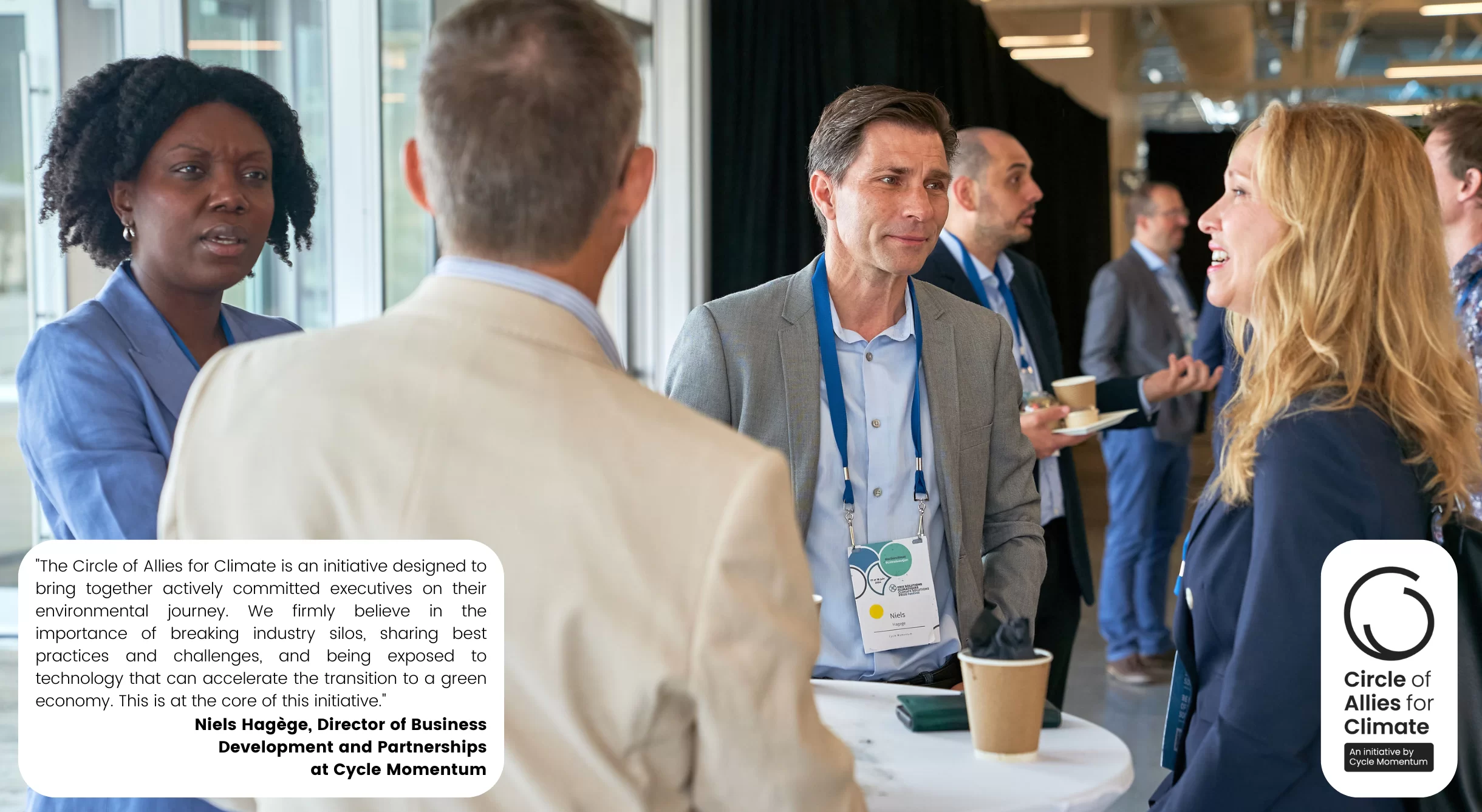
Niels Hagège, Director of Business Development and Partnerships at Cycle Momentum, leads the Circle. Asked in 2024 to sum up its purpose, he put it this way: “The mission of the Circle is to accelerate the transition to a more sustainable future by significantly reducing greenhouse gas emissions through the adoption of clean technologies in various challenging-to-decarbonize industries such as construction, mining, transportation, energy, packaging, or agriculture. The Circle brings together senior executives actively committed to the decarbonization efforts of their organization.”
Why did Cycle Momentum create a circle for industrial executives?
Because the emissions that matter most in Quebec sit inside industrial plants, and the people responsible for cutting them rarely get to compare notes across sectors. According to the Quebec government’s 2023 GHG inventory, industry produced 24.7 Mt CO2e in 2023, or 31.7% of the province’s 78.0 Mt total, second only to transportation. Within that industrial total, 51.5% came from industrial processes and product use, 47.4% from industrial combustion and 1.1% from fugitive emissions. Process emissions are the hard part: they cannot be solved by switching a boiler to electricity, they require new chemistry, new materials or new equipment, which is exactly what climate-tech start-ups build.
The picture is similar at the national level. Environment and Climate Change Canada’s 2024 indicators attribute 77.5 Mt CO2e, or 11% of Canada’s 685 Mt, to heavy industry alone.
Corporate commitments have not closed that gap on their own. Accenture’s Destination Net Zero 2025 study of the world’s 4,000 largest companies found that only 16% are on track to reach net zero in their operations by 2050, and that those leaders represent just 4% of the group’s total operational emissions. The companies that are on track tend to be the smaller emitters. The large industrial emitters are precisely the ones the Circle is built for.
Niels Hagège explained the reasoning behind the Circle in the same terms: “Our initiative is the result of our observations over the past few years collaborating with companies and industrial leaders. We firmly believe in the importance of breaking industry silos, sharing best practices and challenges and being exposed to technology that can accelerate the transition. This is at the core of this initiative.”
Who are the members of the Circle of Allies for Climate?
As of September 2026, the Circle counts 20 industrial members. They span aluminium, steel, mining and critical minerals, energy production and distribution, aerospace, rail, construction and building materials, packaging, water and waste management, and port logistics:
- Aluminerie Alouette
- Alstom
- ArcelorMittal
- Boralex
- CAE
- Canam
- Énergir
- Hydro-Québec
- Kruger Energy
- Linde
- Nouveau Monde Graphite
- Pomerleau
- Port de Québec
- Rio Tinto
- Safran
- Saint-Gobain
- Schneider Electric
- Soucy
- Sustana
- Veolia
The mix is deliberate. A decarbonization lead at a steelmaker and one at a port authority face different technologies but the same questions: which solutions are mature enough to pilot, how to fund a first demonstration, how to structure the relationship with a start-up so both sides can live with the risk. The Circle exists so those answers travel between sectors instead of being rediscovered in each one.
What do members of the Circle actually receive?
Membership is organized around four commitments that Cycle Momentum makes to each executive:
- Engage with committed peers: connect with senior executives from leading large corporations to share ideas and best practices.
- Thought leadership: gain exclusive access to networking sessions, exclusive conferences and specialized climate-tech events.
- Discover cutting-edge technologies: access start-ups offering technological solutions to reduce GHG emissions.
- Participate in specialized and tailored events: hear from renowned climate-tech experts about the latest technologies and industry trends.
In Niels Hagège’s words: “Our initiative connects peers from various industries to share ideas and strategies, driving synergies that benefit everyone involved. We offer exclusive access to thought leadership through networking sessions, specific workshops, and discussion panels. Additionally, participants can discover cutting-edge technologies from start-ups focused on reducing GHG emissions. Lastly, we host specialized and tailored events where attendees can expand their networks and learn from renowned Climate Tech experts about the latest industry trends.”
The start-up access is the part that distinguishes the Circle from a conventional executive roundtable. Cycle Momentum screens climate-tech companies through its own platform, which tracks 56 climate-tech sub-sectors and has qualified more than 9,000 start-ups, and it has accelerated 135 of them through its programs. Members see the companies that survive that filter, not a cold inbound pipeline. The full range of services for corporates is described on the Partner Services page.
How does the Circle connect to open innovation pilots?
The Circle is the front door. The open innovation challenges are where members put money and plant time behind a technology. Several Circle members, including Boralex, Hydro-Québec and Kruger Energy, are also the Mission Allies who co-funded the two industrial pilots that came out of the Wind Circular Innovation Challenge. Those pilots run on a $350,000 CAD budget, of which $135,000 came from private partners, $200,000 from public sources and $15,000 from the winning start-ups themselves. The breakdown, and why the two pilots were financed differently, is explained in How Do You Fund an Industrial Pilot?
The Cascades partnership shows what the model looks like from the corporate side. In 2022, Cascades and Cycle Momentum launched the Clean Energy Challenge to find heat-generation technologies that could cut GHG emissions from pulp and paper production. Carl Blanchet, Vice President of Innovation at Cascades, described the outcome: “Opening up to the world by working together with the innovation ecosystem, here is an open innovation initiative that demonstrates the power of collaboration. The support, expertise and rigor of the Cycle Momentum team have allowed us to accelerate our technology monitoring and reach an impressive number of companies. It makes me proud to be part of a company that is taking concrete action with quality partners to make a difference for our future generations.”
There is evidence that this kind of corporate involvement changes start-up outcomes. A 2024 study in Nature Energy by Kathleen Kennedy, Morgan Edwards and Kavita Surana found that corporate investment in publicly funded climate-tech start-ups improves exit rates by 155%, compared with a 78% improvement from other private investment. Corporates also invest close to home: 42% of investments from transportation corporations went to transportation start-ups and 59% of agriculture corporation investments went to agriculture start-ups. That sector loyalty is why a cross-sector circle is useful. It exposes a mining executive to a water-treatment start-up, or a packaging executive to a heat-recovery technology, that their own scouting would never surface.
The business case is also getting clearer. In BCG’s September 2025 survey of 1,924 executives across 16 industries, 82% of companies said they had captured economic benefits from decarbonization, and 6% reported value exceeding 10% of annual revenue.
How can a company join the Circle of Allies for Climate?
The Circle is aimed at senior executives from large companies in the sectors listed above who are responsible for decarbonization within their organization. As Niels Hagège explains: “We are targeting senior executives from large companies in the sectors I mentioned earlier who are responsible for decarbonization issues within their organizations.” To join, email him at nhagege@cyclemomentum.com or use the contact form. Participation criteria and the benefits offered are detailed on the Partner Services page.
Companies that want to go further than peer exchange can also work with Cycle Momentum on a customized program: technology scouting, start-up recruitment and selection, and the design and funding of a demonstration pilot. Since 2021, 19 partners have trusted Cycle Momentum with projects of this kind, and six international corporate programs have been completed in areas such as agtech, biofuels, water tech, bioeconomy, sustainable packaging and the circular economy.
Editor’s note, September 2026: this article combines Cycle Momentum’s July 4, 2024 launch announcement of the Circle of Allies for Climate with the July 23, 2024 interview with Niels Hagège, updated with the current membership and emissions data from the 2023 Quebec GHG inventory.