Every wind turbine blade that goes out of service today has nowhere to go. Most end up in a landfill, buried, not recycled. But what if the material inside that blade could be recovered, transformed, and put back to work in a completely different industry?
FibeCycle is setting out to prove exactly that, and the next seven months will show how.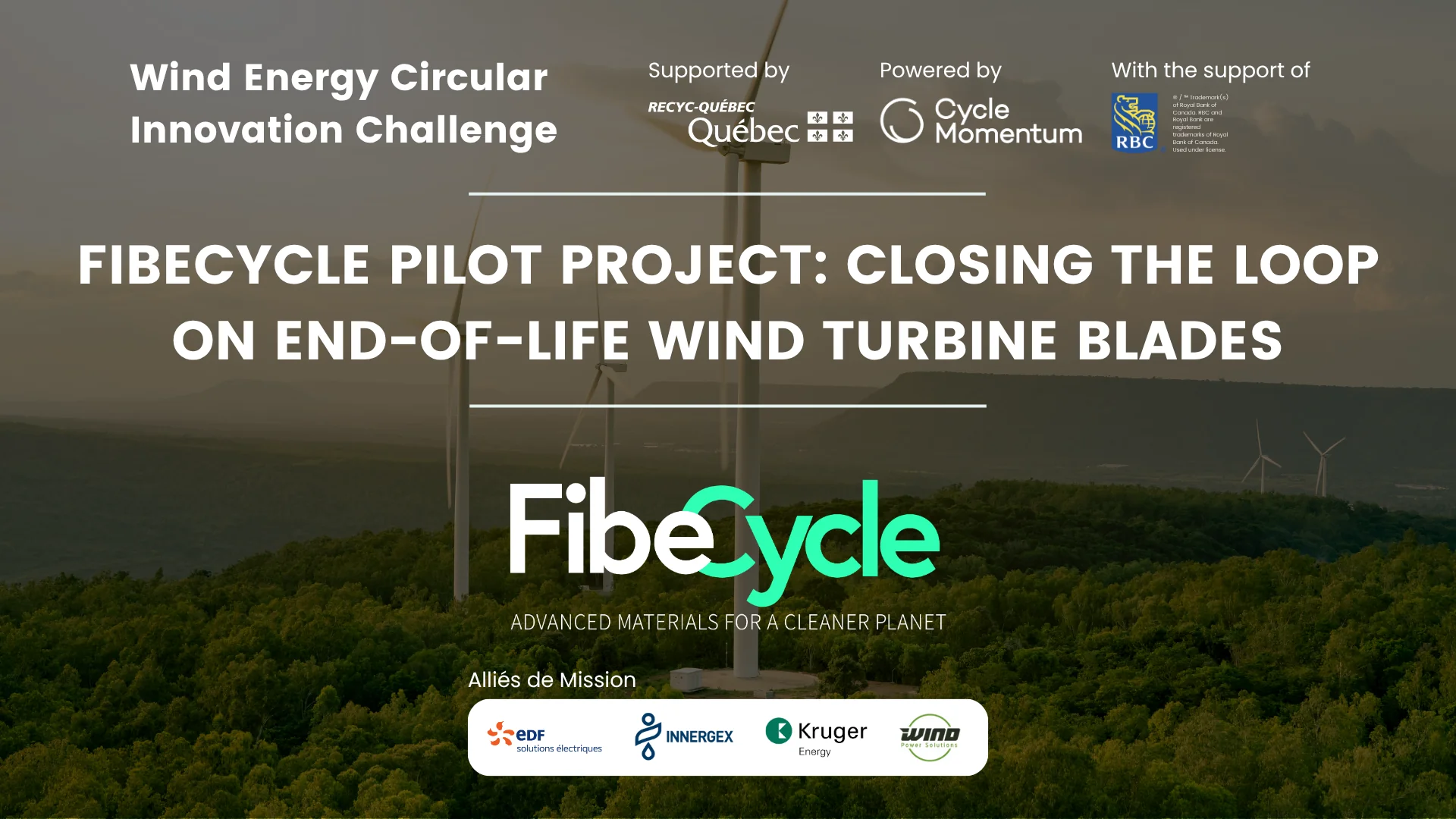
Materials in the Wind Energy Sector
The ongoing energy transition—characterized by the electrification of transportation, the reduction of fossil fuel use, and the increasing share of renewable energy in the global energy mix—will significantly contribute to reducing greenhouse gas (GHG) emissions. However, it also introduces new challenges, particularly related to the management of materials reaching the end of their life cycle.
According to Québec’s Ministry of Energy and Natural Resources (MERN, 2022), 1,985 wind turbines were installed in Québec between 1999 and 2021, mainly in the Gaspésie–Îles-de-la-Madeleine region. Considering an average lifespan of 20 to 25 years, turbines installed in the early wind farms of the 2000s will begin reaching the end of their operational life in the coming years.
Recognizing the importance of this issue, RECYC-QUÉBEC published a study in 2022 presenting an overview of current and projected material flows related to Québec’s energy transition. One of the study’s key findings highlights the scale of the upcoming challenge: in just nine years, the quantity of materials generated is expected to increase from 2,562 tonnes in 2021 to more than 124,000 tonnes per year by 2030, representing nearly a fifty-fold increase.
At the same time, the number of wind turbines continues to grow. Under Hydro-Québec’s 2035 plan, approximately 1,500 additional turbines are expected to be deployed by 2035. As a result, the development of innovative and sustainable solutions for managing end-of-life wind turbine components is becoming an increasingly urgent priority.
Project Objectives
Building on three years of active work in fibreglass composite recycling, this Pilot Project marks FibeCycle most ambitious step yet: processing a complete wind turbine blade from end to end, in Canada, and validating the full recycling pathway at industrial scale.
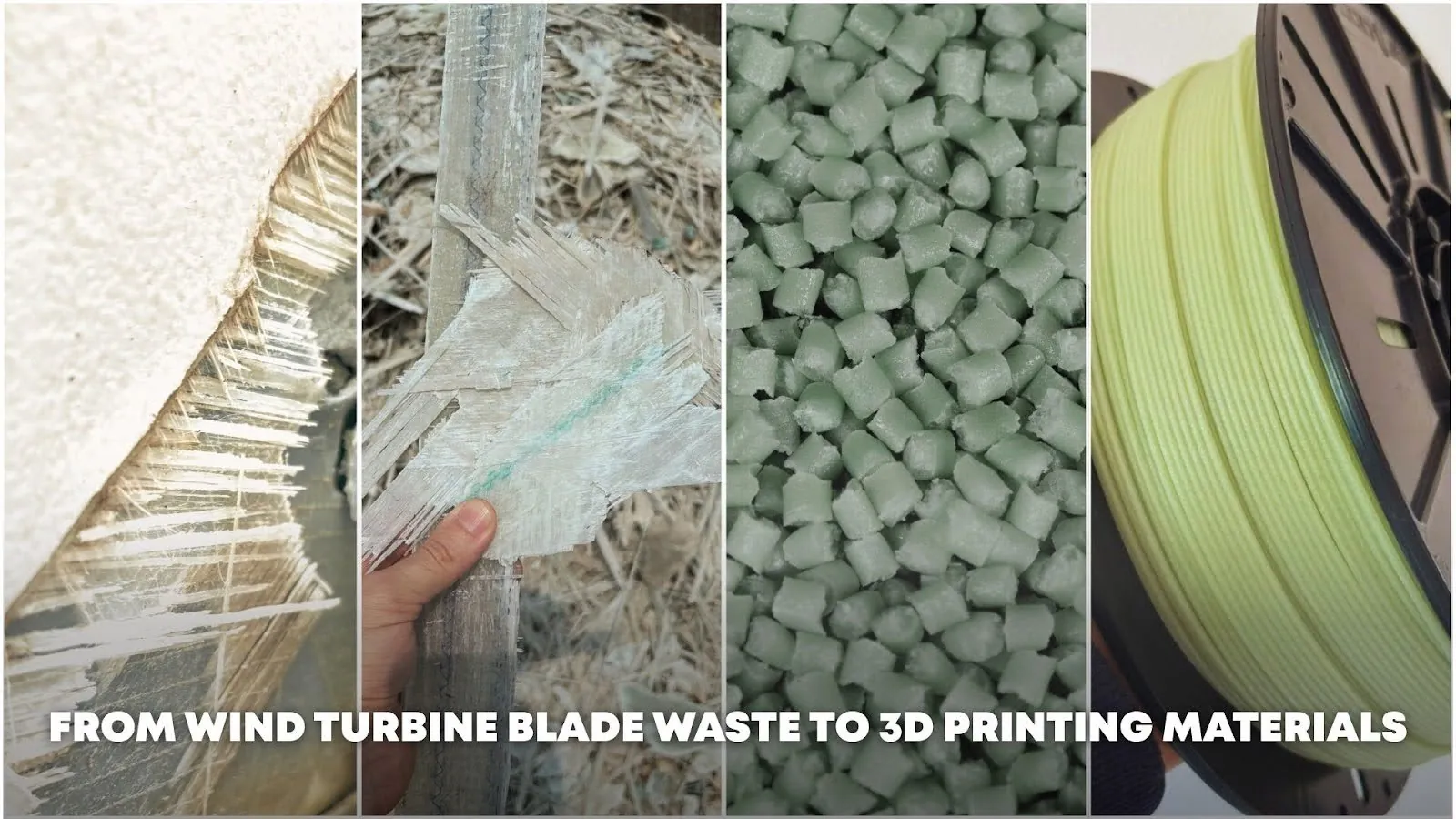
Through its proprietary technology, evaluated in collaboration with National Research Council of Canada, composite materials recovered from decommissioned blades can be transformed into ecoFRP™, reinforced high-performance thermoplastic composites, that can be processed by injection moulding and additive manufacturing to manufacture parts for sectors such as automotive, construction, furniture, common goods, and other industries.
This Pilot Project will explore and maximize the different material streams that a single blade can generate, demonstrating the full potential of recovery. Results will be documented in a comprehensive technical report summarizing findings and lessons learned including potential CO₂ emission reductions and validate the recyclability of ecoFRP™ material. Ultimately, the project aims to lay the groundwork for a large-scale industrial recycling model.
Benefits for Industrial Partners
For industrial partners, the project provides a concrete opportunity to validate the recyclability of wind turbine blades while participating in one of the first industrial initiatives of this kind in Canada. By contributing to the pilot phase, partners gain early insight into emerging recycling pathways for composite materials and position themselves at the forefront of circular solutions in the wind energy sector.
Participation in the project also offers increased visibility as a partner contributing to the development of innovative circular solutions. In addition, partners will benefit from priority access to FibeCycle’s future recycling capacity as the technology moves toward industrial deployment.
Project Implementation
The Pilot Project begins on April 15, 2026, and is expected to run for approximately seven months. The first phase focuses on the cutting and pre-processing of an entire wind turbine blade, followed by the recovery and processing of resulted mix of resins and fibres, the intermediate material that feeds directly into the production of ecoFRP™. Subsequent phases will cover the manufacturing and characterization of ecoFRP™, the development of a demonstration prototype through 3D printing, and a series of tests to validate the recyclability of the obtained materials.
Partners and Funding
The pilot project brings together several industrial partners, including INNERGEX, KRUGER Energy, EDF Power Solutions, and Wind Power Solutions LLC., all contributing to the initiative through financial participation, in-kind support, and industry expertise. Their financial contribution provides access to project reports and early engagement with the technology.
In addition to financial participation, the project benefits from important operational support, including the provision, cutting, and transportation of wind turbine blades, as well as technical and logistical collaboration from participating partners.
Cycle Momentum has also supported FibeCycle in structuring the pilot initiative and in exploring public funding opportunities through programs such as the Technoclimat program (Québec).
This initiative could represent an important step toward structuring one of the first dedicated industrial solutions in Canada to address fiberglass composite waste from wind turbine blades, while connecting the full value chain—from blade decommissioning to material recovery and advanced manufacturing—within a circular economy approach.
Solving Canada’s Blade Waste Challenge
FibeCycle believes a circular economy is only possible when the entire value chain commits to it. That is the real value of this project, bringing together companies and people who believe they can make a difference, to solve a real problem together. This is where wind turbine blade waste becomes circular economy value. FibeCycle’s Pilot Project is about that: building a real solution for a real problem that Canada can no longer afford to ignore.
Curious about what comes next? Follow FibeCycle on LinkedIn and subscribe to our newsletter — the journey is just beginning.